

As NCPWD Calls for Creation of Inclusive Education Department in FCT Education Secretariat
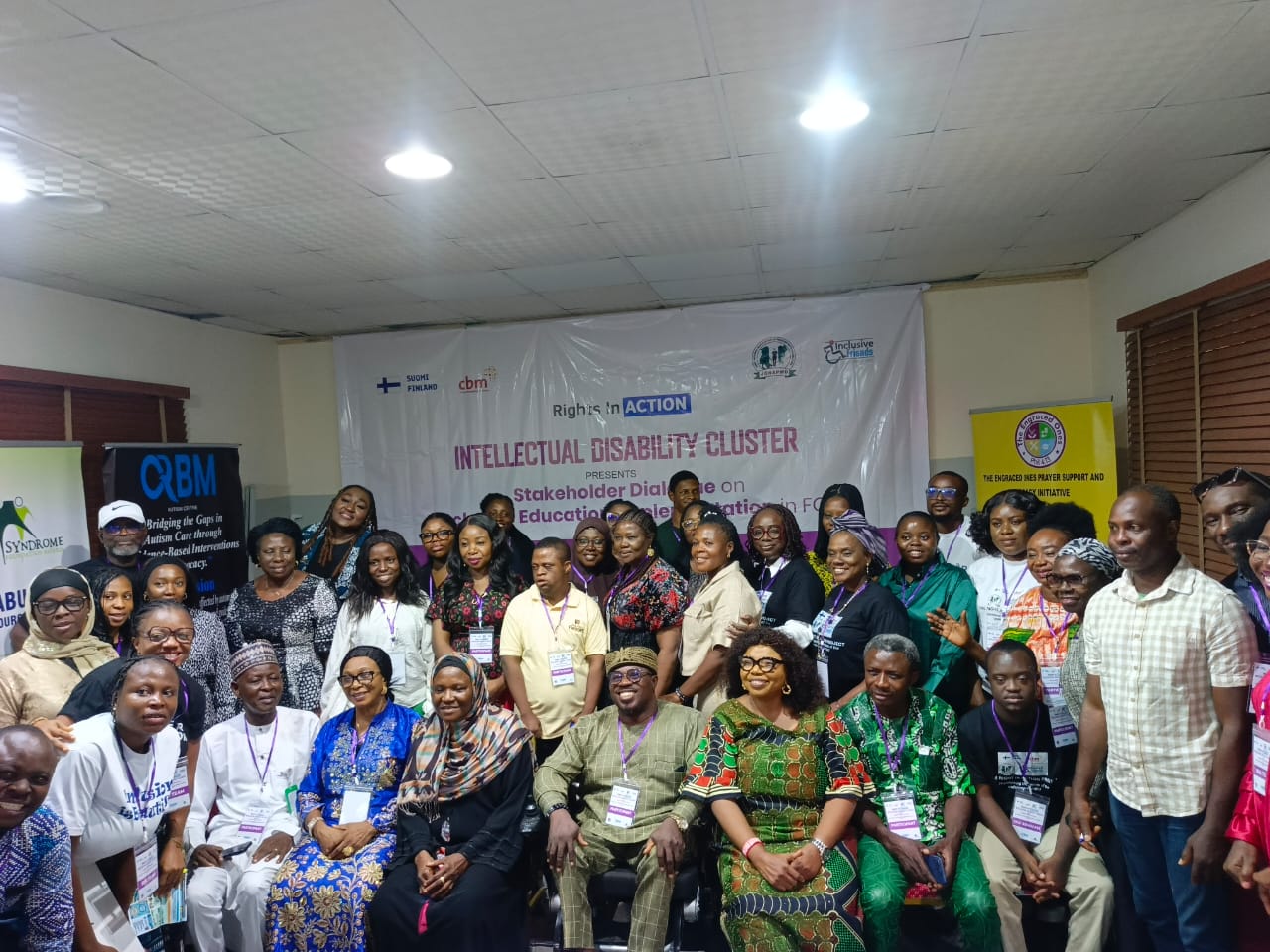
Abuja witnessed a major gathering of disability rights advocates, government officials, educators, development partners, and civil society organizations as stakeholders converged to push for the full implementation of inclusive education in the Federal Capital Territory (FCT).
The high-level dialogue, organized under the Right in Action Project with the theme, “From Policy to Practice: Multi-Stakeholder Dialogue on Inclusive Education Implementation in FCT,” took place on Tuesday in Abuja. The event was convened by The Engraced Ones, alongside partners in the Intellectual and Developmental Disability Cluster, including Down Syndrome Foundation Nigeria and RBM Autism Foundation. The project was supported CBM Global through JONAPWD and Inclusive Friends Association( IFA).
The dialogue served as a platform for stakeholders to critically examine the state of inclusive education in the FCT, identify existing gaps, and chart a practical path towards ensuring that children with disabilities have equal access to quality education.
Moving Beyond Sympathy to Rights-Based Inclusion
In her opening address, the Convener of The Engraced Ones, Mrs. Biboara Yinkere, emphasized that children with intellectual and developmental disabilities should no longer be viewed through the lens of charity or sympathy.
According to her, education is a fundamental human right guaranteed under national and international legal frameworks, including the UN Convention on the Rights of Persons with Disabilities (CRPD) and Nigeria’s Discrimination Against Persons with Disabilities (Prohibition) Act 2018.
She noted that despite existing laws and policies, many children with disabilities remain excluded from mainstream education due to inaccessible learning environments, inadequate teacher training, and insufficient budgetary provisions.
“For many years, the conversation around children with developmental and intellectual disabilities has been treated as a matter of charity. But sympathy does not build wheelchair ramps. Sympathy does not train teachers. Sympathy does not create adapted curricula. Education is a right, not a favor,” she stated.
Mrs. Yinkere further highlighted findings from the Political Economy and Gaps Analysis (PEGA) conducted under the Right in Action Project, which revealed significant shortcomings in the implementation of inclusive education across schools in the FCT.
She urged stakeholders to embrace collective accountability and ensure that discussions at the dialogue translate into concrete actions that improve the lives of children with disabilities.
Policies Exist, But Implementation Remains Weak
Delivering the keynote address, Becky Selekere, Centre Manager of RBM Autism Foundation and a member of the Intellectual Disability Cluster, lamented the persistent gap between policy formulation and implementation.
She acknowledged that Nigeria has made significant commitments through various legal instruments, including the Disability Act and the National Policy on Inclusive Education. However, she stressed that many children with intellectual disabilities continue to face exclusion from quality education.
“Today, we gather not because policies are absent, but because too many of them remain unimplemented,” she said.
According to Selekere, many families still battle stigma and discrimination, while schools often lack the resources, training, and support systems needed to effectively accommodate learners with disabilities.
She called on government institutions, educators, healthcare professionals, parents, civil society organizations, and persons with disabilities to strengthen collaboration in addressing barriers to inclusion and ensuring accountability.
“The Right in Action Project is a call to move beyond discussions and towards concrete actions that ensure rights are protected, services are accessible, and inclusion becomes the standard rather than the exception,” she added.
NCPWD Calls for Inclusive Education Department in FCT
A major highlight of the event was the keynote presentation delivered on behalf of the Executive Secretary of the National Commission for Persons with Disabilities (NCPWD), Chief Ayuba Burki Gufwan.
Represented by Ikem Uchegbulam, the Executive Secretary reaffirmed the Commission’s commitment to promoting and monitoring compliance with inclusive education policies across Nigeria.
He emphasized that inclusive education plays a critical role in fostering independence, self-reliance, and future opportunities for children with disabilities.
According to him, denying children with disabilities access to inclusive learning environments often translates into lifelong dependence and exclusion.
To strengthen implementation efforts, he urged the FCT Administration, through the Education Secretariat, to establish a dedicated Department of Inclusive Education.
He explained that such a department would provide focused leadership, coordination, and oversight necessary to ensure that inclusive education policies move beyond documentation and become visible realities within schools across the FCT.
Uchegbulam further assured stakeholders that the National Commission for Persons with Disabilities would continue to monitor compliance and advocate for the full implementation of inclusive education policies in line with national and international obligations.
Stakeholders Seek Renewed Commitment
During the interactive dialogue session, representatives from key institutions, including the Ministry of Education, FCT Education Secretariat, The Qualitative Magazine (TQM), TLMN, disability organizations, educators, and development partners, shared perspectives on the challenges and opportunities surrounding inclusive education.
Participants identified several barriers hindering implementation, including inadequate funding, insufficient teacher capacity, poor accessibility of school infrastructure, lack of assistive learning materials, weak enforcement mechanisms, and limited awareness among education stakeholders.
Many speakers stressed that inclusive education should not be treated as a special intervention but as an integral component of the education system.
They called for stronger political will, increased budget allocations, systematic teacher training, improved data collection on learners with disabilities, and greater involvement of persons with disabilities in education planning and decision-making processes.
Commitment Towards Action
One of the key outcomes of the dialogue was the collective resolve among stakeholders to strengthen collaboration and accountability mechanisms aimed at advancing inclusive education in the FCT.
Participants agreed that achieving inclusive education requires sustained engagement between government institutions, civil society organizations, disability rights groups, development partners, communities, parents, and persons with disabilities themselves.
The stakeholders emphasized that every child, regardless of disability, deserves the opportunity to learn in a safe, accessible, and supportive environment.
As discussions concluded, there was a shared understanding that the time for policy conversations alone has passed. What is now required is deliberate action that transforms commitments into measurable outcomes.
The Stakeholder Dialogue reinforced a simple but powerful message: inclusive education is not a privilege for a few—it is a fundamental right for all.
For the thousands of children with disabilities in the Federal Capital Territory who continue to face barriers to learning, stakeholders agreed that the future must be one where no child is left behind and where inclusion becomes the norm rather than the exception.
Click the link below to join our WhatsApp channel


