

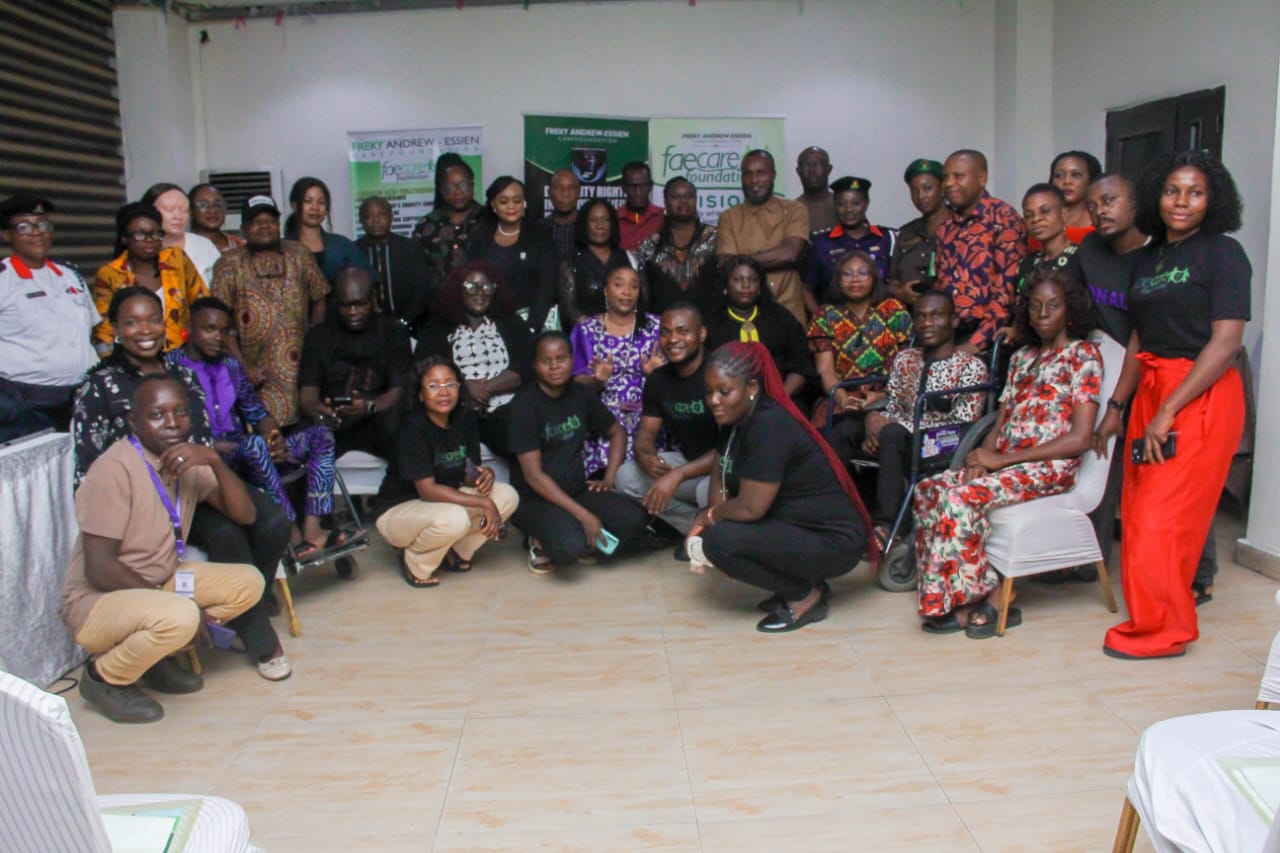
Momentum is building in Port Harcourt as government actors, civil society leaders, and disability advocates intensify calls for the passage of a comprehensive disability rights law in Rivers State—a move widely seen as long overdue.
At a high-level stakeholder roundtable convened by the Freky Andrew-Essien Care Foundation with support from the Disability Rights Fund, participants delivered a clear message: inclusion must move from rhetoric to enforceable reality.
The engagement, held under the Disability Rights Initiative Project: Rural Rivers, brought together a cross-section of influential voices—government officials, organisations of persons with disabilities (OPDs), development partners, and civil society groups—united by a shared urgency to dismantle systemic barriers facing persons with disabilities across the state.
A Persistent Gap Between Policy and Reality
Despite the existence of the Discrimination Against Persons with Disabilities (Prohibition) Act, 2018 at the national level, stakeholders expressed concern that the lived realities of persons with disabilities in Rivers State remain largely unchanged.
From inaccessible public buildings and transport systems to limited inclusive education opportunities and barriers in healthcare delivery, participants painted a stark picture of exclusion that continues to define everyday life for many.
Employment discrimination also featured prominently in discussions, with advocates noting that economic empowerment remains elusive for a large segment of the disability community.
“The Problem Is the System, Not the Disability”
Setting the tone for the roundtable, the Executive Director of FAECARE Foundation, Amb. Ndifreke Andrew-Essien, challenged long-standing misconceptions about disability.
According to her, the barriers faced by persons with disabilities are not inherent to their conditions but are the direct result of systems that have failed to accommodate diversity.
Her message resonated across the room: inclusion is not charity—it is a fundamental human right and a critical development issue.
From Dialogue to Legislation
One of the most significant outcomes of the roundtable was a unified demand for the acceleration of the drafted Rivers State Disability Rights Bill. Stakeholders emphasized that without a state-specific legal framework, efforts toward inclusion would remain fragmented and largely ineffective.
Participants argued that the proposed law would serve as a powerful tool to:
- Guarantee accessibility in public and private spaces
- Protect the rights of persons with disabilities
- Ensure equal participation across education, employment, healthcare, and governance
Equally important, stakeholders called for the establishment of a dedicated institutional mechanism—such as a Disability Commission—to oversee implementation, monitor compliance, and enforce accountability across government structures.
Inclusion Must Be Mainstreamed, Not Isolated
Beyond legislation, the roundtable stressed the need to integrate disability inclusion into all sectors of governance. Ministries of education, health, infrastructure, and labour were identified as critical entry points for reform.
Participants warned that without embedding inclusion into planning, budgeting, and policy execution, progress would remain slow and disjointed.
Nothing About Us Without Us
A recurring theme throughout the engagement was the importance of active participation by persons with disabilities in decision-making processes.
Stakeholders emphasized that policies are more effective, relevant, and sustainable when shaped by those who directly experience the challenges they aim to address.
For many attendees, this was not just a principle—it was a demand for representation, dignity, and ownership.
Institutional Commitments Signal Hope
Encouragingly, several government institutions present at the roundtable signaled readiness to support the disability inclusion agenda.
The Nigeria Security and Civil Defence Corps highlighted the existence of its Disability Rights Help Desk, designed to facilitate reporting and redress for rights violations.
Similarly, the Rivers State Ministry of Justice reaffirmed its willingness to provide legal backing for enforcement once a state law is enacted.
The Rivers State Ministry of Social Welfare, through its Permanent Secretary overseeing disability affairs, also reiterated its commitment to advancing policies that promote inclusion and protection for persons with disabilities.
The Road Ahead: Strategy, Advocacy, and Political Will
As the roundtable drew to a close, stakeholders outlined a strategic roadmap for the months ahead. Key action points include:
- Engaging political leaders and lawmakers to fast-track the disability bill
- Establishing a technical working group to refine and advocate for the legislation
- Sustaining advocacy through media engagement and public awareness campaigns
Participants also acknowledged the complex political landscape in the state but stressed the importance of preparedness and persistence.
A Defining Moment for Rivers State
For many, the roundtable marked more than just another policy dialogue—it signaled a growing movement toward systemic change.
There was a shared vision of a Rivers State where disability no longer limits opportunity, where infrastructure is accessible, and where governance is truly inclusive.
FAECARE Foundation, in its closing remarks, emphasized that the true test of progress will not be in promises made, but in policies enacted and lives transformed.
The message from Port Harcourt was unmistakable and urgent:
No more delays. No more barriers. It is time to legislate, implement, and include.
As advocacy efforts gain traction, all eyes are now on Rivers State’s leadership to translate this momentum into concrete legislative and institutional reforms—steps that could redefine inclusion and set a precedent for other states across Nigeria.


