

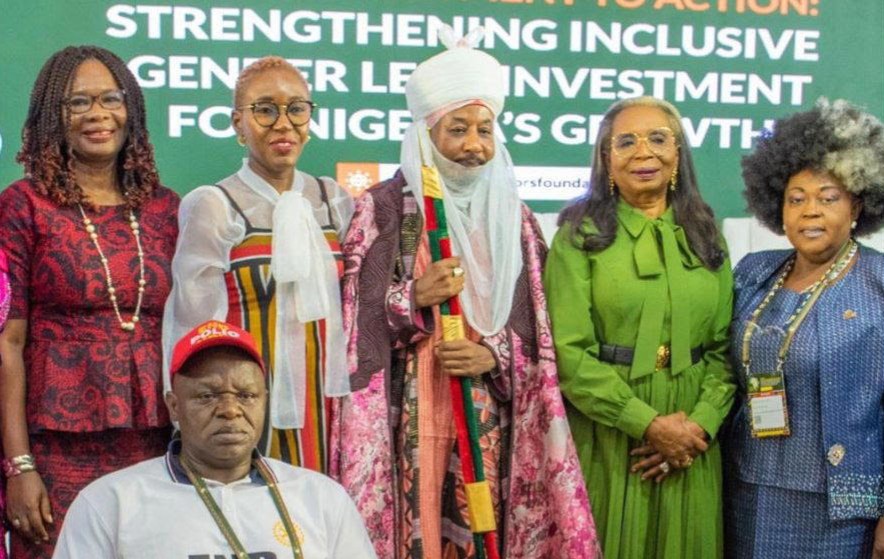
Stakeholders in Nigeria’s investment and development ecosystem have raised serious concerns over the slow pace of gender and social inclusion financing in the country, revealing that only $1.25 billion has been deployed out of the $8 billion commitment targeted for gender and social inclusion investments by 2035.
The alarming disclosure was made on Thursday during the 4th Gender Impact Investment Summit held in Lagos, where investors, policymakers, financial institutions, regulators, and development partners gathered to discuss the future of inclusive financing and economic empowerment in Nigeria.
Participants at the summit warned that Nigeria’s widening inclusion gap poses a major threat to national productivity, economic sustainability, and inclusive growth, particularly as millions of women, youths, and Persons With Disabilities (PWDs) continue to face barriers in accessing finance, investments, and economic opportunities.
Stakeholders further lamented that Nigeria currently faces a staggering $6.75 billion funding shortfall in efforts aimed at promoting inclusive access to capital for vulnerable and marginalized groups across the country.
According to them, despite increasing conversations around gender equity and social inclusion, practical implementation remains weak, leaving many Nigerians excluded from meaningful participation in the nation’s economy.
The concerns were highlighted during the presentation of findings from the Inclusive Capital Scorecard: Gender Equality and Social Inclusion (GESI) Baseline Survey, a report that exposed significant structural and institutional gaps within Nigeria’s inclusion and investment ecosystem.
Speaking during the summit, Etemore Glover, Chief Executive Officer of the foundation, described the report as a vital roadmap for dismantling longstanding barriers preventing vulnerable groups from accessing financial opportunities.
“The GESI Baseline Report is more than a document; it is the data-driven foundation required to fix structural barriers in our financial system,” she stated.
Glover noted that although women own nearly 40 percent of businesses in Nigeria, they continue to receive only a disproportionately small share of formal credit and investment support.
“While women own nearly 40 percent of Nigerian businesses, they receive a disproportionately small share of formal credit. This report empowers stakeholders to identify acute gaps and benchmark progress as we move toward a truly inclusive economy,” she added.
She stressed that without intentional investments in women, youths, and Persons With Disabilities, Nigeria risks losing enormous economic potential capable of driving national development and poverty reduction.
Also speaking at the summit, Ibukun Awosika, Chairperson of GSG Nigeria and Vice Chair of GSG Impact, described the gathering as a major turning point in advancing gender-lens investing and inclusive economic policies in Nigeria.
According to her, the summit underscored the urgent need for investors, financial institutions, and policymakers to move beyond rhetoric and begin embedding gender equality and social inclusion principles into every investment decision.
“By providing the data-driven foundation needed to benchmark progress, it demands that stakeholders not only mobilise inclusive capital at scale but also embed GESI and gender lens investment principles into every investment decision and policy,” Awosika said.
The summit also featured a high-level policy roundtable involving regulators, government ministries, development agencies, and key stakeholders within the financial and investment sectors.
Participants at the roundtable made commitments aimed at accelerating policy implementation and strengthening inclusive financing opportunities for women, youths, and Persons With Disabilities, especially within climate-resilient and sustainable industries.
Experts at the summit maintained that Nigeria cannot achieve meaningful economic growth while a significant percentage of its population remains financially excluded.
They warned that the continued exclusion of vulnerable populations from investment opportunities could worsen poverty, unemployment, inequality, and social instability in the country.
Delivering a keynote address titled, “Turning Gender Equity into Economic Advantage,” the Emir of Kano, Muhammadu Sanusi II, emphasized the need for Nigeria to remove systemic barriers limiting women’s participation in the economy.
Sanusi argued that gender equality should not merely be treated as a social responsibility, but as a strategic economic tool capable of boosting national prosperity, innovation, and sustainable development.
He called on governments, financial institutions, and private sector players to intentionally support policies and investments that promote women’s financial inclusion and economic participation.
According to him, countries that prioritize gender inclusion often record stronger economic growth, increased productivity, and improved national development outcomes.
The summit concluded with renewed calls for stronger collaboration among the government, private sector, civil society organizations, development partners, and financial institutions to bridge the inclusion gap and ensure equitable access to opportunities for all Nigerians, regardless of gender, disability, or social status.
Stakeholders also stressed the importance of accountability, policy enforcement, data-driven decision-making, and increased investment in social inclusion initiatives to prevent millions of vulnerable Nigerians from being left behind in the country’s economic future.
Click the link below to join our WhatsApp channel


