

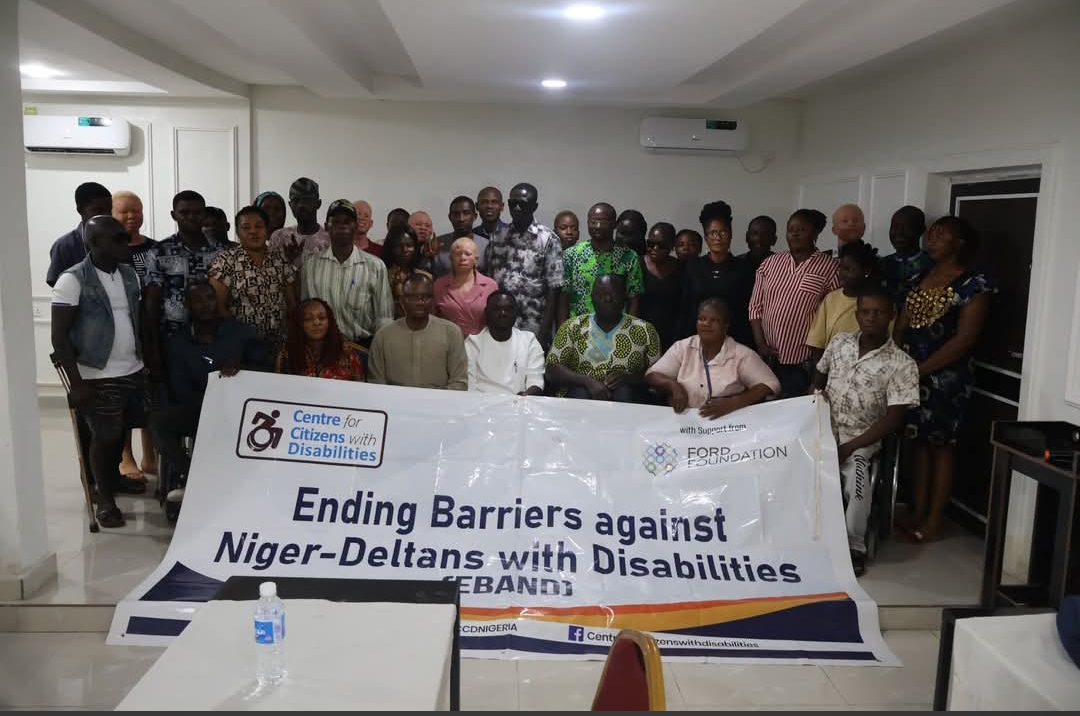
YENAGOA, BAYELSA STATE – Determined to break longstanding barriers that have excluded Persons with Disabilities (PWDs) from benefiting fully from development opportunities in oil-producing communities, the Centre for Citizens with Disabilities (CCD), through its Ending Barriers Against Niger-Deltans with Disabilities (EBAND) project, has intensified efforts to promote disability inclusion across the Niger Delta region.
With support from the Ford Foundation, CCD recently convened a two-day advocacy and capacity-building workshop in Yenagoa, Bayelsa State, bringing together Persons with Disabilities from oil-producing communities, government representatives, Organizations of Persons with Disabilities (OPDs), traditional and community stakeholders, as well as media practitioners.
The workshop served as a strategic platform for participants to gain deeper insights into the Petroleum Industry Act (PIA) 2021, strengthen their advocacy and leadership capacities, and develop practical strategies for ensuring the inclusion of Persons with Disabilities within the Host Community Development Trust (HCDT) structures established under the Act.
For decades, many communities in the Niger Delta have borne the environmental and socio-economic consequences of oil exploration activities. However, within these communities, Persons with Disabilities often face an additional layer of exclusion, making them among the most marginalized groups in the region. The workshop therefore focused on empowering participants to challenge these barriers and actively engage in decision-making processes affecting their communities.
In his goodwill message, the Chairman of the Joint National Association of Persons with Disabilities (JONAPWD), Hon. Ekpomokumor Mayor, commended CCD for its unwavering commitment to advancing disability inclusion within the implementation framework of the Petroleum Industry Act.
He also applauded the Bayelsa State Government for assenting to the State Disability Bill, describing the move as a significant milestone in the promotion and protection of the rights of Persons with Disabilities.
While celebrating the progress achieved, Hon. Mayor urged participants not to relent in their advocacy efforts.
According to him, the enactment of disability laws alone is not enough; what remains critical is ensuring their effective implementation and translating legal provisions into tangible improvements in the lives of Persons with Disabilities.
“Rights become meaningful only when they are implemented. We must continue to organize, advocate, and engage relevant stakeholders to ensure that Persons with Disabilities are fully included in governance and development initiatives,” he emphasized.
Delivering the opening remarks, the Founding Executive Director of CCD, Dr. Hon. David Obinna Anyaele, congratulated participants and stakeholders for their commitment to advancing disability inclusion in the Niger Delta.
He noted that while the Petroleum Industry Act has created important structures and opportunities for community development through the Host Community Development Trusts, many Persons with Disabilities remain excluded from these processes.
Dr. Anyaele stressed that the workshop was designed to bridge this gap by equipping participants with the knowledge, skills, and confidence needed to engage effectively with decision-makers and advocate for inclusive development.
“The Petroleum Industry Act has created opportunities for host communities to participate in development initiatives, but many Persons with Disabilities are yet to benefit from these structures. This training is aimed at empowering participants to understand the law, identify opportunities for engagement, and advocate effectively for inclusion,” he stated.
Throughout the intensive sessions, participants critically examined the realities facing communities in the Niger Delta. Discussions highlighted how environmental degradation, oil pollution, poverty, and structural inequalities have compounded the challenges faced by Persons with Disabilities in the region.
Facilitators guided participants through key provisions of the Petroleum Industry Act, particularly the Host Community Development Trust, which is funded through a three percent contribution from oil companies’ operational expenditures. Participants explored how these funds are intended to support community development and discussed ways to ensure that disability inclusion becomes a central consideration in project planning and implementation.
The training also exposed participants to core principles of disability rights, strategic advocacy, inclusive governance mechanisms, stakeholder engagement, and alliance-building approaches.
A key takeaway from the workshop was the understanding that advocacy goes beyond making requests or appealing for sympathy. Participants learned that effective advocacy is a structured and strategic process that requires evidence, planning, collaboration, and sustained engagement with decision-makers.
To reinforce learning, facilitators organized practical role-play exercises where participants simulated advocacy visits to traditional rulers and community leaders. The exercises emphasized the importance of respect, cultural sensitivity, clear communication, and relationship-building in achieving advocacy objectives.
The interactive nature of the sessions encouraged participants to share experiences from their respective communities, identify common challenges, and collectively develop solutions for increasing disability representation in community governance structures.
By the conclusion of the workshop, participants expressed renewed confidence and a stronger sense of purpose. Many described the training as transformative, noting that it had equipped them with practical tools to influence policies and decisions affecting their lives.
Participants pledged to return to their communities as champions of inclusion, committed to mobilizing fellow PWDs, engaging traditional institutions, collaborating with civil society organizations, and advocating for meaningful participation in Host Community Development Trusts and other development platforms.
The workshop ended with a collective call for governments, oil companies, community leaders, and development partners to recognize Persons with Disabilities as equal stakeholders in the development of the Niger Delta.
As stakeholders continue to push for equitable and sustainable development in oil-producing communities, the CCD-led initiative represents a significant step toward ensuring that no one is left behind. It reinforces the message that Persons with Disabilities are not passive recipients of development interventions but active contributors, leaders, and rightful beneficiaries of the resources and opportunities meant for their communities.
The training has therefore set the stage for a new wave of disability-inclusive advocacy across the Niger Delta, one aimed at transforming policies into action and ensuring that the promises of the Petroleum Industry Act become a reality for all citizens, regardless of disability status.
Click the link below to join our WhatsApp channel


