

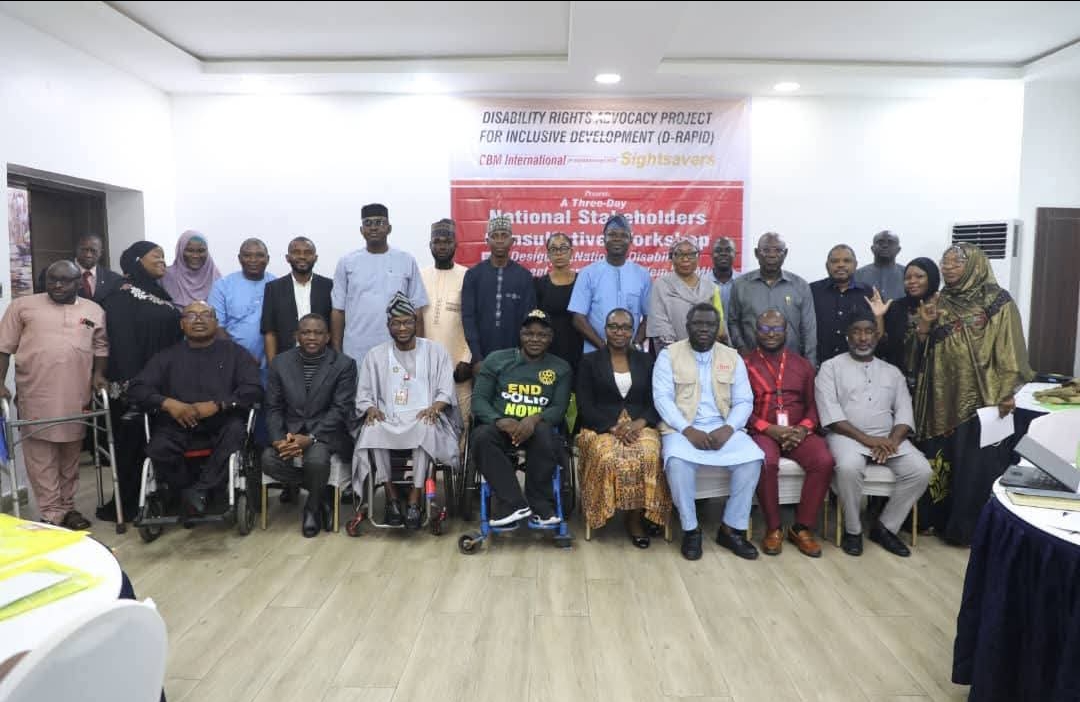
ABUJA, NIGERIA – In a landmark move aimed at transforming disability governance and evidence-based policymaking in Nigeria, the National Commission for Persons with Disabilities (NCPWD) has convened a three-day National Stakeholders Workshop to design a comprehensive National Disability Management Information System (NDMIS), a groundbreaking initiative expected to revolutionize disability data collection, management, and utilization across the country.
The high-level workshop, held at Stratton Hotel, Asokoro, Abuja, from May 18 to 20, 2026, brought together key government institutions, development partners, disability rights organizations, technical experts, and representatives of Organizations of Persons with Disabilities (OPDs) to address one of the most critical challenges facing disability inclusion in Nigeria—the absence of accurate, harmonized, and reliable disability data.
Declaring the workshop open, the Executive Secretary of the National Commission for Persons with Disabilities, Hon. Ayuba Burki Gufwan, described the initiative as a strategic intervention designed to confront longstanding gaps in disability data and ensure that persons with disabilities are no longer invisible in national development planning.
According to him, Nigeria’s disability ecosystem has for decades been characterized by fragmented information systems, inconsistent estimates, and weak integration into national statistical and administrative frameworks, resulting in inadequate representation of persons with disabilities in government policies and development programs.
“Our disability ecosystem remains fragmented, largely estimate-based, and poorly integrated into national administrative and statistical systems. These deficiencies continue to affect planning, budgeting, policy formulation, service delivery, and inclusion efforts across the country,” Gufwan stated.
Millions of Nigerians with Disabilities Undercounted
The NCPWD boss highlighted several systemic challenges hindering effective disability data management in Nigeria.
Among the major issues identified were weak disability-disaggregated administrative data across Ministries, Departments and Agencies (MDAs), limited adoption of internationally recognized disability measurement tools such as the Washington Group Questions, under-registration of persons with disabilities, the absence of a harmonized national disability database, and poor interoperability among existing sectoral data systems.
He warned that the consequences of these gaps extend far beyond statistics.
“These gaps mean that millions of Nigerians with disabilities remain undercounted, underserved, and excluded from development outcomes,” he said.
Gufwan emphasized that reliable data is the foundation of effective governance and inclusion, noting that governments cannot adequately plan for citizens they cannot accurately count.
“Data is life,” he declared. “Without credible disability data, it becomes difficult to design effective policies, allocate resources appropriately, monitor progress, and ensure that persons with disabilities are included in national development efforts.”
Building Nigeria’s First National Disability Database
The Executive Secretary explained that the Commission’s vision is to establish a robust National Disability Management Information System capable of providing real-time, reliable, and accessible disability-related data for planning and decision-making.
The proposed NDMIS will create a secure and standalone National Disability Database while harmonizing disability-disaggregated data collected by various government institutions.
It will also strengthen compliance monitoring of the Discrimination Against Persons with Disabilities (Prohibition) Act 2018, improve policy formulation and budget planning, and enhance Nigeria’s reporting obligations under the Sustainable Development Goals (SDGs) and the United Nations Convention on the Rights of Persons with Disabilities (UNCRPD).
According to Gufwan, the initiative will provide government agencies and development partners with the evidence needed to make informed decisions that directly improve the lives of persons with disabilities.
Standardized Data Collection Tool in the Works
One of the major expected outcomes of the workshop is the development of a National Universal Disability Data Collection Tool that aligns with internationally accepted Washington Group Questions.
The tool is expected to provide a standardized framework for collecting disability data across all sectors and levels of government in Nigeria.
The workshop is also expected to produce a comprehensive national action plan outlining the phased design, pilot testing, and operationalization of the National Disability Management Information System.
Stakeholders believe that once implemented, the system will significantly improve disability registration, monitoring, service delivery, and policy evaluation nationwide.
Experts, Government Agencies and Development Partners Unite
Speaking on the objectives of the workshop, the Director of Planning, Research and Statistics at NCPWD, Mr. Idowu Iwere, explained that the exercise was deliberately structured as a technical co-creation platform to encourage collaboration among stakeholders.
He noted that the workshop was designed to bring together Ministries, Departments and Agencies, non-governmental organizations, development partners, researchers, and OPDs to harmonize systems, improve interoperability, and strengthen evidence-based policymaking.
The event attracted prominent stakeholders, including the Senior Special Assistant to the President on Equal Opportunities, Hon. Mohammed Abba Isa, the Head of Social Affairs Division of ECOWAS, Dr. Alves Dalmanda, representatives of the National Bureau of Statistics (NBS), Federal Ministries of Education and Health, and several other MDAs.
Development Partners Pledge Support
Development partners and international organizations at the workshop reaffirmed their commitment to supporting Nigeria’s efforts to improve disability data systems.
Representatives of Sightsavers, GIZ, and CBM International delivered goodwill messages and pledged continued collaboration with the National Commission for Persons with Disabilities to ensure the successful implementation of accurate and disability-inclusive data collection mechanisms.
The organizations emphasized that reliable disability data remains a critical requirement for advancing inclusion, measuring progress, and ensuring that no person with a disability is left behind in national development programs.
Towards a More Inclusive Nigeria
The workshop featured technical paper presentations, intensive working sessions, adoption of operational models, and strategic discussions on the future of disability data governance in Nigeria.
Observers have described the initiative as a historic milestone in Nigeria’s disability inclusion journey, noting that the availability of accurate disability data could transform how government institutions plan, budget, and deliver services to millions of persons with disabilities.
As the country continues its pursuit of inclusive development, stakeholders believe that the National Disability Management Information System will serve as a game-changing tool capable of bridging information gaps, strengthening accountability, and ensuring that persons with disabilities are fully represented in national statistics and development outcomes.
For many disability advocates, the message emerging from the workshop is clear: inclusive development begins with inclusive data, and Nigeria can no longer afford to leave millions of persons with disabilities uncounted and unseen.
Click the link below to join our WhatsApp channel


