

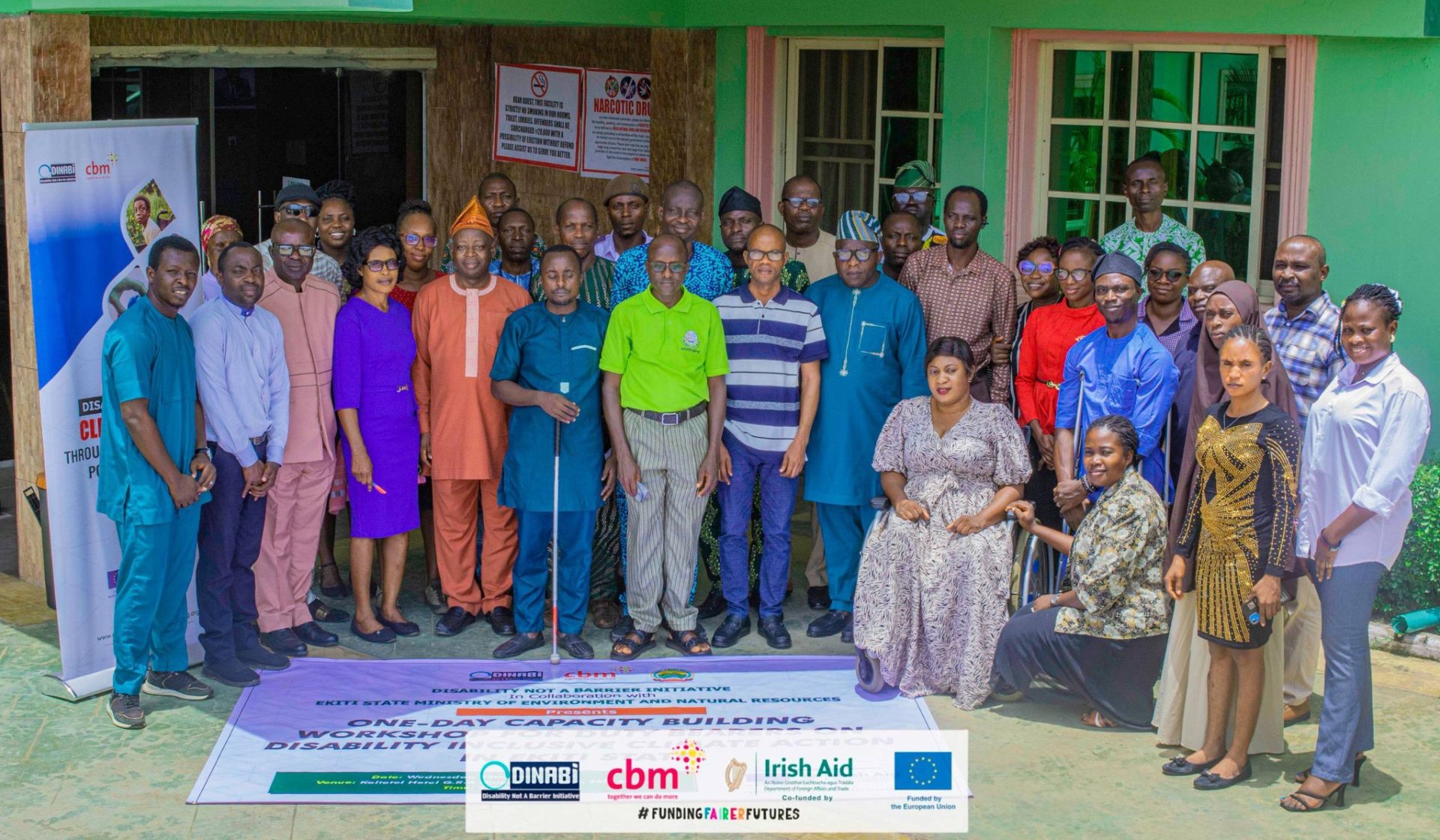
In a bold step toward bridging the gap between climate action and social inclusion, the Ekiti State Government, in collaboration with Disability Not a Barrier Initiative Nigeria, has convened a high-impact capacity-building workshop aimed at equipping duty bearers with the knowledge and tools required to drive inclusive climate governance.
The strategic training, supported by Irish Aid and co-funded by the European Union alongside CBM Global Disability Inclusion, brought together a diverse mix of participants from government institutions, civil society organisations, and the media.
Climate Change Meets Inclusion
Far from being a routine workshop, the programme served as a crucial platform to deepen understanding of climate change and its far-reaching consequences—particularly for vulnerable populations, including persons with disabilities.
Declaring the workshop open, the Commissioner for Environment and Natural Resources, Tosin Aluko Ajisafe, described climate change as a complex issue that transcends environmental concerns.
“Climate change is not just about the environment; it sits at the intersections of human rights, development, and our collective future,” she stated.
Represented by the Permanent Secretary of the Ministry, Dr. Sunday Omoya, the Commissioner stressed the urgent need to equip duty bearers with the right skills to effectively include persons with disabilities in climate mitigation and adaptation strategies.
She highlighted that inclusive climate planning must go beyond theory, urging stakeholders to design and implement programmes that are accessible, participatory, and equitable. According to her, strengthening capacity in inclusive disaster risk reduction is no longer optional but essential.
“A Social Justice Issue”
In a powerful assertion, the Commissioner framed climate change as a matter of social justice, drawing attention to its disproportionate impact on persons with disabilities.
“Impacts such as floods, heatwaves, drought, and food insecurity affect persons with disabilities more severely due to barriers like limited mobility, inaccessible information, and systemic exclusion,” she noted.
She further emphasized that duty bearers—ranging from policymakers and government officials to community leaders and service providers—carry both a moral and legal responsibility to ensure that no one is left behind.
“To meet this responsibility, we must invest in knowledge and awareness, so we can fully understand the diverse needs of persons with disabilities and how climate risks uniquely affect them,” she added.
DINABI Pushes for a Shift in Mindset
In his opening remarks, the Executive Director of Disability Not a Barrier Initiative Nigeria, Olajide Funso Benjamin, delivered a passionate call for a paradigm shift in how society perceives disability.
“We must rejig our thinking about persons with disabilities. They are not objects of pity. Disability is not a disease—it is a natural part of human diversity,” he said.
He stressed that persons with disabilities are entitled to the same fundamental human rights as everyone else and should not face discrimination or stigmatization in accessing services and opportunities.
Speaking on the broader implications of climate change, Benjamin painted a stark picture of Nigeria’s vulnerability, citing environmental degradation, economic instability, and social inequalities as compounding factors.
“The effects of climate change are profound—impacting agriculture, water resources, and human health. But these effects are not evenly distributed,” he warned.
He identified rural communities, women, children, the elderly, and persons with disabilities as the most vulnerable groups, noting that individuals with disabilities often face additional barriers in accessing information, resources, and disaster response services.
Driving Policy and Practical Solutions
Earlier, DINABI’s Programme Officer, Mike Duyile, explained that the initiative was strategically designed to influence climate policy in Ekiti State, with the Ministry of Environment serving as a critical partner.
He noted that beyond raising awareness, the training aimed to empower participants with practical tools to design and implement inclusive climate programmes.
Participants were exposed to innovative approaches for ensuring accessibility in climate interventions, as well as strategies for embedding equity and inclusion into policy frameworks and community-level actions.
Building Champions for Inclusive Climate Action
Stakeholders at the workshop described the training as a significant milestone in building a new generation of climate champions—individuals equipped not only with knowledge of environmental challenges but also with the competence to address them inclusively and sustainably.
From accessible communication strategies to inclusive disaster preparedness planning, participants gained hands-on insights into how to mainstream disability inclusion across all aspects of climate action.
Renewed Commitment to Inclusion
At the close of the workshop, participants expressed a strong commitment to translating knowledge into action. Many pledged to integrate inclusive approaches into their respective roles, whether in policymaking, advocacy, or service delivery.
They also reaffirmed their dedication to promoting sustainable development initiatives that prioritize equity, resilience, and the active participation of all segments of society—especially those often left on the margins.
A Step Toward a More Inclusive Future
As climate challenges continue to intensify globally, initiatives like this signal a growing recognition that effective solutions must be inclusive by design.
For Ekiti State, the collaboration between government and civil society represents not just a response to climate change, but a deliberate move toward a future where no one—regardless of ability—is left behind.
Click the link below to join our WhatsApp channel


