

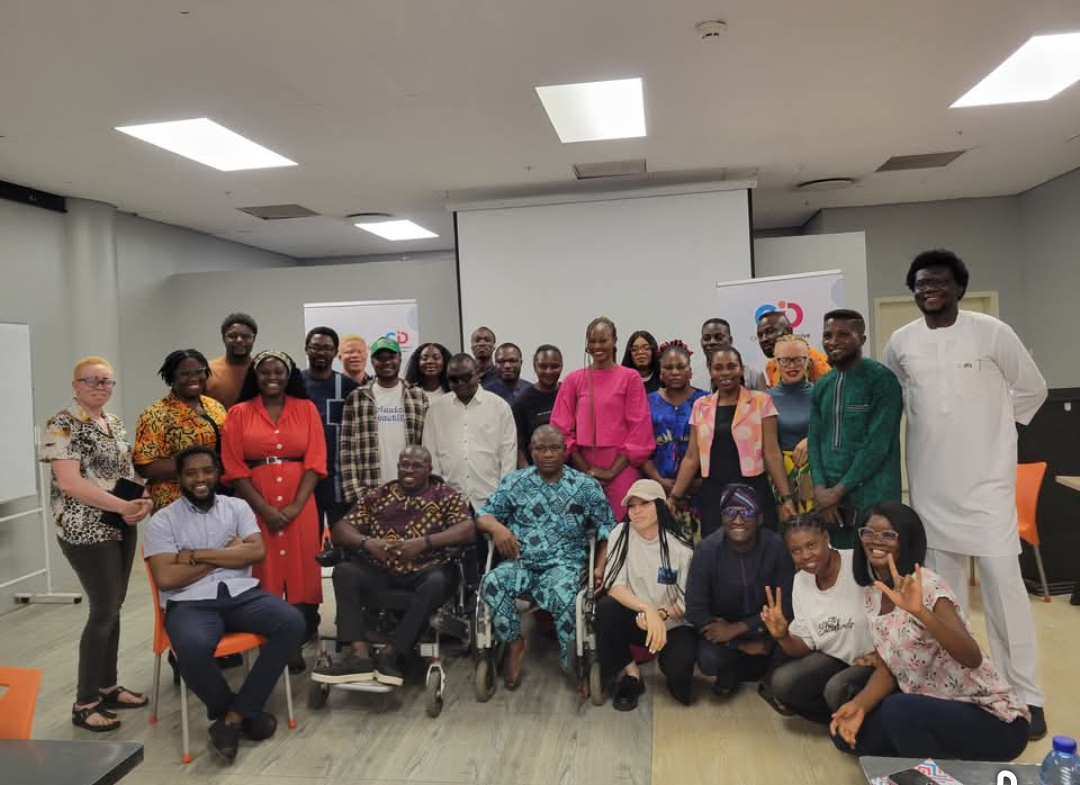
Stakeholders in Nigeria’s technology and disability advocacy ecosystem have issued a strong call for the full enforcement of the Discrimination Against Persons with Disabilities (Prohibition) Act, warning that poor compliance continues to shut out millions of persons with disabilities from the country’s rapidly expanding digital economy.
The call came during a three-day digital accessibility training organised by the Centre for Inclusive Development (CID), with support from the Disability Rights Fund, under its Enhancing Digital Accessibility for Persons with Disabilities in Nigeria project.
Participants at the training expressed deep concern that, despite existing laws and policies, Nigeria’s digital ecosystem remains largely inaccessible to persons with disabilities. They noted that the problem cuts across sectors—from private digital platforms to critical government portals.
According to the stakeholders, many websites still lack basic accessibility features such as text alternatives for images, making them unusable for blind and visually impaired persons. Similarly, the absence of captions and transcripts in multimedia content continues to exclude deaf users, while platforms that depend solely on mouse navigation restrict access for individuals with motor disabilities.
The situation is even more troubling in essential services. Participants highlighted barriers within banking and fintech applications, as well as government platforms like those managed by the Independent National Electoral Commission. Issues such as complex language, poor colour contrast, and unclear error messages were identified as significant obstacles, particularly for users with cognitive and learning disabilities.
“These barriers are not just technical flaws—they are systemic exclusions,” one participant noted. “They cut millions of Nigerians off from public services, economic opportunities, and civic participation. Yet, the irony is that most of these issues can be fixed with the right knowledge and commitment.”
While acknowledging that Nigeria has made progress by enacting the disability law and aligning with global standards like the Web Content Accessibility Guidelines (WCAG), stakeholders stressed that implementation remains the weakest link.
They referenced ongoing commitments by the National Information Technology Development Agency, particularly under its Strategic Roadmap and Action Plan, which prioritises inclusive digital infrastructure. However, they insisted that commitments must translate into measurable action and compliance across all sectors.
Speaking at the event, Isaiah Ude, Program Manager of the EDAPDN Project at CID, emphasised that the training was designed to go beyond awareness and build real capacity among Organisations of Persons with Disabilities (OPDs).
“Awareness is not enough,” Ude said. “We want OPDs to gain practical, technical skills—to audit digital platforms, identify accessibility gaps, and use evidence-based advocacy to demand change. Our goal is to empower them to lead accessibility audits and become strong drivers of digital inclusion in Nigeria.”
A dedicated session for developers and IT professionals underscored that accessibility is not optional but both a legal and professional responsibility. Experts warned that as Nigeria’s digital ecosystem continues to grow, failure to embed accessibility from the design stage will only deepen inequality.
“Nigeria’s digital growth is commendable,” Ude added. “But growth that excludes persons with disabilities is not progress—it is discrimination. Developers and IT professionals have a critical role to play. If accessibility becomes a standard practice in their work, the ripple effect will be transformative.”
Digital accessibility expert and lead trainer, David Owumi, reinforced this perspective, stressing that disability inclusion is fundamentally about designing environments that work for everyone.
“Disability is not the problem—the environment is,” Owumi said. “We must create systems, both online and offline, that guarantee access for all, regardless of ability. Inclusion is not charity; it is a responsibility.”
The training is part of CID’s broader strategy to drive nationwide compliance with accessibility standards by engaging key stakeholders across government, the private sector, and the disability community.
As Nigeria pushes forward in its digital transformation journey, stakeholders insist that inclusion must not be an afterthought. Instead, they argue, it should be a core principle—ensuring that no one is left behind in the digital age.
Click the link below to join our WhatsApp channel


