

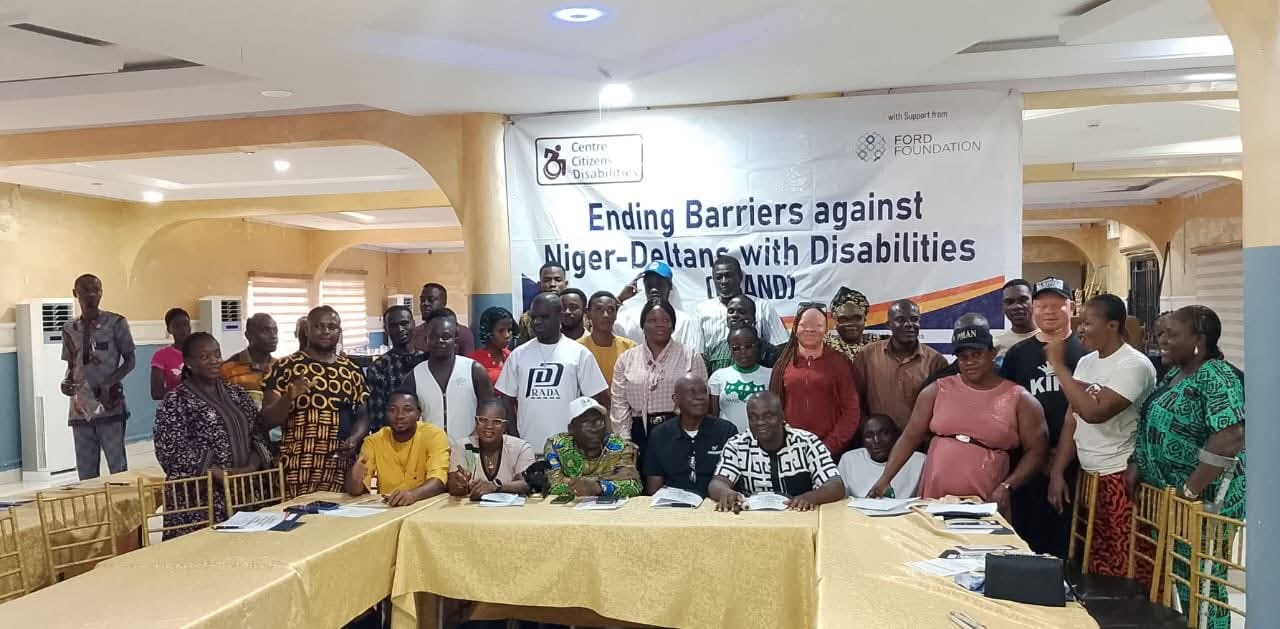
The Centre for Citizens with Disabilities (CCD) has intensified efforts towards promoting disability inclusion in Nigeria’s oil-producing communities through a comprehensive two-day advocacy training held in Anambra State under its Ending Barriers Against Niger-Deltans with Disabilities (EBAND) project.
The impactful workshop brought together Persons with Disabilities (PWDs) from oil-producing communities, government representatives, Organisations of Persons with Disabilities (OPDs), civil society actors, and members of the media in a strategic effort aimed at equipping participants with advocacy skills and knowledge necessary to push for the inclusion of PWDs in the benefit-sharing structures of the Petroleum Industry Act (PIA) 2021.
The training served as a critical platform for participants to examine the persistent exclusion of persons with disabilities from governance and development structures within host communities despite the enormous contributions of the Niger Delta region to Nigeria’s economy through oil exploration and production.
Speaking during the opening session, the Senior Programme Officer of CCD, Florence Attah, provided participants with an overview of the organisation’s vision, mission, and core values. She encouraged participants to take full advantage of the training and become advocates for disability inclusion within their various communities.
According to her, the training was not merely an academic exercise but a call to action for participants to return home and actively engage community leaders, government institutions, and stakeholders in ensuring that persons with disabilities are adequately represented in the implementation of the Petroleum Industry Act.
She also disclosed that previous advocacy engagements conducted in other states had already begun yielding positive outcomes, expressing optimism that Anambra State would also witness meaningful progress through sustained advocacy and collaboration.
In his opening remarks, the Acting Director of CCD, Godwin Unumeri, welcomed participants and commended their commitment towards advancing equity, justice, and inclusive development within the Niger Delta region.
He lamented the continued exclusion of persons with disabilities from governance structures and benefit-sharing arrangements established under the Petroleum Industry Act framework, despite the strategic economic importance of the Niger Delta.
Mr. Unumeri stressed that the workshop was specifically designed to empower participants with practical advocacy skills and legal knowledge required to demand representation within Host Community Development Trusts (HCDTs), Boards of Trustees, Advisory Committees, and other community decision-making platforms established under the PIA.
He emphasized that inclusion should never be viewed as charity but as a fundamental human right that must be protected and respected at all levels of governance and development planning.
Representing the Anambra State Disability Rights Commission, Chidera Okafor commended CCD for what he described as a timely and impactful intervention. He reaffirmed the Commission’s commitment towards promoting accessibility, equal opportunities, and inclusive participation for persons with disabilities across the state.
Similarly, the Chairman of Joint National Association of Persons with Disabilities (JONAPWD), Ugochukwu Okeke, applauded CCD for sustaining advocacy engagements in Anambra State. He urged participants from oil-producing communities not to remain passive observers but to actively participate in community affairs and decision-making processes affecting their lives and livelihoods.
The first day of the workshop focused extensively on understanding the vulnerabilities faced by persons with disabilities within the Niger Delta environment. Facilitators examined the devastating effects of oil exploration and environmental degradation on host communities, while also highlighting the unique challenges confronting persons with disabilities in accessing opportunities, information, and participation.
Participants were introduced to the fundamentals of disability rights, the provisions of the Petroleum Industry Act, and the operational structure of the Host Community Development Trusts (HCDTs). Discussions revealed significant gaps within existing governance structures that continue to exclude persons with disabilities from leadership positions and benefit-sharing arrangements.
Facilitators also emphasized the importance of understanding legal frameworks, resisting discrimination, engaging in community governance, and using strategic advocacy approaches to push for meaningful inclusion.
The workshop featured highly interactive sessions during which participants openly shared their lived experiences and realities within oil-producing communities. Many spoke about environmental pollution, social exclusion, poor access to information, inaccessible communication channels, and the absence of disability-friendly policies within community structures.
Participants further explored practical advocacy tools including media engagement, alliance building, stakeholder engagement, grassroots mobilisation, and community participation as effective strategies for driving inclusion and social change.
The second day of the training shifted focus towards advocacy strategies, inclusive governance, leadership development, and practical entry points for disability inclusion within the Petroleum Industry Act structures.
Participants received training on advocacy planning, stakeholder mapping, inclusive budgeting, needs assessment, and strategies for ensuring that disability issues are integrated into community development plans and local budgets.
Through role-play exercises, group discussions, and practical simulations, participants learned how to engage traditional rulers, community leaders, government agencies, and oil companies in demanding representation for persons with disabilities within Host Community Development Trusts, Boards of Trustees, and Advisory Committees.
Facilitators repeatedly stressed the importance of persistence, unity, evidence-based advocacy, and collective action in achieving sustainable inclusion and policy reforms.
At the conclusion of the workshop, participants expressed renewed confidence, determination, and commitment towards advancing disability inclusion within their respective communities.
Many pledged to replicate the knowledge gained during the training by stepping it down to other members of the disability community, strengthening coordinated advocacy networks, and sustaining engagement with relevant stakeholders to ensure that persons with disabilities are no longer excluded from governance and benefit-sharing processes under the Petroleum Industry Act.
The training was widely described as another significant milestone in the ongoing struggle for inclusive development and equal participation in the Niger Delta region.
Observers noted that the workshop not only empowered participants with advocacy knowledge but also strengthened the collective voice of persons with disabilities in demanding accountability, representation, and equitable access to opportunities within host communities.
As conversations around inclusive governance and sustainable development continue to gain momentum in Nigeria, the CCD’s EBAND project is increasingly emerging as a strategic intervention aimed at ensuring that no person with disability is left behind in the implementation of the Petroleum Industry Act and broader community development initiatives across the Niger Delta region.
Click the link below to join our WhatsApp channel


