

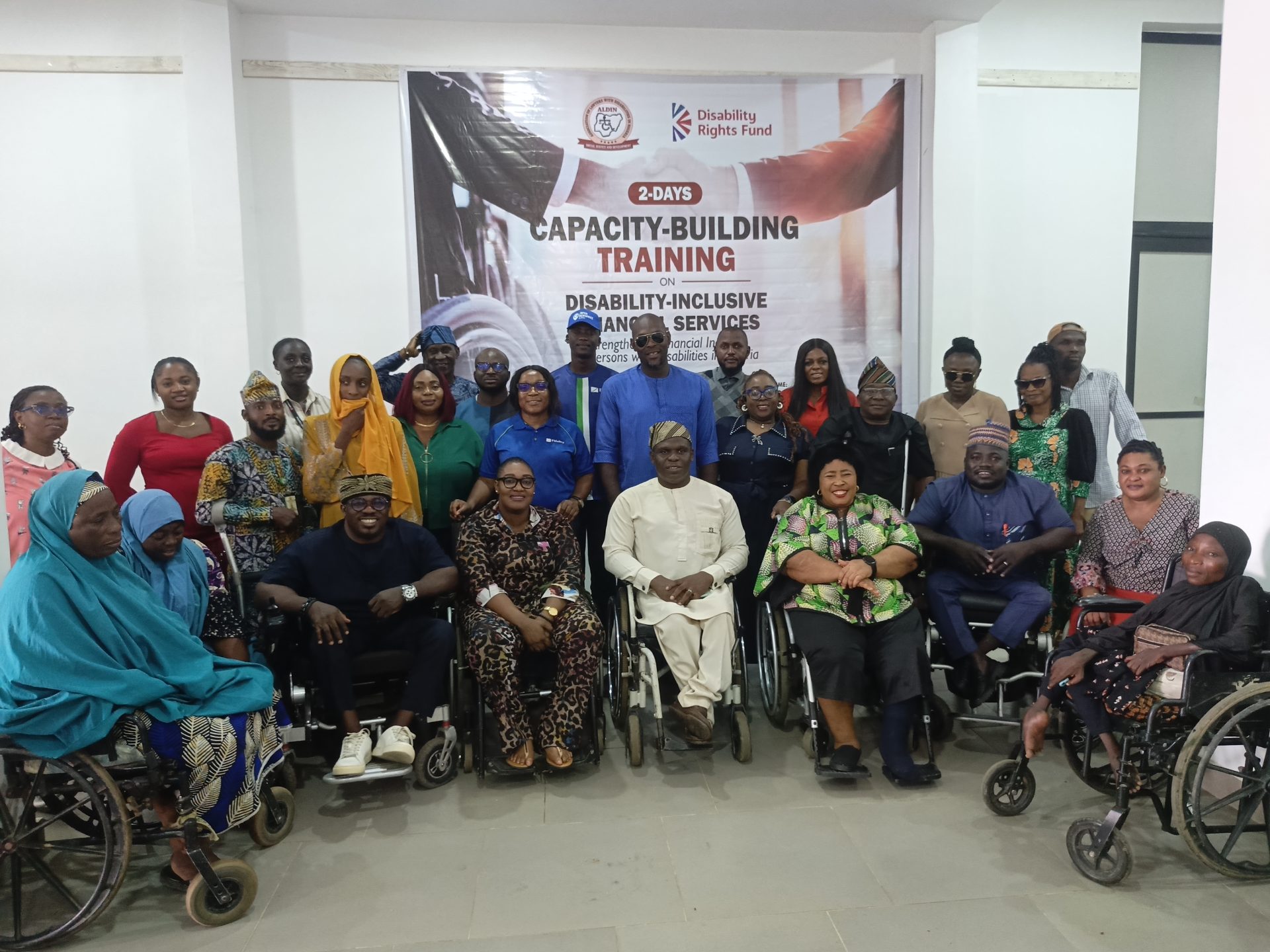
“Equal rights must include equal access to justice and economic opportunities” — ALDIN President
The Association of Lawyers with Disabilities in Nigeria (ALDIN), with support from the Disability Rights Fund (DRF), has called for urgent action to remove the physical, digital, communication and attitudinal barriers preventing persons with disabilities from fully accessing financial services in Nigeria.
The call was made during a two-day capacity-building training on “Strengthening Financial Inclusion of Persons with Disabilities in Nigeria,” held in Abuja from September 30 to October 1, 2026.
The training brought together stakeholders to deepen understanding of the barriers faced by persons with disabilities in accessing banking and other financial services and to promote practical approaches towards more accessible, inclusive and non-discriminatory financial systems.
Speaking during the training, Tosan Rukevwe Mene, Esq., President of ALDIN, said financial inclusion must go beyond simply having a bank account.
“Equal rights must include equal access to justice and economic opportunities,” Mene said.
She explained that ALDIN provides pro bono legal services to persons with disabilities whose rights have been violated, urging persons with disabilities to seek legal support whenever they encounter discrimination or other violations in accessing financial services.
According to her, financial inclusion means ensuring that persons with disabilities can access financial services, pursue economic opportunities and exercise their rights without discrimination or unnecessary barriers.
‘Disability Inclusion Is Not Charity’
Mene stressed that disability inclusion should not be treated as an act of charity or goodwill but as a matter of justice, equality and human rights.
Persons with disabilities continue to encounter numerous barriers when attempting to access banking services, ranging from inaccessible buildings and ATMs to inaccessible digital platforms and communication barriers.
For wheelchair users, the journey to a bank can become an obstacle course. Some banking halls lack appropriate ramps, while narrow security doors and poorly designed entrances can prevent wheelchair users from entering independently.
The barriers do not end at the physical environment.
Persons with visual impairments may encounter difficulties using ATMs or banking applications that are not compatible with screen readers, while Deaf customers may face communication challenges where sign language interpretation is unavailable.
These barriers can deny persons with disabilities the independence and dignity that other customers take for granted.
From Banking Halls to Digital Platforms
The training examined a broad range of issues affecting financial inclusion, including disability rights and legal obligations, the United Nations Convention on the Rights of Persons with Disabilities (CRPD), Nigeria’s disability legislation, reasonable accommodation, accessibility standards, inclusive customer service and digital financial services.
Participants also explored practical measures that banks and other financial institutions can adopt to make their services more accessible.
Mene noted that ALDIN organised the training to strengthen the capacity of relevant stakeholders while also empowering persons with disabilities with knowledge of their rights.
She encouraged persons with disabilities to take advantage of ALDIN’s pro bono legal services whenever their rights are violated.
She also appealed to well-meaning Nigerians who want to support persons with disabilities in accessing justice to collaborate with ALDIN.
According to her, stronger collaboration among lawyers, persons with disabilities, financial institutions, government agencies, civil society organisations and the media can help ensure that the rights of persons with disabilities are upheld.
Banks Have Legal Obligations
One of the facilitators, Dr. Yusuf Achenyo Iyodo, told The Qualitative Magazine that the training provided an important platform for both persons with disabilities and financial institutions to understand their respective responsibilities.
Iyodo said persons with disabilities were given relevant information on how to access financial services and understand their rights, while banks were exposed to the practical measures required to make their services inclusive.
He highlighted some of the everyday challenges faced by persons with disabilities, including the inability of some blind customers to independently operate ATMs and difficulties faced by wheelchair users in reaching or using ATM platforms.
According to him, these are not merely inconveniences but issues that can have legal consequences where financial institutions fail to meet their obligations under applicable disability and accessibility laws.
“When a bank isn’t meeting these requirements, they are already breaching the law,” Iyodo told TQM.
He stressed that the training was also designed to empower persons with disabilities to understand their rights and confidently demand accessible financial services.
A Call for Accessible Banking
The discussions underscored the need for banks to move beyond policies on paper and make accessibility a practical reality across their branches, ATMs, mobile applications, websites and customer-service systems.
For persons with disabilities, financial inclusion is about more than opening a bank account. It is about being able to save, withdraw money, make payments, access credit, operate digital banking platforms, run businesses and participate fully in the economy independently and with dignity.
The message from the training was clear: financial exclusion is a disability rights issue.
As Nigeria continues to expand digital banking and financial services, stakeholders must ensure that technological advancement does not create new barriers for persons with disabilities.
True financial inclusion will only be achieved when every customer—regardless of disability—can access financial services independently, safely, equally and without discrimination.


