

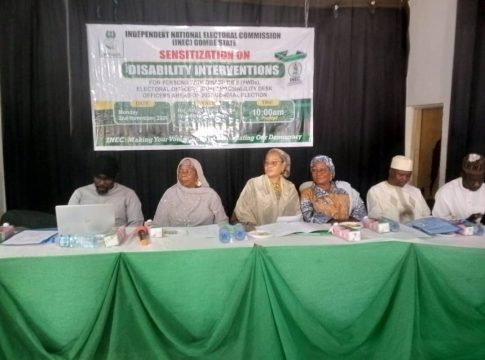
The Commission says it is strengthening accessibility measures, training electoral personnel and engaging disability organisations to ensure that no eligible voter is excluded because of disability.
The Independent National Electoral Commission (INEC) in Gombe State has reaffirmed its commitment to ensuring that Persons with Disabilities (PWDs) enjoy equal opportunities to participate in Nigeria’s electoral process ahead of the 2027 General Election.
The Resident Electoral Commissioner (REC), Umar Mukhtar Gajiram, gave the assurance through the Administrative Secretary, Fadimatu Aliyu Bakari, at a sensitisation workshop on disability inclusion, accessibility and electoral interventions for PWDs, Electoral Officers (EOs) and Disability Desk Officers in Gombe State.
Gajiram stressed that the right to vote and participate in democratic activities belongs to every Nigerian, irrespective of physical, visual, hearing or other forms of disability.
He noted that PWDs are important stakeholders in Nigeria’s democracy, emphasising that their votes, voices and contributions must be recognised and protected throughout the electoral process.
INEC Strengthens Accessibility Measures Ahead of 2027
Highlighting the Commission’s efforts to promote inclusive elections, the REC disclosed that INEC had introduced several measures to improve electoral accessibility for PWDs.
These include the provision of assistive voting materials, improved access to polling units, capacity-building for electoral officials and collaboration with organisations of PWDs.
However, he observed that introducing these measures would not be sufficient without proper understanding, commitment and effective implementation by electoral personnel and other stakeholders.
According to him, the sensitisation workshop was designed to bridge knowledge gaps, encourage experience-sharing and provide an opportunity for participants to identify existing barriers and develop practical solutions ahead of the 2027 elections.
He urged Electoral Officers to make disability inclusion an integral part of their responsibilities rather than treating it as an additional assignment.
Disability Desk Officers Charged on Accountability and Engagement
The REC also charged Disability Desk Officers to remain accessible and responsive to the needs of PWDs, maintain regular engagement with disability communities and ensure that their concerns are communicated to the Commission for necessary action.
Addressing representatives of PWDs, he encouraged participants to speak openly about their experiences, identify existing gaps and make practical recommendations that would help improve INEC’s services.
He maintained that meaningful engagement with disability organisations was essential to building an electoral system that responds to the actual needs of voters with disabilities.
No Eligible Voter Should Be Left Behind
Looking ahead to the 2027 General Election, Gajiram emphasised the need for practical interventions that would address the different accessibility requirements of voters with disabilities.
He specifically highlighted the importance of ensuring that wheelchair users can access polling units without unnecessary barriers, voters with visual impairments receive appropriate voting assistance, and persons with hearing impairments have access to essential electoral information in accessible formats.
He further stressed that facilitating the participation of PWDs in elections should not be regarded as an act of kindness or favour but as the protection of a fundamental democratic right.
The REC urged participants to translate the knowledge and discussions from the workshop into concrete actions that would improve electoral accessibility, voter education and participation.
He expressed confidence that the engagement would contribute to building a more inclusive electoral process where every eligible Nigerian, regardless of disability, could exercise their civic rights with dignity, independence and confidence.
As Nigeria approaches the 2027 General Election, the real test of INEC’s commitment will not be the promises made at sensitisation workshops but the extent to which those promises translate into accessible polling units, inclusive voter education, appropriate assistive materials and an electoral process that leaves no eligible voter behind.


