

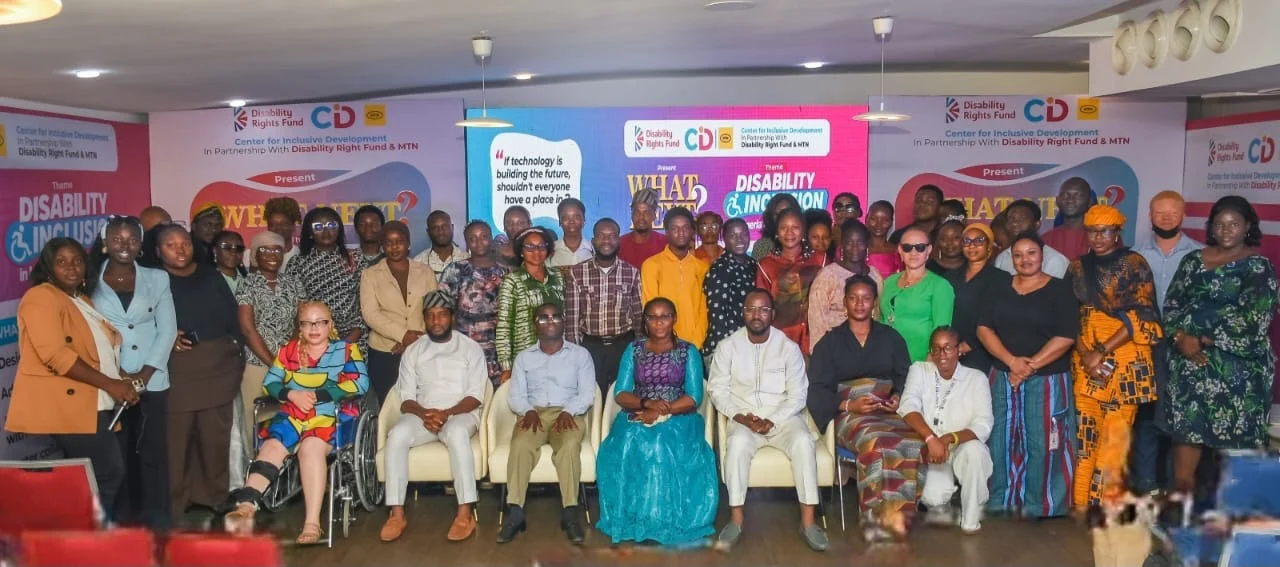
Abuja – As Nigeria continues to embrace digital transformation across education, employment, banking, e-commerce and public services, stakeholders have called for deliberate action to ensure that persons with disabilities are not left behind in the country’s rapidly expanding digital economy.
The call was made in Abuja on Thursday during the third edition of the What Next Learning Series, organised by the Centre for Inclusive Development (CID) in partnership with the Disability Rights Fund (DRF) and MTN Nigeria. The event was themed “Disability Inclusion in Nigeria’s Digital [Economy].”
The stakeholders warned that while digital technology continues to create new opportunities, inaccessible websites, mobile applications, online platforms and other digital services are shutting millions of persons with disabilities out of meaningful participation.
Speaking at the event, CID Co-Founder, Mrs Yauri Aduak, said digital inclusion requires more than creating opportunities for persons with disabilities; it demands deliberate efforts to identify and remove the barriers preventing their full participation in society.
“At CID, we believe that inclusion is not simply about creating opportunities for persons with disabilities to participate. It is also about deliberately removing the barriers that prevent their full and meaningful participation in society. This belief is at the heart of the What Next Learning Series,” Aduak said.
She explained that the series was established to move disability inclusion conversations beyond awareness, commitments and good intentions towards practical solutions and measurable change.
Aduak noted that Nigeria’s digital transformation was opening up opportunities across several sectors, but warned that persons with disabilities could not fully benefit from these developments without accessible digital infrastructure and services.
According to her, findings from CID’s project on Enhancing Digital Accessibility for Persons with Disabilities in Nigeria, supported by DRF, have highlighted both the opportunities and challenges surrounding digital accessibility.
She added that engagements with Organisations of Persons with Disabilities (OPDs) and other stakeholders had demonstrated that achieving digital inclusion required institutional commitment, technical capacity and sustained collaboration.
She therefore urged stakeholders to translate discussions into concrete actions, emphasising that no single institution could achieve digital inclusion independently.
Inaccessible Technology Continues to Exclude Persons with Disabilities
Also speaking, the Programme Officer for Sub-Saharan Africa at the Disability Rights Fund, Mr Theophilus Odaudu, described digital inclusion as ensuring that everyone can independently access and use digital products and services without relying on third-party assistance.
He expressed concern that many digital platforms remain inaccessible because technology developers often fail to consider the diverse accessibility requirements of persons with disabilities during the design and development process.
Using practical examples, Odaudu explained that blind persons frequently encounter websites with unlabeled buttons and images without alternative text descriptions, making it difficult for screen-reading software to interpret information.
He noted that deaf persons require captioned videos to access audio-visual content, while persons with intellectual disabilities need simple, clear and easy-to-understand language rather than complicated technical information.
Odaudu observed that although Nigeria has laws and policies promoting the rights and inclusion of persons with disabilities, there are still insufficiently specific standards requiring technology developers and companies to integrate accessibility into their products from the outset.
He identified weak enforcement of existing legal provisions and the absence of clear accessibility standards as major obstacles to achieving meaningful digital inclusion.
He called on relevant government institutions to strengthen enforcement mechanisms and ensure that persons with disabilities are actively involved in decisions affecting their rights and participation.
He also challenged technology companies to involve persons with disabilities in the design, development and testing of digital products, stressing that accessibility should be considered from the beginning rather than treated as an afterthought.
MTN Reaffirms Commitment to Disability Inclusion
In her remarks, MTN Nigeria’s Chief Human Resource Officer, Mrs Esther Akinnukawe, described disability inclusion as both a moral responsibility and an important driver of national development.
Represented by Mr Chikaodi Ofoegbu, Head of Customer Operations and Experience, North, MTN Nigeria, she highlighted some of the company’s interventions to improve accessibility within its workplace.
These include ramps, modified workspaces, accessible fittings and emergency wheelchairs designed to improve the working environment for employees and visitors with disabilities.
She also highlighted the contributions of the MTN Foundation and initiatives such as the MTN Skills Academy in supporting education, scholarships and digital skills development for persons with disabilities.
Akinnukawe further commended CID for developing MakeAm, an artificial intelligence-powered WhatsApp tool designed to empower persons with disabilities through accessible technology.
She described the initiative as an example of how familiar digital platforms can be leveraged to break barriers, improve access to information and create equal opportunities.
Digital Inclusion Must Move Beyond Promises
The discussions at the What Next Learning Series underscore an important reality: digital transformation cannot be considered successful if a significant segment of the population is unable to access and benefit from it.
For millions of persons with disabilities, an inaccessible website can mean being denied information, an inaccessible banking application can restrict financial independence, and an inaccessible recruitment platform can become another barrier to employment.
As Nigeria advances its digital economy, accessibility must become a fundamental requirement in technology development, public service delivery, digital education and business operations.
The responsibility extends beyond government to technology companies, telecommunications providers, financial institutions, developers, civil society organisations and the disability community itself.
More importantly, persons with disabilities must not merely be consulted after digital products have been developed. They must be involved from the planning and design stages through testing, implementation and evaluation.
Digital inclusion is not a favour to persons with disabilities. It is a matter of equal rights, accessibility, independence and participation.
Nigeria cannot build a truly inclusive digital economy while millions of its citizens remain locked out by inaccessible technology.
An Inclusive Society Is Possible!


