

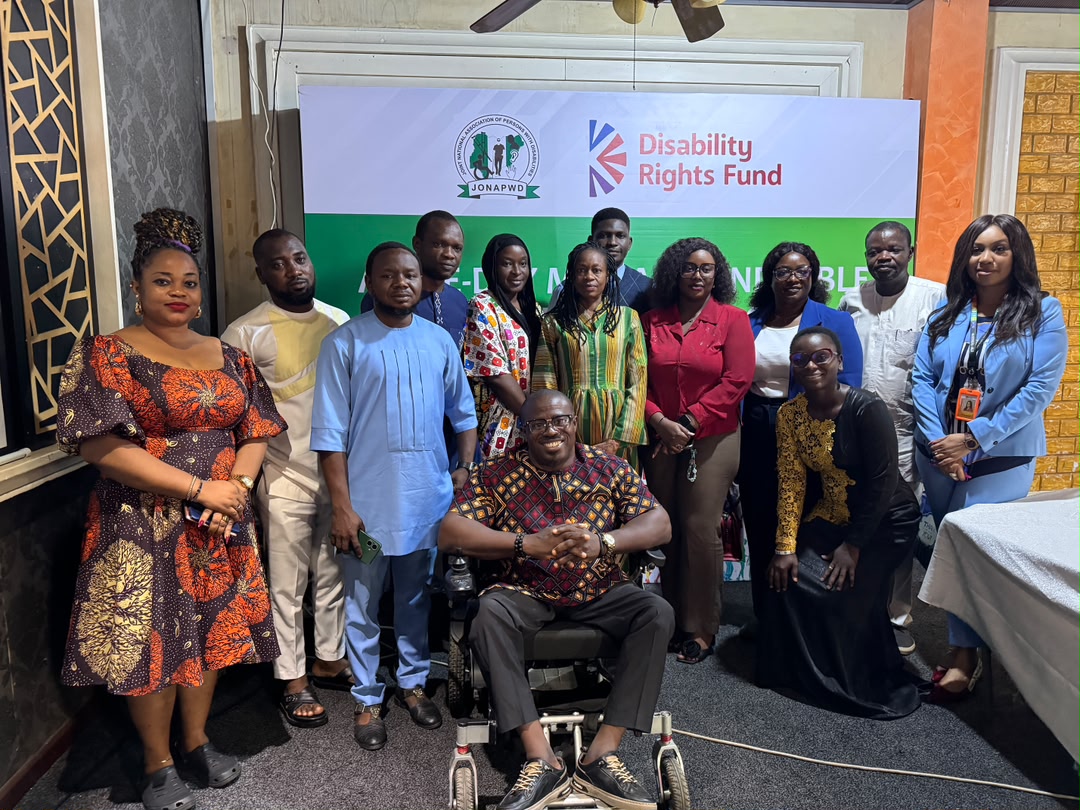
Abuja, Nigeria – The Joint National Association of Persons with Disabilities (JONAPWD) has called on journalists and media practitioners to become active partners in holding government and other stakeholders accountable for the implementation of Nigeria’s commitments under the Global Disability Summit (GDS), emphasizing that disability inclusion must move beyond policy declarations to measurable impact.
The call was made during a one-day Media Roundtable on Nigeria’s Global Disability Summit Commitments held in Abuja, bringing together media professionals, disability advocates, development partners, and representatives of organisations of persons with disabilities to strengthen awareness and accountability around Nigeria’s disability inclusion agenda.
The event, themed “Driving Awareness and Accountability for Disability-Inclusive Development in Nigeria,” provided a platform for stakeholders to examine the media’s role in advancing disability rights, shaping public discourse, and tracking progress on commitments made by Nigeria at the 2025 Global Disability Summit in Berlin, Germany.
Speaking at the event, the National President of the Joint National Association of Persons with Disabilities (JONAPWD), Abdullahi Aliyu Usman, represented by the organisation’s Programme Officer, Bukunmi Adejumo, described the summit as the world’s largest platform dedicated to promoting the rights, dignity, and inclusion of persons with disabilities.
She explained that the Global Disability Summit, established in 2017, has evolved into a powerful global movement that brings together governments, United Nations agencies, civil society organisations, development partners, and organisations of persons with disabilities to drive commitments on disability-inclusive development and humanitarian action.
According to Adejumo, the summit provides countries with a unique opportunity to transform disability rights from policy statements into practical outcomes that improve lives.
“The challenge before us is not simply making commitments. The challenge is ensuring that those commitments are implemented, monitored, and translated into meaningful change for persons with disabilities,” she said.
She disclosed that the Nigeria 2025 GDS Commitments Action Plan was developed by organisations of persons with disabilities in collaboration with the National Commission for Persons with Disabilities (NCPWD), with support from the Disability Rights Fund (DRF).
The action plan, she noted, serves as a roadmap for advocacy, accountability, and engagement with government institutions while creating a framework through which citizens and disability organisations can monitor implementation and demand results.
Accessibility Beyond Ramps
One of the major commitments highlighted during the roundtable focuses on digital information and communication accessibility, an area participants described as particularly significant to the media sector.
Adejumo revealed that the Federal Government has committed to ensuring that the National Broadcasting Commission implements disability-inclusive and accessible broadcasting services by December 2027.
The commitment includes wider use of sign language interpretation, captioning, audio descriptions, and other accessibility measures across broadcast platforms.
She added that government institutions have also pledged to consult persons with disabilities and their representative organisations when designing digital information and communication platforms.
“The commitment is not just about providing information. It is about ensuring that information is accessible to everyone regardless of disability,” she stated.
Participants stressed that accessibility should not be narrowly defined as the provision of ramps alone. Rather, it encompasses the design of physical environments, technologies, transportation systems, communication platforms, public services, and information systems that can be accessed and utilized by all citizens.
Without accessible schools, healthcare facilities, workplaces, transportation networks, and digital platforms, stakeholders noted that millions of Nigerians with disabilities remain excluded from development opportunities.
Driving Financial Inclusion
The roundtable also spotlighted government commitments aimed at improving financial inclusion for persons with disabilities.
According to Adejumo, the Federal Government has undertaken to ensure that at least 75 percent of banks operating in Nigeria provide accessible services and facilities for persons with disabilities by June 2028.
She further disclosed that government has committed to pursuing legislation that would allocate at least two percent of Nigeria’s annual consolidated revenue to disability inclusion initiatives across sectors by December 2026.
Stakeholders described the proposed funding commitment as a significant step towards ensuring that disability inclusion receives the financial backing necessary for meaningful implementation.
Tackling the Education Gap
Inclusive education emerged as one of the most urgent issues discussed during the engagement.
Adejumo expressed concern over the continued exclusion of many children with disabilities from Nigeria’s education system, noting that thousands remain out of school while many of those enrolled face segregation, inaccessible learning environments, and inadequate support services.
She described the current state of inclusive education as inadequate and called for urgent action to address systemic barriers.
As part of Nigeria’s GDS commitments, government aims to ensure that 70 percent of out-of-school children with disabilities return to school by 2028 through inclusive policies and targeted interventions.
However, she warned that commitments alone would not deliver results without concrete implementation.
“We need action. We need to ensure that these commitments are reflected in government programmes, budgets, and implementation plans,” she emphasized.
Six Priority Areas for Action
While Nigeria’s 2025 Global Disability Summit commitments cover twelve thematic sectors, JONAPWD identified six priority areas that will receive particular attention in implementation efforts.
The priority areas include:
- Social Protection
- Work, Entrepreneurship and Employment
- Healthcare
- Education
- Climate Action
- Accessibility
According to Adejumo, progress in these six sectors would naturally strengthen implementation across other thematic areas.
“If we achieve these priorities, many of the other commitments will fall into place because they are interconnected,” she explained.
The broader GDS thematic sectors include digital inclusion, financing for disability inclusion, inclusive education, legal capacity, humanitarian action, private sector engagement, climate action, social protection, healthcare, accessible infrastructure, community inclusion, and inclusive employment.
Climate Action and Humanitarian Inclusion
The roundtable also highlighted the growing importance of climate action within the disability inclusion agenda.
Participants noted that persons with disabilities often face disproportionate risks during emergencies and climate-related disasters due to inaccessible evacuation plans, communication barriers, and limited support systems.
Advocates stressed that climate resilience and disaster preparedness strategies must intentionally include persons with disabilities to ensure no one is left behind during emergencies.
Similarly, the action plan prioritizes legal capacity and community inclusion, particularly for persons with intellectual and psychosocial disabilities.
Adejumo emphasized the need to establish supported decision-making mechanisms that enable all persons with disabilities to exercise their legal rights and participate fully in society.
Media’s Role in Driving Accountability
A major focus of the roundtable was the role of the media in ensuring that disability inclusion commitments do not remain mere promises on paper.
Participants acknowledged a significant gap in public awareness and information dissemination regarding Nigeria’s disability commitments and agreed that journalists have a critical role to play in bridging that gap.
As part of the engagement, media practitioners participated in a co-creation session aimed at developing a media strategy for tracking Nigeria’s Global Disability Summit commitments.
One of the major outcomes of the session was a collective agreement on the importance of adopting appropriate disability terminology and embracing a rights-based approach to reporting.
Stakeholders urged journalists to move away from the charity-based narrative that has historically dominated disability coverage and instead focus on human rights, equality, accessibility, and social justice.
The media, they noted, can help amplify the voices of persons with disabilities, expose implementation gaps, and keep disability inclusion at the forefront of public discourse.
One of the most resonant messages from the roundtable was:
“Disability inclusion is not a matter for persons with disabilities alone. We need everybody to come together to ensure that we are able to demand our rights.”
From Commitments to Impact
The roundtable concluded with a renewed commitment among disability advocates, development partners, and media practitioners to work collaboratively toward ensuring that Nigeria’s disability inclusion agenda translates into tangible outcomes.
Stakeholders emphasized that the true measure of success will not be the number of commitments made or meetings held, but whether persons with disabilities experience real improvements in their daily lives through accessible education, quality healthcare, decent employment opportunities, inclusive communities, and equal participation in national development.
For JONAPWD and the broader disability movement, the message is clear: the era of promises must give way to action.
As Nigeria moves towards the next Global Disability Summit in 2028, disability advocates want the country to return with evidence of progress rather than a repetition of unfulfilled pledges.
For the more than 32 million Nigerians with disabilities, the transition from commitments to impact could be the defining step towards achieving true inclusion and equal citizenship.
Click the link below to join our WhatsApp channel


