

By TQM News,
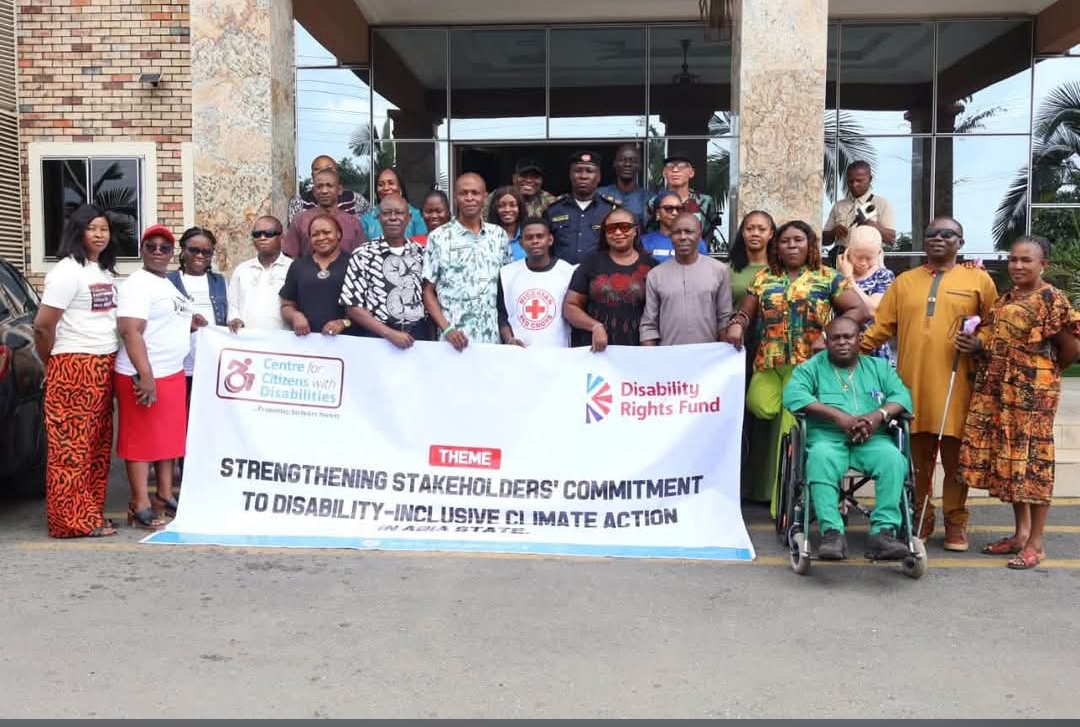
The Centre for Citizens with Disabilities (CCD), with support from the Disability Rights Fund (DRF), has intensified efforts to ensure that Persons with Disabilities (PWDs) are no longer left behind in climate change planning and response, following a two-day high-level stakeholders’ workshop held in Umuahia, Abia State.
The strategic engagement brought together representatives of government ministries and agencies, Organizations of Persons with Disabilities (OPDs), civil society organizations, emergency response institutions, development partners, and media professionals to deepen collaboration and strengthen commitments toward disability-inclusive climate action in the state.
The workshop forms part of CCD’s ongoing climate inclusion project, which commenced in 2025, and seeks to ensure that disability considerations are fully integrated into climate policies, disaster preparedness, adaptation strategies, and government development plans.
Speaking during the opening ceremony, the Acting Director of the Centre for Citizens with Disabilities (CCD), Mr. Godwin Unumeri, welcomed participants and appreciated them for sustaining the momentum of a project that has continued to make significant impact across Nigeria.
According to him, the core mission of CCD is to ensure that Persons with Disabilities are actively included in every stage of climate change governance through sustained advocacy, institutional strengthening, and capacity building for relevant government institutions.
He stressed that while Nigeria has developed several policies and frameworks, implementation remains the country’s greatest challenge.
“Planning and implementation are two sides of the same coin. Having good policies alone is not enough. We must continue to strengthen the capacity of institutions and stakeholders so that disability inclusion becomes a practical reality in our climate change response,” he said.
Unumeri further emphasized that climate change disproportionately affects persons with disabilities, making it imperative for governments to deliberately incorporate accessibility, inclusion, and participation into environmental policies and emergency response mechanisms.
Delivering the goodwill message on behalf of the Abia State Commissioner for Environment, Mr. Philemon Asonye Ogbonna, the Head of Department, Climate Change, Mr. Chris Ike, commended CCD for its consistency and leadership in advancing disability rights.
He acknowledged that the organization has become a dependable partner to government by constantly bringing disability issues to the forefront of policy discussions and ensuring that inclusive development remains a priority.
According to him, CCD’s interventions have continued to challenge government institutions to rethink the way climate policies, programmes, budgets, and implementation strategies are designed.
“Your work has put us as government on track to, as a matter of utmost importance, consider disability inclusion in designing initiatives, budgeting processes, implementation strategies, policies, frameworks, and development plans,” he stated.
He assured participants of the state government’s willingness to continue working closely with disability stakeholders to promote inclusive environmental governance and ensure that no resident is excluded from climate action because of disability.
The workshop also received glowing commendation from the Chairman of the Joint National Association of Persons with Disabilities (JONAPWD), Abia State Chapter, Comrade Okechukwu Wisdom, who described CCD as one of Nigeria’s foremost disability advocacy organizations.
According to him, CCD has consistently distinguished itself through impactful programmes that have strengthened the voices and capacities of persons with disabilities across different sectors.
He noted that the organization’s interventions have gone beyond awareness creation to practical empowerment in advocacy, leadership, policy engagement, and organizational development.
Reflecting on the climate inclusion project, Wisdom praised CCD’s research-driven approach, explaining that the organization first conducted extensive assessments across local government areas and senatorial zones to identify the peculiar climate challenges affecting persons with disabilities before organizing the stakeholders’ engagement.
“CCD is no longer a small organization. What they are doing has become a tradition and a culture. They continue to break new ground in advocacy, sensitization, leadership, and management.”
He continued:
“This climate change initiative did not begin with bringing us into a hall to teach us. They first carried out research across our local governments and zones to understand our peculiar realities before bringing stakeholders together to develop solutions.”
In a statement that drew applause from participants, Wisdom concluded:
“Today, whenever issues concerning disability, government engagement, inclusion, and development are discussed, one thing is certain—CCD is everywhere you go.”
The two-day workshop featured technical presentations, interactive discussions, group work, and policy dialogues aimed at strengthening disability-inclusive climate governance in Abia State.
The first day concentrated on developing practical strategies that would guarantee the meaningful participation of Persons with Disabilities in climate change planning, policy formulation, disaster risk reduction, and decision-making processes.
Participants examined barriers preventing persons with disabilities from accessing climate information, emergency services, humanitarian interventions, and adaptation programmes while proposing practical solutions for addressing these challenges.
The second day shifted attention to strengthening the capacity of government officials and key stakeholders responsible for implementing climate-related policies and programmes.
Discussions focused on institutional responsibilities, inclusive policy implementation, cross-sector collaboration, accessible communication, disability data, and mechanisms for monitoring progress toward inclusive climate governance.
The workshop attracted broad participation from strategic institutions, including the National Orientation Agency (NOA), the Abia State Ministry of Health, the Abia State Commission for the Welfare of Persons with Disabilities, the Nigeria Red Cross Society, the Abia State Fire Service, the State Emergency Management Agency (SEMA), civil society organizations, media practitioners, and representatives of Organizations of Persons with Disabilities.
Participants unanimously agreed that climate change presents unique and disproportionate challenges for persons with disabilities, particularly during disasters and humanitarian emergencies, making disability inclusion an essential component of effective climate action.
At the end of the engagement, stakeholders reaffirmed their commitment to strengthening collaboration between government institutions, disability organizations, and development partners to ensure that climate policies are inclusive, accessible, and responsive to the needs of all citizens.
One of the major outcomes of the workshop was the adoption of a comprehensive 10-point communiqué, which provides a roadmap for integrating disability inclusion into climate policies, budgeting, planning, implementation, monitoring, and emergency response systems in Abia State.
The workshop also recorded several significant achievements, including renewed commitments from relevant government ministries to mainstream disability into climate initiatives, stronger partnerships among stakeholders, improved understanding of disability-inclusive climate governance, and practical recommendations for sustaining the momentum beyond the workshop.
As climate change continues to intensify across Nigeria, participants agreed that building resilient communities will only be possible when Persons with Disabilities are recognized not merely as beneficiaries of climate interventions but as active contributors to planning, decision-making, and implementation.
The workshop ended with a renewed resolve among all stakeholders to work collectively toward building an inclusive climate governance system where accessibility, participation, equality, and resilience are guaranteed for everyone, ensuring that no one is left behind in climate action.


