

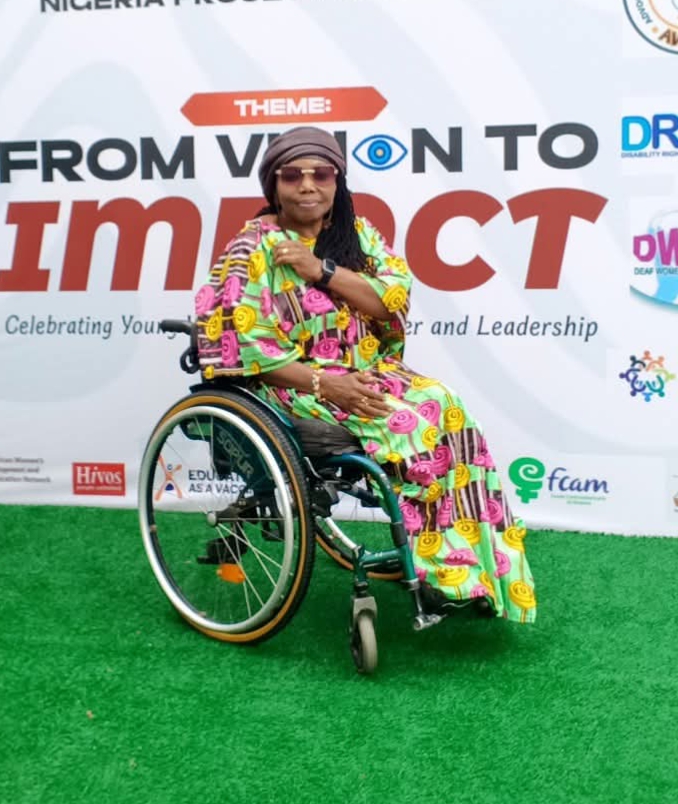
Founder/Executive Director, Advocacy for Women With Disabilities Initiative (AWWDI), in an Exclusive Interview with Chris Agbo of The Qualitative Magazine
Sexual and gender-based violence (SGBV) remains one of the most serious human rights challenges confronting women and girls. For women and girls with disabilities, however, the experience can be even more devastating, as they often face additional barriers related to communication, accessibility, stigma, poverty, dependence on caregivers and access to justice.
The Advocacy for Women with Disabilities Initiative (AWWDI) has consistently advocated for the rights, empowerment and inclusion of women and girls with disabilities, including on issues of gender-based violence and sexual and reproductive health rights.
In this exclusive interview with Chris Agbo of The Qualitative Magazine (TQM), Mrs. Patience Ogolo Dickson, Founder and Executive Director of AWWDI, discusses the vulnerability of women and girls with disabilities to SGBV, the barriers that prevent survivors from reporting abuse, the role of caregivers, inaccessible shelters and justice institutions, and what government must do to protect survivors.
TQM: How widespread is SGBV against persons with disabilities, based on your experience?
Patience Ogolo Dickson: SGBV is a serious issue affecting society generally, particularly women and girls. But when we talk about women and girls with disabilities, we are dealing with a different level of vulnerability.
Women with disabilities experience multiple forms of discrimination. Their disability may make it more difficult for them to escape abuse, report what happened or access the support they need afterwards.
We must also understand that disability does not make someone vulnerable to violence. It is the barriers created by society, institutions and systems that increase their vulnerability.
Women and girls with disabilities are often excluded from information about their rights and from programmes designed to prevent and respond to SGBV. This needs to change.
TQM: Why do you think many cases of SGBV against women with disabilities remain unreported?
Patience Ogolo Dickson: One of the biggest problems is access to justice.
Many victims already know that getting justice can be difficult. For a woman with a disability, the barriers can be even greater.
There is stigma, discrimination, poverty, lack of information, inaccessible police stations and courts, communication barriers and sometimes the fear of losing the very person they depend on for support.
Some survivors may therefore decide to remain silent because they do not believe the system will protect them.
We must create an environment where survivors feel safe enough to speak and where speaking out leads to protection, investigation and justice.
TQM: Which groups of persons with disabilities are particularly vulnerable to SGBV?
Patience Ogolo Dickson: Women and girls with disabilities generally face significant risks, but the nature and level of vulnerability differ according to individual circumstances.
Women and girls with intellectual, psychosocial, sensory and multiple disabilities may face particularly serious barriers to communication, reporting and accessing support.
We also have to pay attention to women who depend on other people for personal care, mobility, communication or financial support.
That dependency can sometimes be exploited by perpetrators.
TQM: Are Deaf women and girls facing unique barriers when reporting SGBV?
Patience Ogolo Dickson: Absolutely.
Communication is one of the major barriers faced by Deaf women and girls who experience SGBV.
Imagine a Deaf woman going to a police station to report sexual violence and there is nobody there who understands sign language. How is she expected to explain what happened while maintaining her privacy and dignity?
In some situations, she may have to rely on a family member or another person to interpret a deeply personal experience. That raises serious concerns about privacy, confidentiality and even the accuracy of the information being communicated.
We need qualified sign language interpreters within the justice, healthcare and protection systems.
TQM: What about women and girls with intellectual or psychosocial disabilities?
Patience Ogolo Dickson: They face very serious challenges.
Women and girls with intellectual or psychosocial disabilities can experience multiple forms of vulnerability, particularly when they depend on family members, caregivers or other people for daily support.
Another concern is that society sometimes does not believe them when they speak about abuse.
We must stop treating people with intellectual or psychosocial disabilities as though they cannot understand or communicate their experiences.
Their voices matter. Their rights matter. And when they report abuse, the system must take them seriously.
TQM: How frequently are caregivers implicated in reported cases of SGBV involving persons with disabilities?
Patience Ogolo Dickson: Caregivers occupy a very sensitive position because they are often very close to the person with a disability.
For some women and girls with disabilities, particularly those requiring significant support, the caregiver may have access to virtually every aspect of their daily lives.
That proximity can create an opportunity for abuse if adequate safeguarding mechanisms are not in place.
We must therefore strengthen monitoring, accountability and safeguarding systems without creating an environment where genuine caregivers are unnecessarily criminalised.
The most important thing is that every person with a disability must be protected from exploitation and abuse.
TQM: What happens when the alleged perpetrator is also the survivor’s caregiver or provider?
Patience Ogolo Dickson: That is one of the most complicated situations.
Imagine a woman with a disability whose alleged abuser is the person who provides her food, accommodation, medication, transportation or personal care.
Reporting the abuse could mean that she loses access to those essential services.
This is why government and service providers must establish systems that protect survivors without leaving them without the support they need.
A survivor should never be forced to choose between justice and survival.
TQM: Are SGBV shelters accessible to survivors with disabilities?
Patience Ogolo Dickson: Accessibility remains a major concern.
A shelter may exist, but that does not automatically mean it is accessible to a woman with a disability.
Accessibility includes physical access, accessible toilets, bedrooms, transportation, communication, information and trained personnel.
A Deaf survivor needs communication support. A blind survivor needs information in accessible formats. A wheelchair user needs an environment that allows independent movement.
So when government says there are shelters for SGBV survivors, we also need to ask: Are those shelters accessible to survivors with disabilities?
TQM: Is Nigeria collecting adequate data on SGBV and disability?
Patience Ogolo Dickson: Data remains a major challenge.
We cannot effectively address a problem that we do not properly understand.
There is a need for reliable, disability-disaggregated data on SGBV so that government can understand the scale of the problem, where survivors are located, what types of barriers they face and what interventions are working.
Organisations of Persons with Disabilities are generating important information through their programmes and community engagements, but there needs to be a stronger national system.
Government must work with OPDs because “nothing about us without us” must apply to data collection as well.
TQM: What are the biggest gaps in Nigeria’s justice system when it comes to survivors with disabilities?
Patience Ogolo Dickson: Accessibility is one of the biggest gaps.
Many police stations and courts are not physically accessible to wheelchair users. Communication support is also inadequate, particularly for Deaf survivors.
For blind survivors, legal information and other important materials may not be available in Braille or accessible digital formats.
There is also a need for justice-sector personnel to understand disability rights and how to interact appropriately with survivors with different disabilities.
Justice is not simply about opening the doors of a court. Justice means ensuring that every survivor can enter, communicate, understand the process, participate and be heard.
TQM: Which laws or policies are not being effectively implemented?
Patience Ogolo Dickson: Nigeria has laws and policies that provide important protections, but implementation remains a major challenge.
The Discrimination Against Persons with Disabilities (Prohibition) Act, 2018 is an important legal framework, but the existence of legislation is not enough.
We need enforcement, monitoring, accountability and adequate funding.
Women with disabilities should be able to see the impact of these laws in their everyday lives—in schools, hospitals, workplaces, police stations, courts, transportation systems and communities.
TQM: What three reforms would make the biggest difference?
Patience Ogolo Dickson: I would highlight three major areas.
First, accessibility must become a condition for government approval and funding.
Nigeria needs a strong “No Accessibility, No Approval” approach for public buildings, schools, hospitals, transportation systems and government services.
The accessibility regulations must be properly implemented and monitored.
Second, economic empowerment must become a central part of disability inclusion.
Women with disabilities should not be treated simply as beneficiaries of welfare programmes.
We need to create pathways to education, skills development, employment, entrepreneurship, access to finance and leadership.
Economic independence can also reduce vulnerability to exploitation and abuse.
Third, Nigeria needs a strong National Disability Data and Accountability System.
We need reliable data that can inform policy, budgeting and programmes across healthcare, education, employment, social protection, justice and SGBV response.
And women with disabilities must be involved in designing, implementing and monitoring these interventions.
TQM: What is your message to policymakers about SGBV against women and girls with disabilities?
Patience Ogolo Dickson: My message is simple: do not wait until another woman with a disability is abused before you act.
We need prevention, protection, response and justice.
Government must ensure that police stations, courts, hospitals, shelters and other services are accessible.
We also need to invest in women with disabilities because empowerment is protection.
When a woman with a disability has education, income, information, confidence and access to justice, she is better positioned to resist exploitation and seek help when her rights are violated.
TQM: Finally, what message do you have for women and girls with disabilities who are experiencing SGBV?
Patience Ogolo Dickson: I want every woman and girl with a disability to know that your disability does not take away your rights.
You deserve safety. You deserve dignity. You deserve to be heard. You deserve justice.
Do not allow society to make you believe that you should accept abuse because you have a disability.
And to families, communities, government institutions and service providers, we have a responsibility to create an environment where women with disabilities can speak without fear and seek help without facing another layer of discrimination.
We must move from sympathy to action, from promises to implementation, and from exclusion to genuine inclusion.
About AWWDI
The Advocacy for Women with Disabilities Initiative (AWWDI) is a women-led disability organisation working to advance the rights, inclusion and empowerment of women and girls with disabilities. Its areas of work include gender-based violence, sexual and reproductive health rights, leadership, empowerment, political participation and policy advocacy.
Under Patience Ogolo Dickson’s leadership, AWWDI has also championed inclusive leadership and developed women with disabilities as community advocates and decision-makers. In 2026, the organisation graduated 100 young women with disabilities from an inclusive leadership and decision-making mentorship programme in Abuja.
Interview conducted by:
Chris Agbo
Publisher, The Qualitative Magazine (TQM)


