

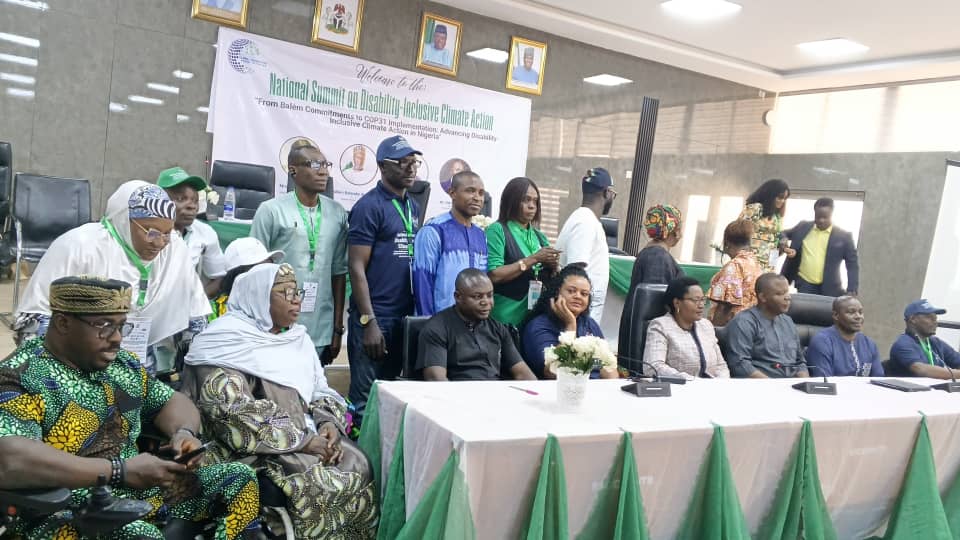
Abuja, Nigeria
The Founder and President of the Global Disabilities Green Initiative (GDGI), Angelina Ugben, has called for urgent and deliberate action to ensure that persons with disabilities are fully included in climate policies, climate financing, green employment opportunities, and environmental sustainability initiatives in Nigeria.
Ugben made the call while delivering her opening remarks at the National Summit on Disability-Inclusive Climate Action, held in Abuja from October 14 to 15, 2026, under the theme: “From Belém Commitments to COP31 Implementation: Advancing Disability-Inclusive Climate Action in Nigeria.”
She emphasised that climate action must move beyond policy promises to practical, measurable interventions that recognise persons with disabilities as active participants, leaders, innovators, and decision-makers in the fight against climate change.
“Climate change affects us all, but persons with disabilities often face additional barriers to accessing information, protection, climate finance, and opportunities in the emerging green economy,” she stated.
According to her, meaningful climate action cannot be achieved without the active participation of persons with disabilities in the development and implementation of policies and programmes designed to address the climate crisis.
Disability Inclusion Is a Matter of Justice, Not Charity
Speaking from her experience as a woman with a disability and an advocate for inclusion, Ugben described disability-inclusive climate action as a matter of justice, equality, and fundamental human rights.
She stressed that persons with disabilities should not be viewed merely as beneficiaries of climate interventions but should be recognised as equal partners whose knowledge, experiences, and contributions are essential to building resilient and sustainable communities.
“Disability inclusion is not charity; it is justice, equality, and a fundamental human right,” she declared, urging stakeholders to dismantle the barriers that prevent persons with disabilities from participating fully in climate-related initiatives.
She noted that inclusive climate policies must address accessibility challenges while ensuring that persons with disabilities have equitable opportunities in renewable energy, climate-smart agriculture, green entrepreneurship, and other emerging sectors of the green economy.
GDGI Pushes for Action Beyond National Borders
The GDGI President reaffirmed her organisation’s commitment to advancing disability-inclusive climate action, green economic opportunities, and sustainable development, noting that the initiative’s growing presence across several countries reflects its determination to promote inclusive environmental solutions beyond national boundaries.
She described the Abuja summit as an important platform for translating global commitments into practical national action, with Nigeria positioned to strengthen disability inclusion in its climate response ahead of COP31 in Türkiye.
Ugben expressed optimism that the summit would foster stronger partnerships among government institutions, development partners, civil society organisations, and organisations of persons with disabilities to advance climate justice and sustainable development.
Abuja Declaration to Drive Implementation
A major anticipated outcome of the two-day summit is the development of a meaningful Abuja Declaration on Disability-Inclusive Climate Action, intended to provide direction for strengthening implementation in Nigeria and contributing to the global climate action agenda ahead of COP31.
Ugben urged participants to use the summit to develop actionable recommendations that would strengthen inclusive climate policies, improve access to climate finance, expand accessible green employment, promote renewable energy, support climate-smart agriculture, and build more resilient communities.
She emphasised that the success of the gathering would depend not only on the quality of discussions but also on the commitment of stakeholders to translate recommendations into concrete results.
She also acknowledged participants joining virtually from different parts of Nigeria and other countries, assuring them that their voices and contributions remained an important part of the collective effort to advance disability-inclusive climate action.
Government, UN Agencies and Development Partners Commended
Ugben expressed appreciation to the Federal Ministry of Environment, the National Council on Climate Change (NCCC), and the Office of the Senior Special Assistant to the President on Climate Technology and Operations for their roles as co-hosts of the summit.
She also acknowledged the contributions of the International Labour Organization (ILO), the United Nations Population Fund (UNFPA), CBM International, the Justice Development and Peace Caritas Initiative (JDPCI), the National Assembly, development partners, the GDGI Board of Trustees, the planning committee, organisations of persons with disabilities, civil society organisations, and other stakeholders.
She described their support and participation as critical to building a stronger coalition for inclusive climate policies and sustainable environmental action.
The summit brought together government representatives, policymakers, development partners, disability advocates, civil society organisations, and other stakeholders to deliberate on strategies for ensuring that climate policies and interventions are accessible, equitable, and responsive to the needs and rights of persons with disabilities.
Building a Greener Nigeria Where No One Is Left Behind
In her concluding remarks, the GDGI President challenged participants to leave the summit with renewed commitment to creating a greener and more inclusive Nigeria where disability does not become a barrier to accessing climate protection, economic opportunities, or participation in environmental decision-making.
She expressed hope that the deliberations would produce lasting partnerships and practical solutions capable of strengthening Nigeria’s disability-inclusive climate agenda.
As Nigeria looks towards COP31, the message from the Abuja summit is clear: climate action cannot be truly inclusive or sustainable if persons with disabilities are left behind. Their participation must be embedded in climate policies, financing mechanisms, green economic opportunities, and implementation frameworks at every level.
For GDGI, the task ahead is to help transform commitments into action and ensure that disability inclusion becomes an integral part of Nigeria’s response to the climate crisis.


