

By TQM News,
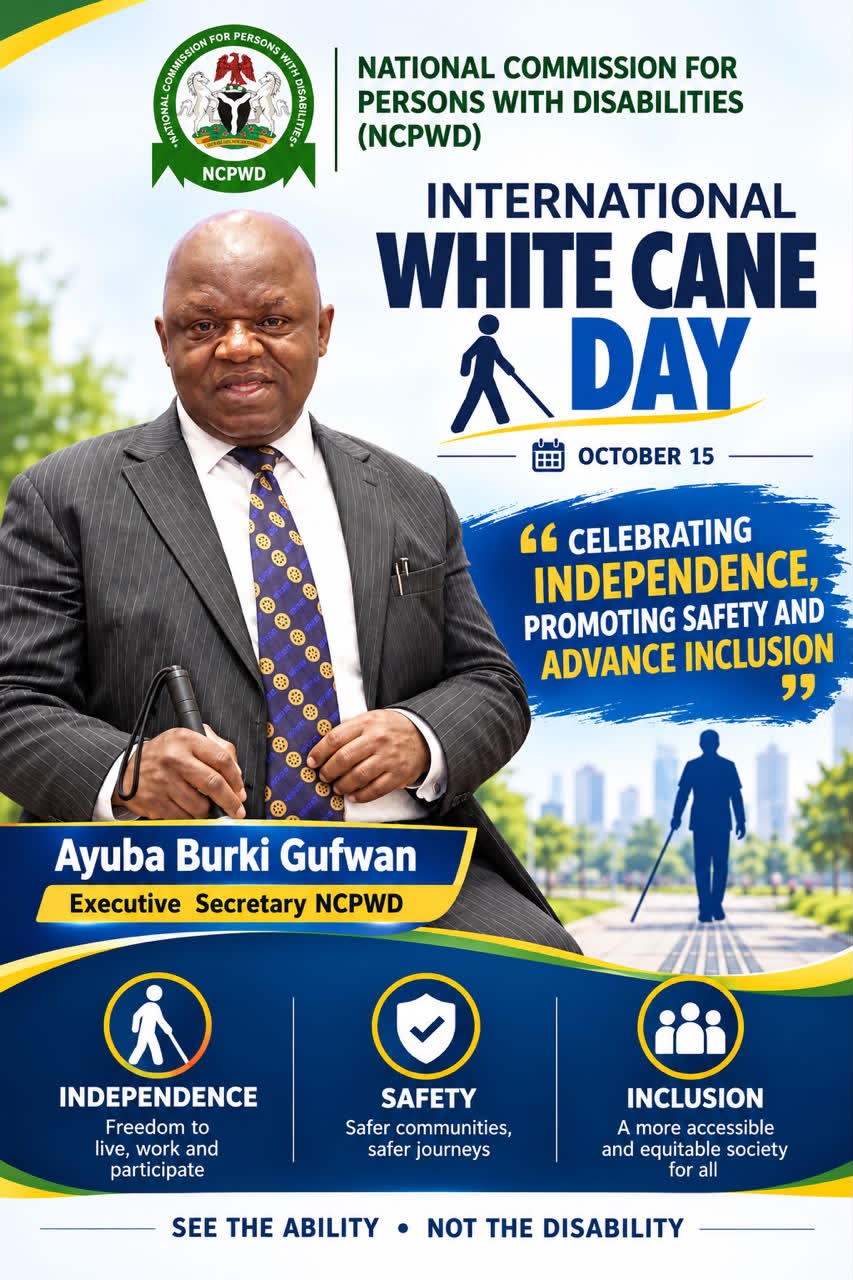
The Executive Secretary of the National Commission for Persons with Disabilities (NCPWD), Hon. Ayuba Burki Gufwan, has reaffirmed the Commission’s commitment to protecting the rights of blind persons in Nigeria, calling on motorists, government agencies and the general public to respect white cane users and promote a safer, more inclusive society.
Gufwan made the call in a press statement issued on Thursday, October 15, 2026, to commemorate this year’s International White Cane Safety Day.
Speaking on behalf of President Bola Ahmed Tinubu and the management and staff of the Commission, the NCPWD boss celebrated blind persons in Nigeria and across the world, describing the white cane as a powerful symbol of independence, dignity, mobility and resilience.
He stressed that the white cane is far more than a mobility aid, noting that it represents the right of blind persons to move freely, live independently, access education, pursue employment and participate fully in society without discrimination or unnecessary barriers.
According to him, the Commission remains concerned about the persistent challenges confronting blind persons, including inaccessible public infrastructure, inadequate assistive devices, limited access to Braille materials, barriers to inclusive education and discrimination in public spaces.
Gufwan noted that these challenges continue to restrict the participation of blind persons in everyday activities, reinforcing the need for stronger government action and greater public awareness.
NCPWD outlines five priority areas
As part of efforts to advance the rights and inclusion of blind persons, the Executive Secretary outlined five key areas of commitment by the Commission.
These include promoting access to quality assistive devices, particularly standard white canes and guide canes; strengthening inclusive education through the provision of Braille materials, accessible learning environments and trained special education teachers; and enforcing accessibility standards for roads, public buildings, transport systems and information in line with the Discrimination Against Persons with Disabilities (Prohibition) Act, 2018.
The Commission also pledged to advocate for the safety of white cane users on roads and in communities while deepening partnerships with Organisations of Persons with Disabilities, particularly the Nigeria Association of the Blind.
Gufwan said such collaborations would be essential to ensuring that blind persons are not excluded from the opportunities and benefits of the Federal Government’s Renewed Hope Agenda.
“Stop, give way and offer support only when requested”
In a direct appeal to Nigerians, the NCPWD boss urged motorists and members of the public to exercise caution around white cane users and respect their right to safe movement.
He emphasised that when members of the public encounter a person using a white cane, they should stop, give way and offer assistance only when requested.
The message, he explained, is about respecting the dignity and independence of blind persons rather than treating them as objects of pity.
The call highlights the importance of public understanding of the white cane and the responsibility of motorists, pedestrians and public institutions to help create safer environments for persons with visual impairments.
Beyond commemoration: The need for inclusive action
International White Cane Safety Day serves as an opportunity to raise awareness of the independence, mobility and rights of blind persons, while drawing attention to the barriers they encounter in navigating public spaces.
For Nigeria, the observance also underscores the need to translate disability inclusion commitments into practical action, including accessible infrastructure, affordable assistive technology, inclusive education, equal employment opportunities and effective enforcement of disability rights legislation.
As the NCPWD joins the global community in marking the day, Gufwan reiterated the Commission’s determination to ensure that blindness does not become a reason for exclusion, discrimination or the denial of opportunities.
“Happy International White Cane Safety Day,” he declared, reaffirming the Commission’s commitment to a society where blind persons can move safely, live independently and participate fully in national development.
The message is clear: respect the white cane, protect the right to safe mobility and recognise the independence and dignity of blind persons.


