

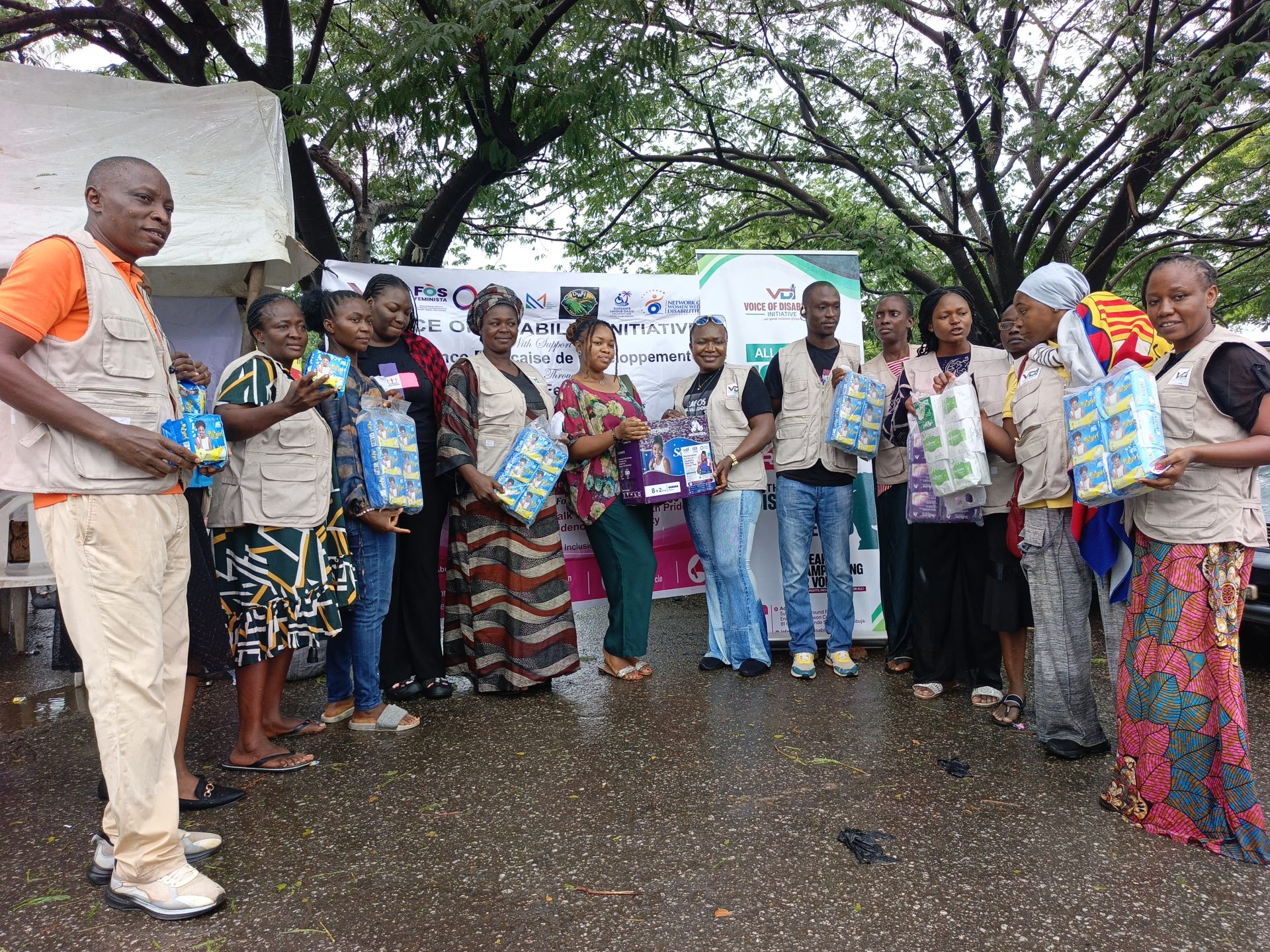
A disability rights organisation, Voice of Disability Initiative (VDI), has called for the deliberate inclusion of girls and women with disabilities in menstrual hygiene campaigns and interventions, warning that period poverty, stigma, inaccessible facilities, and lack of disability-friendly information continue to deny many of them the dignity, confidence, and opportunities they deserve.
The organisation made the call on Wednesday in Abuja during an advocacy outreach at the popular Wuse Market to commemorate this year’s International Menstrual Hygiene Day, an event aimed at raising awareness on menstrual health, breaking harmful stereotypes, and promoting menstrual dignity for all women and girls.
Speaking at the event, the Executive Director of VDI, Barr. Catherine Edeh, lamented that despite growing conversations around menstrual health, women and girls with disabilities are still largely excluded from policies, programmes, and interventions designed to support menstrual hygiene management.
According to Edeh, who is deaf, menstruation is a natural biological process that affects every girl regardless of disability status, yet societal neglect has created additional challenges for girls with disabilities, making an already sensitive experience more difficult.
“Our message is simple: menstruation is natural and it does not discriminate. Whether a person has a disability or not, menstruation remains part of life. Unfortunately, whenever menstrual health discussions take place, women and girls with disabilities are often forgotten,” she said.
She explained that the consequences of this exclusion are far-reaching, ranging from school absenteeism and low self-esteem to social isolation and reduced participation in educational and community activities.
Period Poverty Affecting Education of Girls With Disabilities
Edeh expressed concern that many adolescent girls with disabilities struggle to access sanitary products and accurate menstrual health information, leaving them vulnerable to embarrassment and poor academic performance.
She noted that for many girls, the inability to afford sanitary pads often translates into missed classes and disrupted learning.
“Most of our girls are in school. When they menstruate, they need sanitary pads and support systems that allow them to remain confident and focused on their studies. Period poverty should not be allowed to disrupt their education or limit their future,” she stated.
The disability advocate stressed that ensuring access to menstrual hygiene products is not merely a health issue but also a matter of educational equity and social inclusion.
Deaf Girls Often Left Without Critical Information
Highlighting the unique challenges faced by different disability groups, Edeh said many deaf girls begin menstruation without understanding what is happening to their bodies because they often lack access to accessible sexual and reproductive health information.
She blamed this on societal attitudes that treat conversations around menstruation and reproductive health as taboo, particularly for women and girls with disabilities.
“Many deaf girls start menstruating without knowing what it means because information is not presented in formats accessible to them. Society often treats sexual and reproductive health discussions as taboo, especially when it comes to deaf women and girls.
“Deaf women should understand that there is nothing wrong with menstruation. It is natural. It is not something they should be afraid of or ashamed of,” she said.
Inaccessible Toilets Create Additional Burden
Edeh also drew attention to the difficulties faced by women with physical disabilities, particularly wheelchair users, when attempting to manage menstruation in public spaces.
According to her, inaccessible toilets remain one of the most overlooked barriers affecting menstrual hygiene management among women with disabilities.
She explained that while many women can easily access public toilets to change sanitary pads, wheelchair users often encounter narrow entrances and facilities that do not accommodate their mobility needs.
“A woman who uses a wheelchair may need to change her sanitary pad while she is out. However, many public toilets are inaccessible. When the toilet door is too narrow, she cannot enter. It is impossible to change sanitary pads outside in public. What then happens to her?
“This is why we must make all public toilets accessible. Accessibility is not a luxury; it is a necessity,” she emphasized.
VDI Establishes Pad Banks and Confidence Corners
As part of efforts to address period poverty and improve menstrual health support for girls with disabilities, Edeh disclosed that VDI has established Pad Banks in three special schools within the Federal Capital Territory (FCT).
The initiative, she explained, is designed to ensure that students can access sanitary products whenever the need arises.
Beyond providing sanitary pads, the organisation has also created what it calls “Confidence Corners”—safe spaces where girls can receive counselling, ask questions, and obtain accurate information about menstruation from trained adults.
“The Pad Bank is not just about providing sanitary products. We are also creating safe spaces where girls who are experiencing menstruation for the first time can seek guidance, ask questions, and build confidence.
“We want every girl to know that menstruation is normal and that support is available whenever she needs it,” Edeh said.
Breaking the Culture of Silence
The VDI Executive Director further challenged cultural and societal attitudes that portray menstruation as a taboo subject, insisting that girls should be encouraged to discuss menstrual health openly and confidently.
“Menstruation is not something to hide or be ashamed of. Girls should be able to say confidently that they are on their period and receive the support they need. It is a sign of healthy development and should be treated with dignity and respect,” she stated.
She urged corporate organisations, development partners, philanthropists, and individuals seeking to undertake social responsibility projects to support initiatives aimed at addressing period poverty among girls with disabilities.
Call for Inclusive Menstrual Health Policies
Edeh revealed that the advocacy forms part of a broader menstrual health project being implemented by VDI with support from Agence Française de Développement (AFD) through Fòs Feminista.
Although the current project is expected to conclude later this year, she assured stakeholders that the organisation remains committed to advancing menstrual health rights and dignity for women and girls with disabilities.
She emphasized that genuine menstrual equity can only be achieved when disability inclusion becomes a central component of all menstrual health policies, programmes, and interventions.
“Our advocacy is for everyone, but our focus is on those who are usually left behind. Girls with disabilities are part of society, and their needs must be included in every conversation, policy, and programme relating to menstrual health and girl-child development.
“We must work together to achieve menstrual hygiene for all women and girls, especially those living with disabilities,” she said.
The event attracted market women, disability advocates, community members, and volunteers who joined VDI in promoting awareness on menstrual health, dignity, and inclusion, while calling for collective action to end period poverty and ensure that no girl is left behind because of disability.
Click the link below to join our WhatsApp channel


