

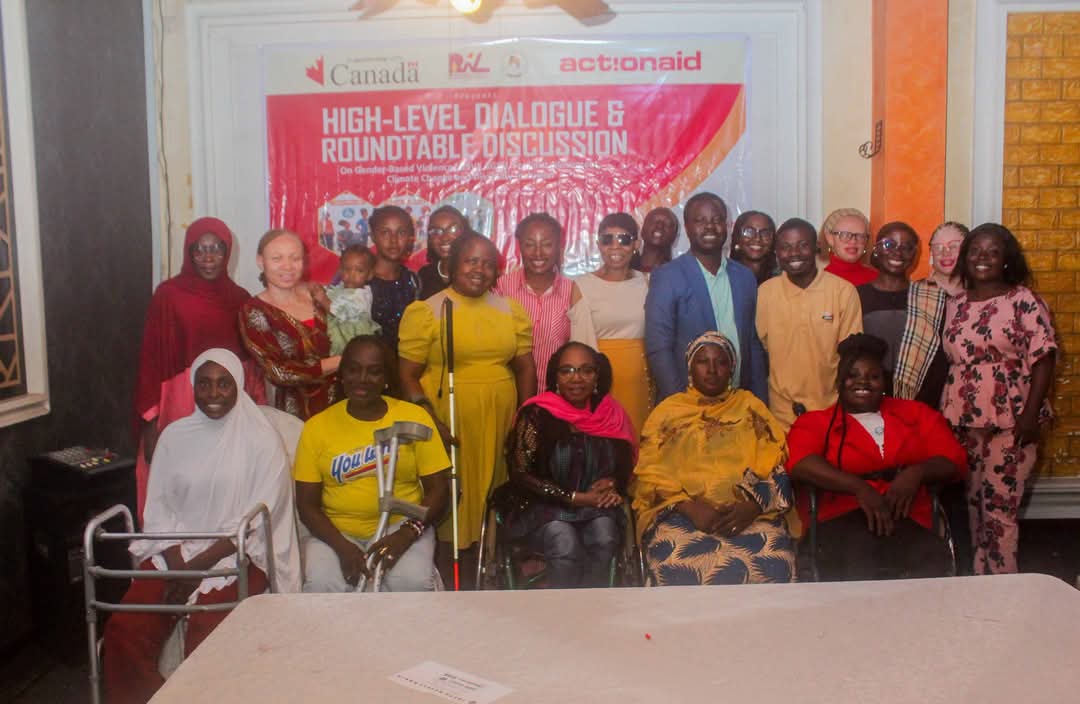
Stakeholders call for women with disabilities to move from policy beneficiaries to decision-makers
Women with disabilities must no longer be treated as passive beneficiaries of government policies and development programmes, the Advocacy for Women with Disabilities Initiative (AWWDI) has declared, as stakeholders gathered to confront gaps in Gender-Based Violence (GBV) response, climate justice and disability inclusion.
At a high-level dialogue and roundtable discussion organised by AWWDI, government representatives, women-led organisations, Organisations of Persons with Disabilities (OPDs) and other stakeholders examined how existing systems continue to leave women and girls with disabilities vulnerable to exclusion, violence and the consequences of climate change.
The message from the meeting was unequivocal: policies affecting women with disabilities cannot be designed without their voices.
The dialogue is part of AWWDI’s wider advocacy efforts to strengthen the participation of women and girls with disabilities in decision-making and development processes.
Speaking on the significance of the gathering, AWWDI Acting National Coordinator, Mrs. Billkisu Yakubu, said the organisation deliberately brought stakeholders together to move beyond conversations and develop practical recommendations that could translate into workable policies.
“We are bringing our different ideas to the table so that we can come up with recommendations and draft a workable policy,” Yakubu said.
She explained that the issues under discussion were interconnected, particularly the relationship between disability, climate change, GBV and women’s leadership.
Climate-related disasters, she noted, can disproportionately affect women with disabilities by increasing their vulnerability to displacement, poverty, violence and exclusion from emergency responses.
From Vulnerability to Leadership
For AWWDI, however, the solution is not simply to protect women with disabilities but to empower them to become leaders and advocates within their communities.
Yakubu said the organisation wants women with disabilities to acquire the confidence and capacity to engage community leaders and speak for themselves whenever decisions affecting their lives are being made.
“We are looking forward to seeing empowered women with disabilities who have become strong advocates and a voice for other women with disabilities,” she said.
AWWDI also plans to build a network of stakeholders capable of sustaining advocacy beyond the project.
Yakubu said the network would create a platform for collaboration and ensure that stakeholders remain available to respond to issues affecting women with disabilities.
The expectation, she explained, is to have people who can become voices for inclusion within their organisations, communities and wider society.
‘Stop Treating Disability as Charity’
Yakubu also delivered a message to government and the general public: disability inclusion must be treated as a rights and development issue rather than charity.
She urged government institutions to involve women with disabilities in the formulation, implementation and monitoring of policies that affect them.
“Disability issues should not be played with,” she said.
She also reminded members of the public that disability can affect anyone and therefore should concern everyone.
“The time has come for every individual to start seeing that disability issues are everybody’s business,” she said.
Policies Exist, But Where Is the Action?
For stakeholders at the dialogue, one of the greatest challenges is not necessarily the complete absence of policies but the gap between policy and implementation.
Destiny Philips, Admin and Financial Officer of the Network of Nigerian Women Mediators, said many people still lack adequate knowledge of inclusive policies addressing SGBV and climate change.
Even where policies are known, she said, implementation remains weak.
Philips called for more committed stakeholders to join the advocacy process and help push inclusive policies from paper into practice.
She also stressed that digital campaigns must be complemented by physical engagements.
Online awareness, she said, can reach large audiences, but continuous meetings and conversations are necessary to reinforce the message.
“Repetition surely helps to get this to the knowledge of many people,” she noted.
Building an Inclusive Movement
The dialogue is part of AWWDI’s broader disability-inclusion work covering gender equality, GBV prevention and response, sexual and reproductive health and rights, climate justice, economic empowerment and inclusive feminist movement strengthening.
The project is supported by ActionAid Nigeria with funding from Global Affairs Canada.
Since the project’s commencement, AWWDI has held an inception meeting, conducted stakeholder mapping and identified key government institutions, OPDs, JONAPWD, civil society organisations and strategic partners whose involvement is critical to achieving its objectives.
The organisation has also developed advocacy messages for accessible Information, Education and Communication (IEC) materials and commenced online campaigns to increase awareness of disability inclusion and related issues.
The latest dialogue brought women-led organisations and women with disabilities together with other stakeholders to examine the gaps and identify possible solutions.
But the real test begins after the microphones are switched off.
For the women whose lives are affected by inaccessible policies, climate disasters, violence and exclusion, the outcome they need is not another declaration—it is action.


