

By Christian Agbo,
The National Agency for the Prohibition of Trafficking in Persons (NAPTIP), with support from the European Union Support to End Sexual and Gender-Based Violence (ESGBV) Programme implemented by International IDEA, has intensified efforts to strengthen media reporting and public engagement on sexual and gender-based violence (SGBV).
The initiative, which focuses on the Federal Capital Territory (FCT) and selected states, seeks to move SGBV reporting away from sensationalism and fragmented coverage towards professional, survivor-centred, ethical, evidence-based and action-oriented journalism.
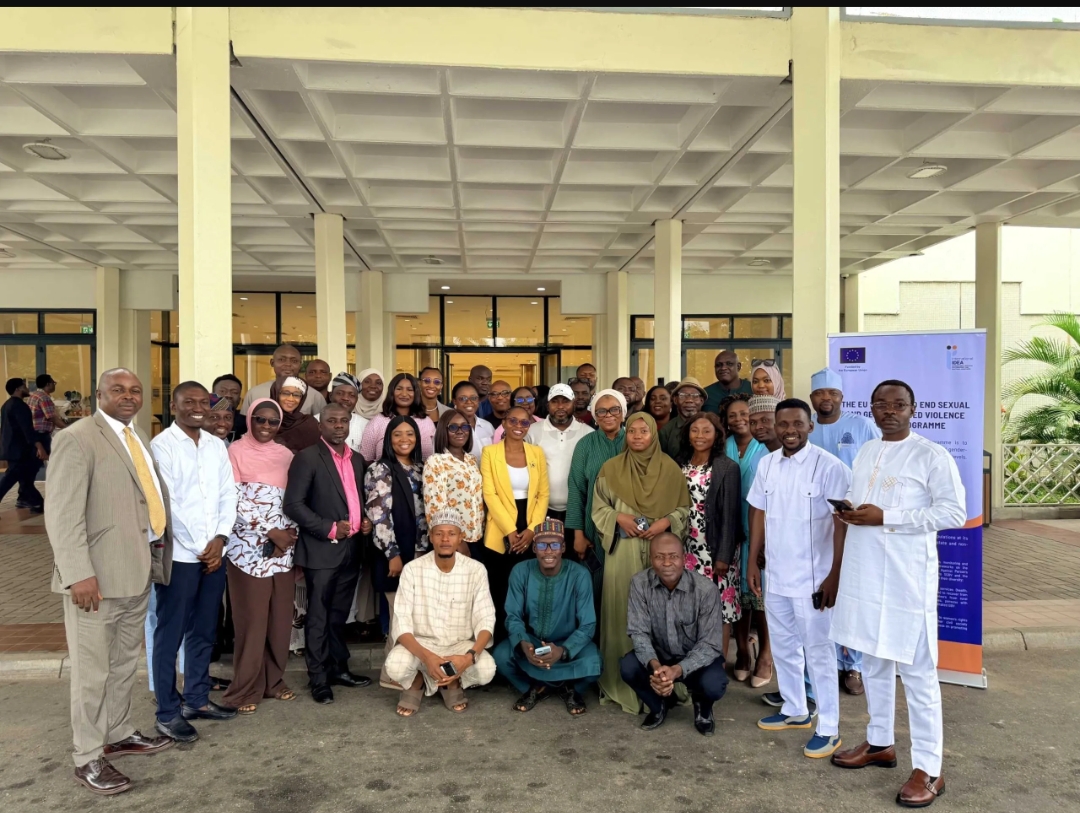
The two-day SGBV Media Corps Workshop brought together journalists to deepen their understanding of SGBV, strengthen ethical reporting practices and equip the media to play a more active role in prevention, public awareness, referral pathways and positive social norm change.
Speaking during the workshop, Winifred Achu Egbosen, Civil Society and Community Mobilisation Lead for the EU Support to End Sexual and Gender-Based Violence Programme implemented by International IDEA, explained that the initiative was designed to build a sustained community of media practitioners committed to responsible SGBV reporting.
According to her, the SGBV Media Corps is a group of journalists working with NAPTIP to consistently promote ethical reporting and contribute to changing narratives around sexual and gender-based violence.
She explained that the programme had supported NAPTIP in establishing Media Corps structures in the FCT and Kaduna State, with 20 journalists from different media organisations participating from each location.
“The idea behind the Media Corps is that these would be a group of people who would not only be reporting ethically on sexual and gender-based violence, but also contributing towards changing the narratives around SGBV,” she said.
Egbosen added that the journalists were expected to promote positive social norms, raise community awareness and ensure that SGBV remained in the public spotlight, while helping to strengthen the response of relevant institutions.
She noted that increased public attention, quality reporting and improved institutional responses could contribute to stronger prosecution of perpetrators and ultimately help reduce the incidence of SGBV.
Beyond the Law: The Gaps That Still Matter
While acknowledging that Nigeria has laws addressing violence against persons, Egbosen pointed out that legislation alone cannot end SGBV.
She noted that the Violence Against Persons (Prohibition) Act (VAPP Act), despite providing an important legal framework, still has implementation gaps and requires stronger awareness and utilisation at state and community levels.
She also stressed the importance of addressing social, cultural and religious norms that can perpetuate violence against women and girls.
According to her, communities must be sensitised from both the top down and the bottom up to understand that certain practices traditionally accepted as cultural norms may actually encourage violence and protect perpetrators.
Another major concern, she noted, is the economic burden placed on survivors.
Survivors may be required to bear transportation costs to police stations, hospitals or courts while simultaneously dealing with emotional and physical trauma.
“It’s like being attacked on so many sides—emotionally, physically, economically,” she explained.
NAPTIP: Media Must Go Beyond Reporting the Numbers
Also speaking, Vincent Adekoye, Head of Press and Public Relations/Population Unit at NAPTIP, said the workshop was aimed at bringing more critical stakeholders into the fight against SGBV.
He said the media had an important role to play beyond simply reporting individual cases.
“We want the media to go out of the normal routine of writing reports to be able to question some things that are coming up,” Adekoye said.
He urged journalists to investigate the reasons behind rising cases of SGBV, examine the roles of institutions and interrogate the influence of customs, norms and behaviours that may contribute to violence.
Adekoye also emphasised the need for survivor-centred reporting, stressing that journalists must protect the dignity and privacy of survivors.
“We want the media to know that the victims are very critical to us. We must protect them. We must ensure their dignity is protected, their privacy,” he said.
He added that responsible reporting should help survivors rebuild trust in society rather than expose them to further stigma and harm.
Over 3,000 Rescued, More Than 20 SGBV Convictions Secured — NAPTIP
Adekoye disclosed that NAPTIP had rescued more than 3,000 people from critical situations since January 2026, while the agency had also secured more than 20 convictions in SGBV-related cases, including three life imprisonment sentences.
He said NAPTIP had expanded its approach by working with frontline institutions, including the police and civil defence, while also engaging communities.
He described the media as a critical partner in the fight against SGBV and said the newly established Media Corps would strengthen this collaboration.
Why Persons with Disabilities Must Be at the Centre of the SGBV Response
One of the significant issues highlighted during the workshop was the vulnerability of persons with disabilities to sexual and gender-based violence.
A participant at the workshop, Comrade Chris Agbo, Publisher of The Qualitative Magazine and a disability inclusion advocate, stressed that persons with disabilities are among the groups most vulnerable to SGBV.
According to him, women with disabilities can experience what he described as “double jeopardy”—facing discrimination because of their gender and additional discrimination because of disability.
He explained that disability can make it more difficult for survivors to prevent abuse, identify perpetrators, report incidents and navigate justice systems.
Agbo gave the example of a blind woman who was allegedly raped by a man who deliberately refused to speak during the assault, making it extremely difficult for the survivor to identify him.
He also highlighted communication barriers confronting deaf survivors who may struggle to report cases to the police because of the absence of sign language interpreters.
“Sometimes, because of the way people look at persons with disabilities, their stories are not believable,” he said, noting that dismissive comments and disbelief can discourage survivors from reporting abuse.
He called for stronger institutional capacity, particularly within police stations, to ensure that persons with disabilities can report SGBV safely and communicate effectively with investigators.
Disability, Intellectual Impairment and Hidden Abuse
Agbo further drew attention to the heightened vulnerability of persons with intellectual disabilities and other impairments that may affect their ability to understand, communicate or report abuse.
He cited cases of women and girls with disabilities being sexually abused by people within their own communities and families, stressing that perpetrators may deliberately exploit their vulnerabilities.
He argued that the SGBV response must therefore be deliberately inclusive and should not treat persons with disabilities as an afterthought.
“Persons with disabilities are among the most vulnerable when it comes to SGBV,” he said.
Technology Is Creating New Frontiers of Gender-Based Violence
Another emerging concern discussed during the workshop was technology-facilitated gender-based violence (TF-SGBV).
The organisers noted that the digital environment is creating new ways through which perpetrators can harass, threaten, exploit, blackmail and abuse victims.
Adekoye urged journalists to understand these emerging dimensions and ensure that reporting keeps pace with the changing nature of SGBV.
The inclusion of technology-facilitated violence in the programme reflects the growing need for journalists and community stakeholders to understand how online abuse intersects with offline violence and discrimination.

Communities Must Stop Settling SGBV Cases Informally
Adekoye also criticised the practice of communities attempting to settle SGBV cases outside the formal justice system.
He said that once an offence has been committed, community leaders or family members should not simply pressure survivors into abandoning cases or negotiate with perpetrators.
According to him, SGBV cases should be allowed to follow due legal processes rather than being treated as private family or community disputes.
He encouraged survivors and members of the public to report cases, assuring them that their identities can be protected.
A New Role for the Media
The workshop ultimately challenged journalists to see themselves not merely as reporters of SGBV incidents but as critical actors in prevention and social change.
The emerging Media Corps is expected to strengthen collaboration between journalists, NAPTIP, civil society organisations, government agencies and communities.
For survivors, particularly persons with disabilities, ethical reporting could mean the difference between being heard and being silenced; between receiving support and facing further stigma; and between pursuing justice and abandoning a case.
The message from the workshop was clear: SGBV reporting must no longer end with telling the story. It must help protect survivors, expose systemic failures, connect victims to support, hold perpetrators accountable and challenge the social norms that allow violence to thrive.
With the media, government agencies, civil society and communities working together, the fight against sexual and gender-based violence can move from reactive reporting to sustained prevention, accountability and meaningful social change.


