

By TQM News,
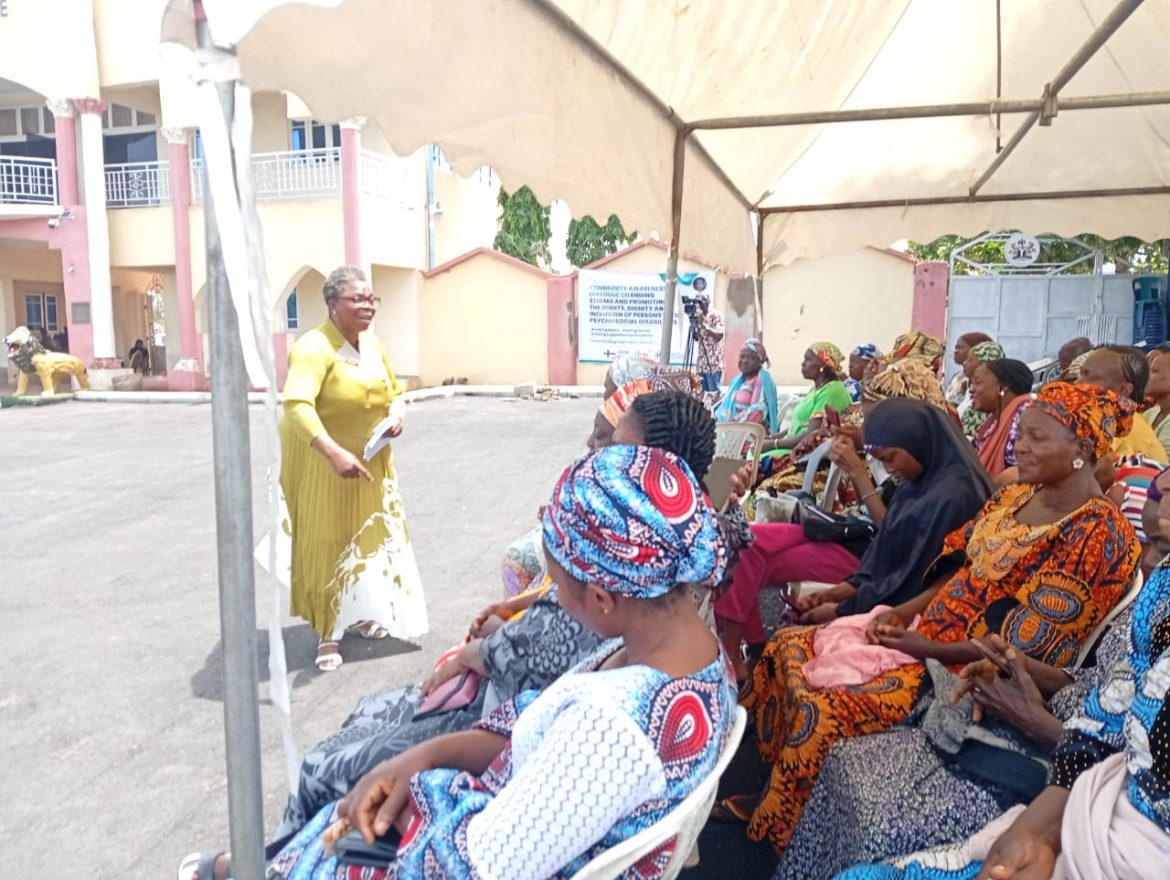
In a significant step towards building a more inclusive society where mental health is recognised as both a human rights and development issue, traditional rulers, healthcare professionals, persons with psychosocial disabilities, government officials, civil society organisations, security agencies, religious leaders, and community members converged at the Palace of His Royal Highness, the Sakaruyi of Karu, Abuja, for a landmark community dialogue aimed at ending stigma and discrimination against persons with psychosocial disabilities.
The high-level engagement, which attracted more than 65 women alongside other stakeholders, served as a powerful platform for open conversations on mental health, disability rights, and community responsibility. It also amplified the voices of persons with psychosocial disabilities, whose lived experiences continue to be shaped by stigma, exclusion, and systemic barriers despite existing legal protections.
The dialogue was implemented by Yamban-Kabati African Foundation (YKAF), a community support psychosocial cluster group under the Rights in Action (RiA) Project, with funding from the Ministry for Foreign Affairs of Finland, technical support from CBM Global Disability Inclusion, and in partnership with the Joint National Association of Persons with Disabilities (JONAPWD) and the Inclusive Friends Association (IFA).
Beyond Mental Illness: Confronting Stigma and Social Exclusion
Participants agreed that for many persons with psychosocial disabilities, the greatest burden is often not the disability itself but the prejudice, discrimination, and social isolation that accompany it.
Across many communities, misconceptions continue to fuel fear and misunderstanding, leading to exclusion from education, employment, healthcare, leadership opportunities, and community participation. Families are frequently left without adequate support, while many individuals suffer in silence due to fear of ridicule or rejection.
Speakers at the event stressed that changing this narrative requires collective action from families, traditional institutions, religious bodies, government agencies, healthcare providers, media organisations, and community leaders.
The dialogue therefore created a safe and inclusive environment where participants openly examined harmful stereotypes surrounding mental health, reflected on the realities faced by persons with psychosocial disabilities, and explored practical solutions for promoting acceptance and inclusion.
Nigeria’s Mental Health Act Offers Hope—but Implementation Remains a Challenge
Stakeholders acknowledged that Nigeria’s Mental Health Act provides a progressive, rights-based legal framework that protects the dignity, autonomy, equality, and inclusion of persons with psychosocial disabilities.
However, they expressed concern that implementation remains inconsistent across many parts of the country, leaving thousands of Nigerians unable to enjoy the protections guaranteed under the law.
Participants noted that awareness of the Act remains low, while access to affordable, quality mental healthcare services continues to be limited, particularly at the community level.
The dialogue therefore emphasised the urgent need for stronger institutional accountability, increased public awareness, improved funding for mental health services, and closer collaboration between government and civil society to ensure that the provisions of the law become meaningful realities.
PEGA Findings Reveal Persistent Inequality
Discussions during the programme were informed by findings from the Political Economy and Gender Assessment (PEGA) conducted under the Rights in Action Project.
The assessment revealed that many persons with psychosocial disabilities continue to experience widespread discrimination, social exclusion, violence, abuse, and limited opportunities to participate in decisions affecting their lives.
The report further highlighted weak institutional accountability and inadequate access to affordable mental healthcare services as major obstacles to inclusion.
Particular attention was drawn to the experiences of women and girls with psychosocial disabilities, who face multiple layers of discrimination due to the intersection of disability and gender inequality.
Stakeholders observed that these women are disproportionately exposed to violence, neglect, economic exclusion, and barriers to justice, making targeted interventions essential.
Lack of Reliable Data Hampers Effective Planning
Participants also expressed concern over the absence of recent nationally representative data on psychosocial disabilities in Nigeria.
While the World Health Organisation (WHO) estimates that one in every eight people globally lives with a mental health condition, many of whom experience psychosocial disabilities, Nigeria still lacks comprehensive national statistics capable of accurately reflecting the magnitude of the issue.
Experts noted that although available evidence indicates that thousands of Nigerians face barriers to diagnosis, treatment, rehabilitation, and community inclusion, the absence of reliable data makes effective planning and resource allocation difficult.
They therefore called for greater investment in inclusive data collection, research, and evidence-based policymaking to strengthen mental health systems across the country.
Lived Experiences Inspire Community Action
One of the most impactful moments of the dialogue came as persons with psychosocial disabilities courageously shared their personal stories.
Their testimonies painted a vivid picture of the discrimination, misunderstanding, isolation, and emotional trauma they continue to endure, while also demonstrating remarkable resilience and determination to live productive lives when provided with appropriate support.
Participants engaged in frank discussions on family support systems, harmful cultural beliefs, gender-based risks, referral pathways, available mental health services, and legal protections under Nigeria’s Mental Health Act.
These conversations helped dispel longstanding myths surrounding mental health and reinforced the importance of treating psychosocial disabilities with empathy, respect, and evidence-based care rather than fear or prejudice.
“Mental Health Is a Human Rights Issue”
Speaking during the event, the Executive Director of Yamban-Kabati African Foundation (YKAF) emphasised that mental health should no longer be viewed solely as a medical issue but as a matter of human rights and social justice.
“Mental health is not simply a health issue; it is a human rights issue. Every person deserves to be treated with dignity, respected for who they are, and supported to participate fully in community life. Today’s dialogue demonstrates that lasting change begins when communities choose understanding over fear, inclusion over discrimination, and action over silence.”
The remarks resonated strongly with participants, who pledged to become ambassadors for mental health awareness within their communities.
‘Nothing About Us Without Us’
A defining feature of the dialogue was its adherence to the disability rights principle of “Nothing About Us Without Us.”
Rather than being passive beneficiaries, persons with psychosocial disabilities played central roles throughout the programme, sharing lived experiences, contributing to discussions, identifying challenges, and proposing practical solutions to improve community inclusion.
Their active participation reinforced the importance of ensuring that policies and programmes affecting persons with disabilities are developed with their direct involvement.
Building Communities That Support Mental Health
The community dialogue forms part of the Mind, Rights & Dignity (MiRiD) Project, a twelve-month advocacy and systems-strengthening initiative designed to improve awareness, accountability, and the effective implementation of Nigeria’s Mental Health Act within the Federal Capital Territory.
Through sustained advocacy, community dialogues, media engagement, institutional collaboration, and partnerships with disability organisations and community leaders, the project seeks to reduce stigma, strengthen community support systems, and promote the rights, dignity, and inclusion of persons with psychosocial disabilities.
As the dialogue concluded, participants collectively committed to challenging stigma wherever it exists, promoting inclusive attitudes, supporting access to mental healthcare, and ensuring that every person—regardless of their psychosocial condition—is treated with dignity, equality, and respect.
The gathering ended with a shared conviction that lasting progress will require more than legislation alone. It will demand informed communities, responsive institutions, sustained advocacy, and a society that recognises mental health as an essential component of human dignity, social inclusion, and national development.
Click the link below to join our WhatsApp channel


