

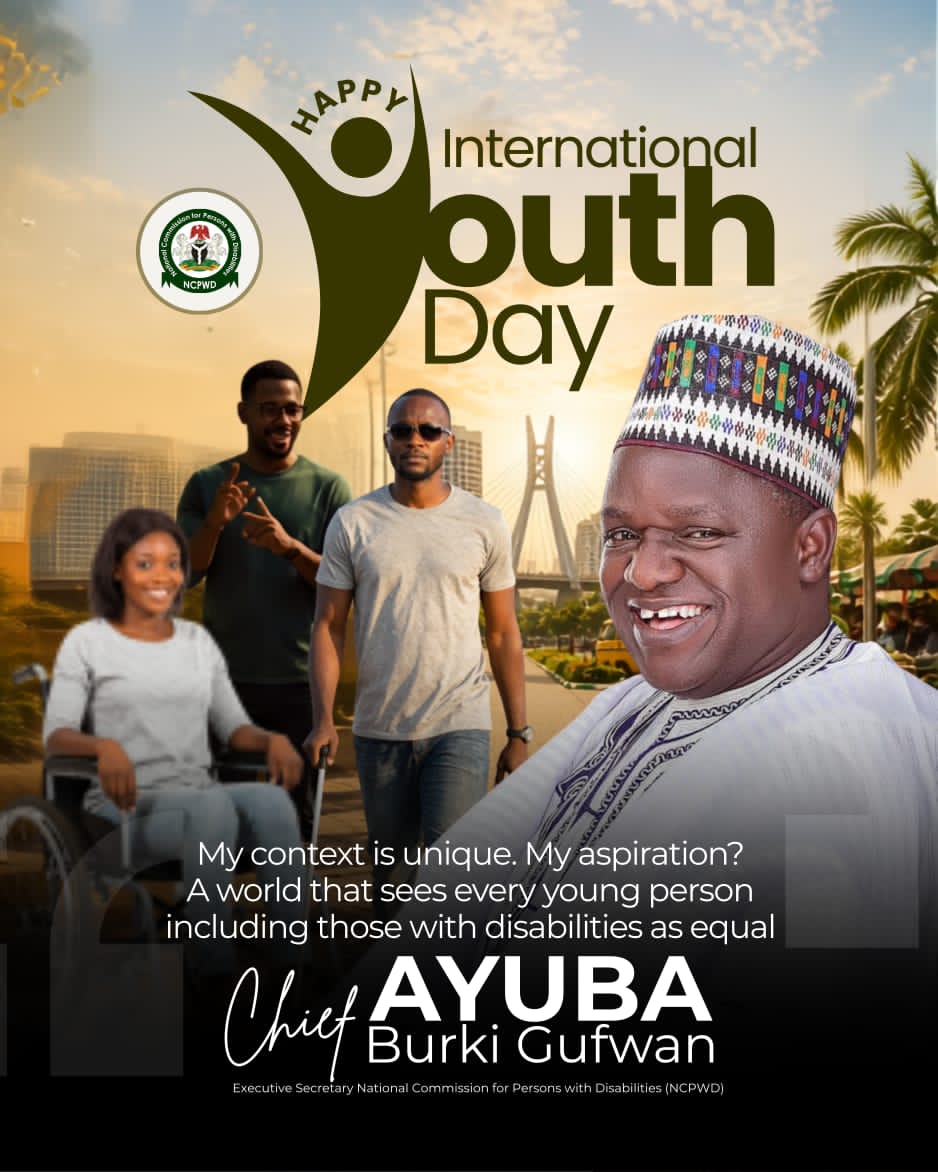
ABUJA — The Executive Secretary of the National Commission for Persons with Disabilities (NCPWD), Chief Ayuba Burki Gufwan, has called for stronger collective action to ensure that young Nigerians with disabilities are not left behind in the nation’s development journey.
Speaking to commemorate International Youth Day 2026, Chief Burki reaffirmed the Commission’s commitment to advancing the rights, opportunities and participation of young persons with disabilities across Nigeria.
The 2026 International Youth Day theme, “Different Contexts, Common Aspirations,” highlights the diverse realities faced by young people globally while underscoring their shared aspirations for dignity, opportunity, independence and meaningful participation in society.
Chief Burki noted that young Nigerians with disabilities often face multiple and interconnected barriers, particularly in inclusive education, employment, digital literacy and access to infrastructure.
He further pointed out that climate-induced displacement and inadequate infrastructure continue to deepen these challenges, especially for young people living in rural and underserved communities.
According to him, these barriers should not be viewed as insurmountable obstacles but as shared national challenges requiring coordinated solutions.
Bridging the Gap Between Policy and Reality
The NCPWD Executive Secretary emphasized the need to move beyond policy formulation to effective implementation, stressing that the real measure of inclusion is the extent to which policies translate into tangible improvements in the daily lives of persons with disabilities.
He said the Commission, under his leadership, is working to address existing gaps while aligning its interventions with the Renewed Hope Agenda of President Bola Ahmed Tinubu, particularly its focus on social inclusion, economic empowerment and equitable access to opportunities.
Chief Burki acknowledged recent progress in areas including assistive technology procurement, public awareness, policy development and the gradual improvement of accessibility in public infrastructure.
However, he stressed that significant work remains, particularly in enforcement, sustainable funding and changing negative societal attitudes towards disability.
“Inclusion Is Everyone’s Responsibility”
Chief Burki also stressed that disability inclusion cannot be achieved by the NCPWD alone.
He called on government institutions, private-sector organisations, civil society groups, communities and individual Nigerians to take ownership of the inclusion agenda.
«“Inclusion is not the sole responsibility of the NCPWD; it is a collective duty.”»
He urged stakeholders to work together to dismantle barriers that prevent young persons with disabilities from accessing education, employment, technology and other opportunities necessary for them to thrive.
Investing in Young Innovators
The NCPWD boss also celebrated the creativity and resilience of young Nigerians with disabilities who are developing innovative solutions despite limited resources.
From adaptive agricultural tools to assistive digital applications, he noted that young people with disabilities are demonstrating that disability does not diminish talent, creativity or the capacity to contribute meaningfully to national development.
He therefore called for increased investment in grassroots innovations and the creation of an ecosystem where young innovators with disabilities can develop, scale and commercialise their ideas.
As Nigeria joins the rest of the world to celebrate International Youth Day 2026, Chief Burki’s message is clear: the aspirations of young Nigerians with disabilities must translate into real opportunities, not remain promises on paper.
He urged all Nigerians to embrace inclusion as both a personal responsibility and a national imperative, stressing that only through collective action can the country transform the common aspirations of its young people into shared and tangible victories — regardless of ability.
Follow the The Qualitative Magazine channel on WhatsApp:


