

By Chris Agbo
When a survivor must overcome inaccessible police stations, family pressure, financial dependence, stigma and disbelief before she can even report sexual violence, the problem is no longer only the crime. It is also a justice system that must do more to reach her.
The report she was afraid to make
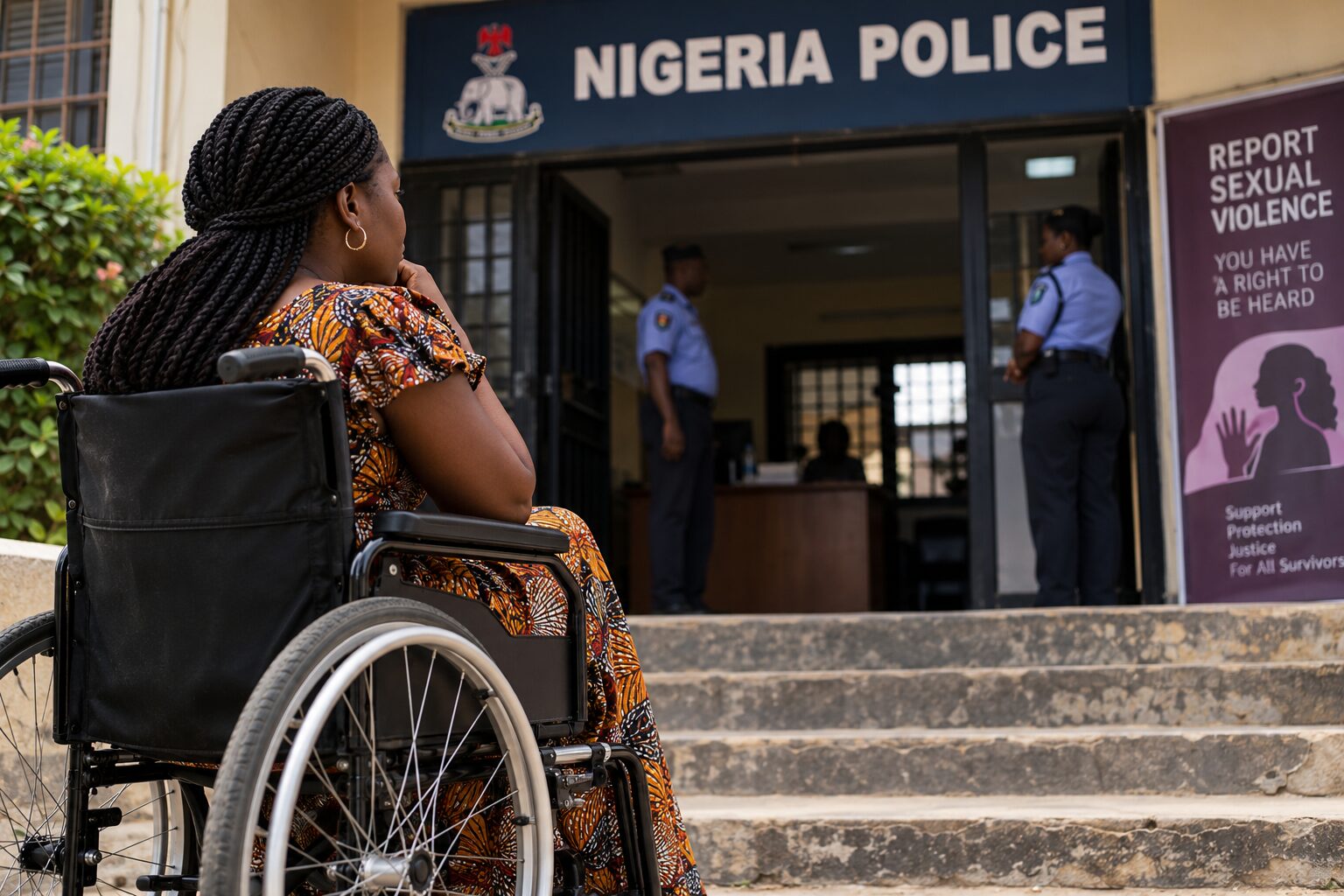
Imagine a young woman by Amara who uses a wheelchair.
Amara lives with a relative who helps her with transportation and some daily activities. One evening, someone she knows sexually assaults her. She is frightened, confused and deeply hurt. She wants to report what happened, but almost immediately, another set of questions begins to overwhelm her.
Who will take her to the police station? Will the entrance be accessible? Will officers believe her? What happens if the person she accuses is someone her family depends on financially? Will her relatives support her, or will they pressure her to remain silent to avoid public shame?
She finally tells a family member what happened.
Instead of asking whether she is safe or needs medical attention, the relative warns her against bringing disgrace to the household. The family suggests that she should keep quiet, forgive the perpetrator and move on.
Amara is left carrying two burdens: the trauma of the assault and the weight of being discouraged from seeking justice.
Amara is an illustrative character, not a real survivor whose case is being reported here. Yet the barriers in her story are precisely the kinds of questions disability-inclusive justice systems must be prepared to answer.
For many women and girls with disabilities, reporting sexual violence may require overcoming obstacles that begin long before they reach a police station. Some depend on others for transport, personal assistance, communication or financial support. Others fear discrimination, retaliation, abandonment or the exposure of deeply personal experiences.
The result is a troubling possibility: a survivor may have a legal right to justice but find the practical route to that justice almost impossible to navigate.
A right that cannot be safely exercised, accessed or understood is a right that institutions must work harder to make real.
When the journey to justice begins with a staircase
Consider also a Deaf woman decides to report sexual assault. She arrives at a police station prepared to tell her story, but no sign-language interpreter is available. An officer asks questions she cannot fully understand, while she struggles to communicate the details of what happened.
Her inability to communicate in the officer’s preferred language may be mistaken for confusion, inconsistency or unwillingness to cooperate.
But the question should not be whether she can adapt to an inaccessible reporting process. The question should be whether the institution has made reasonable arrangements to communicate with her.
Now consider a woman with a visual impairment who cannot independently read a complaint form, or a woman with an intellectual disability who needs information explained in clear, accessible language and appropriate support to communicate her account.
Their disabilities do not erase their right to report a crime. Nor should communication differences automatically make their accounts less worthy of attention.
An accessible justice system must recognise that people communicate in different ways. It should provide appropriate communication support, accessible information, respectful interviewing and safeguards against coercion.
For a wheelchair user, access may begin with a ramp and an accessible toilet. For a Deaf survivor, it may begin with qualified interpretation. For a survivor with an intellectual disability, it may require an interviewer who understands how to ask clear, non-leading questions and allow sufficient time for responses.
These are not luxuries. They are practical measures that can help make reporting possible.
The United Nations Convention on the Rights of Persons with Disabilities (CRPD), particularly Article 13, requires states to facilitate effective access to justice for persons with disabilities, including through appropriate procedural accommodations and training for justice personnel.
Nigeria’s obligation to protect the rights of persons with disabilities must therefore be reflected not only in legislation but also in the everyday conduct of police officers, healthcare workers, prosecutors and court personnel.
When the people expected to protect her ask her to keep quiet
For some survivors, the first barrier is not a government institution. It is the family.
Imagine a young woman with a physical disability who experiences sexual abuse by a person known to her household. Her family may fear public embarrassment, the loss of financial assistance, community gossip or a prolonged court case.
A relative may tell her that reporting the incident will destroy the family’s reputation. Another may insist that the matter should be settled privately. Someone else may argue that, because she depends on the accused person for transport, accommodation or personal assistance, she should not risk losing that support.
These pressures can leave a survivor feeling that she must choose between justice and survival.
Family members can provide essential emotional support, practical assistance and protection. Many do. But when relatives intimidate a survivor, suppress her account, threaten abandonment or obstruct her attempt to seek help, the family can become another barrier between her and justice.
It is important not to assume that every family intervening in a case is acting maliciously. Families may be frightened, poorly informed or concerned about a survivor’s safety. The response, however, must centre the survivor’s rights, wishes and protection.
An adult woman with a disability is not a family possession. Her right to bodily autonomy, dignity and protection from violence does not disappear because she needs assistance with daily activities.
Where the survivor is a child, her best interests, safety and applicable child-protection laws must guide the response.
Protection must never become a justification for silencing the person it is supposed to protect.
The dangerous myth that disability means consent
One of the most harmful attitudes surrounding sexual violence against women with disabilities is the assumption that their bodies, relationships or experiences of consent can be judged through stereotypes about disability.
A woman with a disability may be viewed as incapable of making decisions, understanding relationships or giving a reliable account of abuse. Another may be treated as though she should be grateful for attention, even when that attention is coercive or abusive.
Both attitudes are wrong.
Disability does not equal consent. Dependence does not equal consent. Marriage, a relationship, a history of sexual activity or a person’s need for personal assistance does not automatically establish consent to a particular sexual act.
Consent must be assessed in accordance with the applicable law and the circumstances of the case. Under Section 1 of the Violence Against Persons (Prohibition) Act, 2015, rape includes specified forms of penetration without consent, including where consent is obtained through force, threats, intimidation, fear of harm or certain other prohibited means.
A survivor’s disability must not be used as a shortcut for dismissing her account. Equally, disability should not be used to make assumptions about a person’s capacity without an appropriate, individualised assessment.
The justice system must investigate allegations fairly, protect due process and ensure that disability-related communication needs are properly addressed.
Women with disabilities deserve the same seriousness, dignity and fairness as every other survivor.
What Nigerian law says — and why implementation matters
Nigeria has legal protections relevant to sexual violence, discrimination and access to justice. The challenge is ensuring that survivors can actually benefit from them.
1. The Violence Against Persons (Prohibition) Act, 2015
The VAPP Act establishes offences and protections relating to violence against persons, including rape. Section 1 defines rape and provides criminal penalties upon conviction, as well as provision for appropriate compensation by the court.
The Act applies in the Federal Capital Territory and in states that have enacted or domesticated it. The applicable state law must therefore be checked when dealing with a case outside the FCT. Other relevant provisions of the Criminal Code, Penal Code and state-specific laws may also apply, depending on the location and facts.
A survivor should not have to understand the entire legal framework before seeking help. Relevant authorities must explain the available options and help her access the appropriate response.
2. The Discrimination Against Persons with Disabilities (Prohibition) Act, 2018
Nigeria’s federal disability law prohibits disability-based discrimination and establishes the National Commission for Persons with Disabilities (NCPWD). Its accessibility and equality framework is relevant to the barriers women with disabilities may encounter when trying to use public services.
The law’s significance extends beyond ramps and buildings. Public institutions must take disability inclusion seriously when designing and delivering services, including information, healthcare and access to justice.
An inaccessible entrance, the absence of reasonable communication arrangements or discriminatory treatment can undermine a survivor’s ability to use services that are theoretically available to everyone.
3. The Constitution of the Federal Republic of Nigeria, 1999, as amended
Section 34 protects the dignity of the human person and prohibits torture and inhuman or degrading treatment. Section 42 addresses discrimination on specified grounds.
These constitutional protections form part of the wider legal framework for human dignity and equality. Their precise application depends on the circumstances and the relevant constitutional provisions.
4. The Child Rights Act, 2003, and applicable state child-rights laws
Where the survivor is under 18, child-protection laws are especially important. Section 31 of the federal Child Rights Act prohibits sexual intercourse with a child and establishes an offence of rape in the circumstances specified by the Act. The Act’s application and corresponding state legislation must be considered in the relevant jurisdiction.
Girls with disabilities may require additional safeguarding and accessible reporting arrangements, but their right to protection must never be conditional on their ability to communicate in a particular way.
5. The Convention on the Rights of Persons with Disabilities
Article 13 addresses access to justice. Article 16 concerns freedom from exploitation, violence and abuse, while Article 6 recognises the multiple forms of discrimination faced by women and girls with disabilities.
Together, these provisions reinforce a central principle: disability-inclusive justice is not charity. It is part of the obligation to respect, protect and fulfil human rights.
The existence of these laws is important. However, a law cannot by itself ensure that an officer listens respectfully, an interpreter is available, a hospital provides timely care or a survivor can reach a court.
That requires training, funding, oversight, accessible infrastructure, survivor-centred procedures and accountability for failures.
The agencies that must do more
Responsibility for improving access to justice cannot rest on survivors and disability organisations alone. Public institutions with relevant mandates must work together.
The Nigeria Police Force (NPF) is a critical entry point for criminal reporting and investigation. Officers should receive training on disability inclusion, survivor-sensitive interviewing, confidentiality, evidence handling and referral procedures. Police stations should make reasonable accessibility arrangements and avoid treating disability-related communication differences as evidence that a complaint lacks credibility.
The Federal Ministry of Justice’s Sexual and Gender-Based Violence Response/Gender Unit coordinates government action in this area and supports access to justice through relevant legal services, prosecution coordination, training and advocacy. Its mandate provides an important platform for strengthening disability-inclusive responses. State ministries of justice and relevant prosecution services also have vital responsibilities.
The National Commission for Persons with Disabilities (NCPWD) should help ensure that disability rights and accessibility are integrated into SGBV prevention, reporting, referral and justice services. This includes identifying barriers, engaging service providers and advocating for effective implementation of the Disability Act.
The National Human Rights Commission (NHRC) receives complaints concerning human rights violations and can help connect complainants with relevant institutions. Its published SGBV access information identifies the short code 6472 as a contact route. Survivors should confirm current availability and accessibility before relying on a particular channel.
The National Agency for the Prohibition of Trafficking in Persons (NAPTIP) has responsibilities under Nigeria’s trafficking legislation and can be relevant where sexual exploitation is connected to trafficking or other offences within its mandate. It is not a substitute for every police or SGBV response service.
Sexual Assault Referral Centres (SARCs) and appropriate health facilities can provide medical care, psychosocial support, documentation and referrals, depending on the services available at the centre. Their services must be physically and communicatively accessible to survivors with disabilities.
The International Federation of Women Lawyers (FIDA Nigeria) and other qualified legal-aid providers and women’s rights organisations can help survivors understand their legal options and seek appropriate support.
State ministries responsible for women affairs and social development, state SGBV agencies where established, disability organisations and relevant social welfare services also have roles in prevention, protection and referral.
No agency can solve the problem alone. Survivors need a coordinated pathway that does not force them to travel from office to office, repeatedly recount traumatic experiences or navigate an inaccessible system without assistance.
When the cost of reporting becomes another punishment
Reporting sexual violence can involve transport costs, time away from work, medical expenses, childcare arrangements and the risk of losing accommodation or personal assistance.
For a woman who has little or no independent income, even reaching a police station or hospital may be difficult. If she depends on the alleged perpetrator or someone connected to him, seeking help can feel particularly risky.
Imagine a woman who is told to return to a hospital for follow-up care, attend the police station for another interview and later appear in court. Each trip requires money and someone who can help her travel. The system may interpret a missed appointment as a lack of commitment, while overlooking the practical barriers that made attendance impossible.
A survivor’s inability to pay for transport or arrange assistance should not be confused with a lack of interest in justice.
Institutions and partners should examine how transport assistance, accessible referral arrangements, legal aid, psychosocial support and appropriate protection measures can reduce these barriers. Services must also respect confidentiality and avoid creating new risks by contacting relatives or caregivers without appropriate consent or safeguarding justification.
The question should not simply be, “Why did she fail to report?”
We must also ask, “What made reporting so difficult, and what did the system do to help?”
From reporting to recovery: justice must not end at the police station
A survivor may need immediate medical attention, emergency contraception where clinically appropriate, assessment for sexually transmitted infections, psychological support, safe accommodation and legal advice.
She may also need a communication assistant, sign-language interpreter, accessible transport or a personal assistant of her choosing, where appropriate and safe.
Services should explain options in accessible formats and seek informed consent for examinations, information-sharing and referrals. They should not assume that a relative or caregiver is automatically the appropriate person to interpret or make decisions for an adult survivor.
Where a survivor requires support to communicate, the aim should be to enable her to express her own wishes and account as clearly as possible, while protecting her from undue influence.
The response must also be trauma-informed. Repeated questioning, blaming language, public exposure and unnecessary retelling can compound the harm.
A survivor should not have to prove her worthiness of assistance by displaying a particular emotional reaction. Some people cry; others become quiet, confused or detached. There is no single correct way to respond to trauma.
Above all, services must not promise outcomes they cannot guarantee. They should provide accurate information, explain the process and treat the survivor with dignity throughout.
The role of the media: report the system, protect the survivor
The media has a responsibility to expose failures without turning a survivor’s suffering into spectacle.
Journalists should avoid publishing identifying details that could expose a survivor to retaliation, stigma or unwanted attention. Consent to an interview must be voluntary and informed, and it should not be treated as permission to publish every intimate detail. Where children are involved, heightened safeguarding and legal protections are essential.
Disability should be described respectfully and only where relevant. A woman’s wheelchair, hearing impairment or intellectual disability should not be presented as the cause of the violence. The responsibility belongs to the perpetrator, and the institutional response must be examined on its own merits.
Good reporting asks difficult questions:
– Was the reporting location physically accessible?
– Were communication accommodations offered?
– Was the complaint handled respectfully and confidentially?
– Was the survivor referred for appropriate medical and psychosocial care?
– Were the applicable laws followed?
– Did any person pressure the survivor to withdraw, reconcile or remain silent?
– What changes will the responsible institution make to prevent similar failures?
These questions move journalism beyond shock and outrage towards evidence, accountability and reform.
They also give institutions a fair opportunity to respond and allow reporting to distinguish verified facts from allegations, illustrative scenarios and opinion.
The Qualitative Magazine: giving visibility to the voices the system overlooks
For The Qualitative Magazine (TQM), disability-inclusive journalism means more than publishing stories about persons with disabilities. It means examining how institutions work, listening to people whose experiences are often excluded from public debate and demanding practical solutions where rights are denied.
TQM is bringing together the voices of women with disabilities, survivors who freely choose to speak, disability-rights advocates, service providers, lawyers, health professionals and public authorities.
The magazine can investigate accessibility at police stations and hospitals, examine the availability of sign-language interpretation and other communication support, document referral gaps, and seek responses from agencies responsible for prevention, protection and prosecution.
It can also highlight examples of good practice, identify service gaps and track whether promised improvements are implemented.
Such reporting must be conducted ethically. Survivors should never be pressured to disclose their experiences for a campaign, and no story should suggest that a person must speak publicly to be believed or to deserve justice.
The aim is not to speak over women with disabilities. It is to help ensure that their voices, choices and rights are respected.
A society cannot claim that justice is accessible merely because a complaint desk exists. Access must be measured by whether people can reach it, communicate safely, obtain appropriate support and receive a fair response.
For TQM, this is an opportunity to make disability rights visible as a matter of public accountability, not charity.
What must change now?
Nigeria needs a practical, measurable commitment to disability-inclusive SGBV services.
First, police stations, hospitals, courts and shelters should assess and address physical, communication and information-access barriers.
Second, officers, healthcare workers, prosecutors and judicial personnel should receive regular training on disability rights, informed consent, safeguarding and survivor-centred practice.
Third, SGBV referral systems should include clear pathways for survivors with different disabilities, with accessible information about where to seek medical care, legal assistance and protection.
Fourth, government agencies and service providers should collect appropriately disaggregated, confidential data that helps identify service gaps without exposing survivors to further harm.
Fifth, disability organisations and women-led organisations should be meaningfully involved in designing, monitoring and evaluating these services. Women with disabilities must participate in decisions that affect their safety and access to justice.
Finally, allegations of sexual violence and failures in the response system must be handled through lawful, fair and accountable processes. Institutions should investigate complaints, address misconduct and report on improvements without disclosing confidential survivor information.
These are not demands for special treatment. They are practical steps towards equal access to protection and justice.
The final question: who opens the door?
Return to Amara, young woman who uses a wheelchair.
Imagine that, this time, she is met by an officer who listens without blaming her. The station has made reasonable access arrangements. She receives information in a format she can understand, is referred for appropriate medical and psychosocial care, and is informed about her legal options. Her choices are respected, her information is protected and her complaint is handled according to the law.
This is not an unrealistic demand for perfect institutions. It is a picture of what a serious commitment to accessible justice should seek to achieve.
We must stop measuring progress only by the number of laws passed, workshops held or awareness campaigns launched. We must also ask whether a woman with a disability can safely report violence, obtain care, understand her options and pursue justice without being silenced by the very people and institutions expected to protect her.
Every inaccessible entrance is a problem to be addressed. Every communication barrier demands a practical response. Every instance of victim-blaming requires accountability. Every survivor who is pressured into silence reminds us that the work is unfinished.
The doors of justice must not remain closed to women because they use wheelchairs, communicate through sign language, need support to understand information or depend on others for daily living.
Disability is not consent. Silence is not proof that violence did not occur. Dependence is not permission to abuse. And justice must never be reserved for those who can navigate an inaccessible system alone.
The measure of a just society is not simply whether its laws condemn sexual violence. It is whether every survivor, including every woman and girl with a disability, can seek protection and justice with dignity.
The Qualitative Magazine calls on government agencies, law enforcement bodies, healthcare providers, legal professionals, disability organisations, women’s rights groups and the public to help turn this principle into everyday practice.
Open the doors. Remove the barriers. Listen to survivors. Make justice accessible.
Because no woman’s right to justice should depend on her ability to reach a building, find an interpreter, pay for transport or persuade her family to believe her.


