

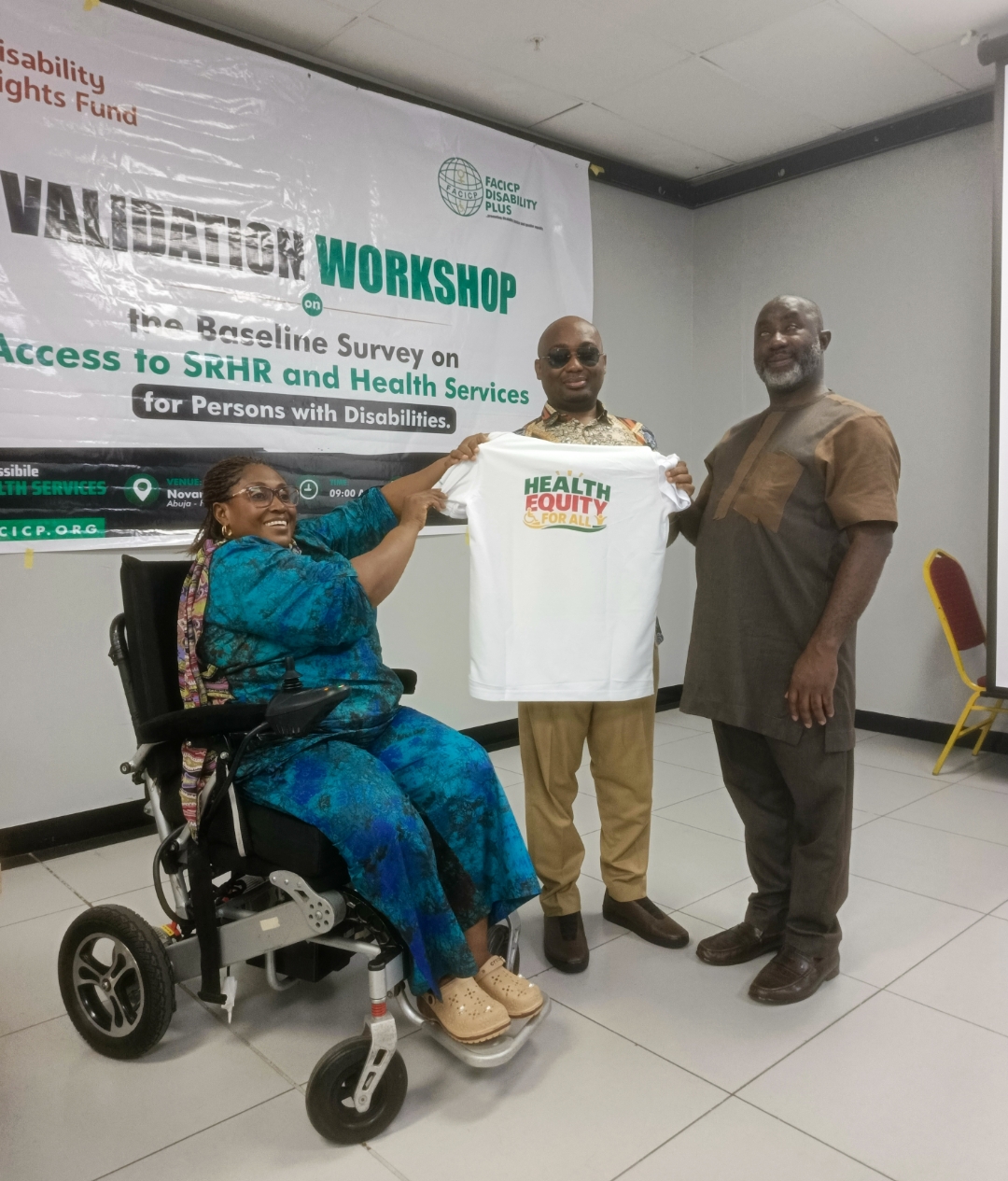
Stakeholders Push for Accessible and Inclusive Healthcare Services for PWDs
In a significant move towards advancing inclusive healthcare and Sexual and Reproductive Health and Rights (SRHR) for Persons With Disabilities (PWDs), FACICP Disability Plus has brought together critical stakeholders from the disability community, healthcare sector, caregivers, and development partners to validate a baseline survey on access to inclusive SRHR and healthcare services in the Federal Capital Territory (FCT).
The validation workshop, held on Friday, May 22nd, 2026, served as a strategic platform for stakeholders to critically review, validate, and collectively adopt findings generated from focused group discussions and engagements with Persons With Disabilities across the FCT Area Councils.
Speaking during the event, the Founder and Chair, Board Of Trustees of FACICP Disability Plus, Judith Ekaete Umoh, who addressed participants on behalf of the board members, appreciated stakeholders for their commitment towards advancing disability inclusion and accessible healthcare services in Nigeria.
Umoh stated that although she now serves more in advisory and mentorship capacities, she remains deeply committed to providing strategic direction and supporting younger disability advocates for the collective advancement of disability rights and inclusion in Nigeria.
She explained that the validation workshop was organized to ensure that the voices, concerns, and lived experiences shared by Persons With Disabilities during the survey process were accurately reflected in the final document.
According to her, the era of making decisions for Persons With Disabilities without directly involving them is gradually coming to an end.
She specially commended Persons With Intellectual Disabilities for actively participating in the process and validating issues affecting them personally.
“We are moving away from the old system where people speak on behalf of Persons With Disabilities without giving them the opportunity to express themselves. Today, persons with intellectual disabilities are demonstrating that they can speak for themselves, validate their own realities, and contribute meaningfully to policy discussions,” she said.
She further noted that some of the respondents who participated in the survey were also present at the validation workshop to make corrections where necessary, expand areas requiring further clarification, and collectively take ownership of the document and its findings.
Umoh also appreciated the Africa Coordinator of the Disability Rights Fund (DRF), Mr. Theophilus Odaudu, for his continuous support to disability inclusion initiatives and for taking time to witness the progress made through the project.
She expressed optimism that the final validated document would strengthen advocacy efforts towards achieving inclusive and accessible SRHR and healthcare services for Persons With Disabilities in Nigeria.
Also speaking at the event, the African Coordinator of Disability Rights Fund (DRF), Mr. Theophilus Odaudu, reaffirmed DRF’s commitment to promoting disability inclusion not only in Nigeria but across the world.
Odaudu emphasized that access to Sexual and Reproductive Health and Rights services remains a fundamental issue for Persons With Disabilities, stressing that quality healthcare is essential for dignity, well-being, and development.
“Health is wealth,” he stated, while noting that the findings from the baseline survey would serve as a strong advocacy tool for disability rights advocates and organizations engaging government institutions and other duty bearers on the need for accessible healthcare services.
He added that the document would help amplify the realities faced by Persons With Disabilities in accessing healthcare and SRHR services, thereby strengthening evidence-based advocacy for inclusive health policies and programs.
One of the lead researchers and respected disability inclusion experts, Dr. Adebukola Adebayo, presented the findings of the survey and provided detailed insights into the methodology, approaches, and data collection processes adopted during the research.
According to him, the study adopted a mixed-methods approach, combining quantitative and qualitative research methodologies to ensure broad and inclusive participation.
He explained that structured questionnaires were administered alongside Focus Group Discussions (FGDs) and Key Informant Interviews (KIIs).
The survey covered major Area Councils within the Federal Capital Territory, including Abuja Municipal Area Council (AMAC), Bwari, Kwali, and Gwagwalada.
Dr. Adebayo disclosed that a snowball sampling technique was used to reach 58 Persons With Disabilities who participated as quantitative respondents, while caregivers and officials from the Federal Ministry of Health participated in FGDs and KIIs.
He explained further that quantitative data collected during the survey were analyzed using descriptive statistics in Microsoft Excel, while qualitative data were analyzed thematically to identify recurring issues, barriers, and recommendations.
The research focused on six major domains, including socio-demographic characteristics, access to healthcare services, quality of healthcare delivery, and other critical areas affecting Persons With Disabilities in accessing Sexual and Reproductive Health and Rights services.
Participants at the workshop made extensive contributions, observations, and recommendations aimed at strengthening the final document.
At the end of the validation process, stakeholders verbally agreed that the findings accurately reflected the realities faced by Persons With Disabilities in accessing SRHR and healthcare services and unanimously adopted the document for further action.
Stakeholders stressed the need for government agencies, healthcare providers, development partners, and policymakers to prioritize accessibility, disability-inclusive healthcare policies, and the full participation of Persons With Disabilities in healthcare planning and implementation.
The workshop ended with renewed calls for stronger advocacy, improved healthcare infrastructure, accessible communication formats, and inclusive healthcare systems that leave no one behind.
The project was supported by the Disability Rights Fund (DRF).
Advocacy message:
Access to Sexual and Reproductive Health and Rights is not a privilege but a fundamental human right for Persons With Disabilities. The voices of PWDs must be heard, respected, and reflected in every healthcare policy and program. Inclusive healthcare saves lives, restores dignity, and promotes equality. Nigeria must act now to build a healthcare system that truly leaves no one behind.


