

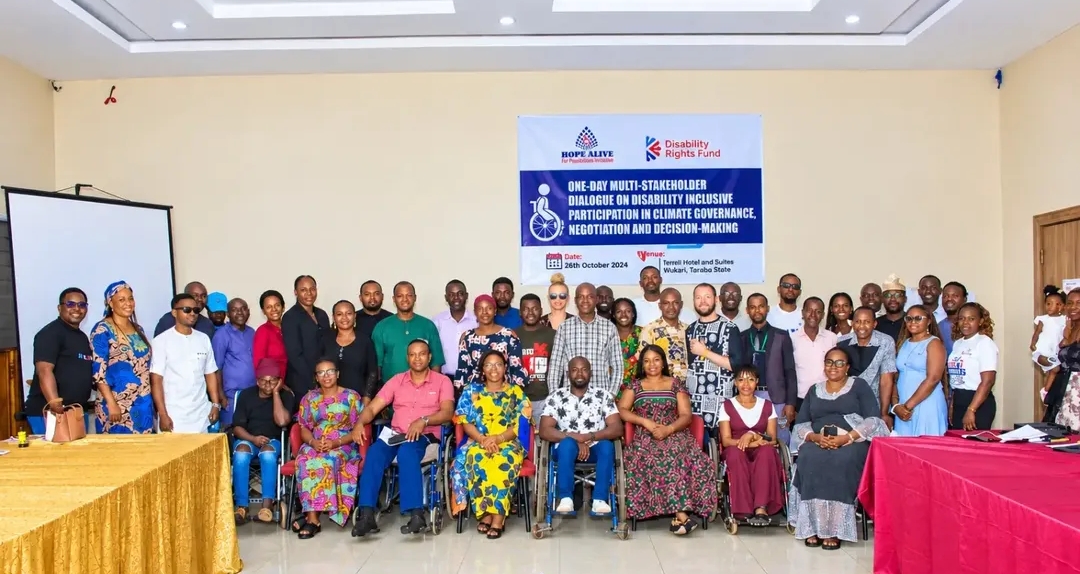
MAKURDI, BENUE — The Benue State Government has pledged to strengthen its support for persons with disabilities and ensure they have meaningful access to opportunities, services and decision-making processes, particularly in climate governance and community development.
The Commissioner for Women Affairs and Social Welfare, Mrs Theresa Ikwue, made the commitment at a one-day multi-stakeholders dialogue on disability-inclusive participation in climate governance, negotiation and decision-making, held in Makurdi.
Represented by the ministry’s Director, Mrs Magdalene Andoor, Ikwue said the state government remained committed to working with civil society organisations, organisations of persons with disabilities and other stakeholders to advance the inclusion, rights and wellbeing of persons with disabilities.
She commended the Hope Alive Possibilities Initiative (HAPI) for convening the dialogue, describing it as timely and important to strengthening disability inclusion in the state.
“Our ministry is open to dialogue, inclusion and needed partnership to promote people with disabilities.
“Today’s dialogue is timely because the disability community is a community that the ministry works closely with. Therefore, we are fully supporting what HAPI is doing in the state,” she said.
The dialogue was organised by HAPI with support from the Disability Rights Fund, bringing together government representatives, civil society organisations and other stakeholders to examine barriers limiting the participation of persons with disabilities in climate-related policies and decision-making.
Climate Emergencies Deepen Existing Barriers
Earlier, the Executive Director of HAPI, Aver Akighir, warned that climate-related emergencies often create additional challenges for persons with disabilities, particularly when emergency responses fail to take accessibility into account.
Akighir pointed out that early warning messages may not be accessible to people who are deaf, while emergency shelters and evacuation centres may pose significant barriers to wheelchair users and others with mobility disabilities.
She further noted that women with disabilities could lose their livelihoods during flooding and may encounter difficulties accessing recovery programmes and other support mechanisms.
According to her, these challenges demonstrate the need to place disability inclusion at the centre of climate governance rather than treating it as an afterthought.
She urged governments at all levels, civil society organisations and organisations of persons with disabilities to use the dialogue as an opportunity to strengthen the participation of persons with disabilities in climate governance and decision-making.
‘Laws Alone Are Not Enough’
Akighir stressed that having laws and policies protecting the rights of persons with disabilities would have limited impact if persons with disabilities were excluded from the processes through which decisions affecting them were made.
She referenced the Discrimination Against Persons with Disabilities (Prohibition) Act, 2018, as well as Nigeria’s obligations under the United Nations Convention on the Rights of Persons with Disabilities, as evidence of the country’s commitment to disability inclusion.
She said the priority should now be translating those commitments into meaningful participation by ensuring that persons with disabilities are actively involved in climate policy development, budgeting, negotiations and decision-making.
Akighir challenged stakeholders to ask critical questions about existing climate governance mechanisms, including whether climate budgets adequately address disability, whether early warning systems are accessible and whether persons with disabilities are sufficiently represented in climate-related decision-making structures.
CSOs Demand Meaningful Participation
Also speaking, the State Coordinator of the Civil Society Organisation Zone B, Blessing Adzege, represented by Moses Makere, called for the full and meaningful participation of persons with disabilities throughout the policy cycle.
Adzege said persons with disabilities should not merely be invited to meetings as participants but should have genuine opportunities to contribute to and influence decisions from policy formulation through implementation, monitoring and evaluation.
She observed that while climate change affects everyone, its consequences are not experienced equally, with persons with disabilities, women and girls and other vulnerable groups often facing additional barriers to information, resources, services and decision-making platforms.
She reaffirmed the commitment of civil society organisations in Benue State to advancing inclusive climate governance, disability rights, gender equality, citizen participation and accountable decision-making.
Beyond Representation to Real Influence
The Makurdi dialogue underscored a growing call for disability inclusion to move beyond symbolic representation towards genuine participation and influence.
For persons with disabilities, inclusion in climate governance is not simply about being present at meetings. It is about having a voice in the decisions, budgets, policies and programmes that directly affect their lives—especially as climate-related disasters continue to expose existing inequalities.
Stakeholders at the dialogue therefore called for stronger collaboration among government, civil society organisations, organisations of persons with disabilities and development partners to ensure that no one is left behind in Nigeria’s response to climate change.


