

Commission demands accessible schools, trained teachers and disability inclusion committees across FCT
For thousands of children with disabilities, getting through the school gate is only the beginning. Being physically present in a classroom does not automatically mean they can learn, participate or enjoy the same opportunities as their peers.
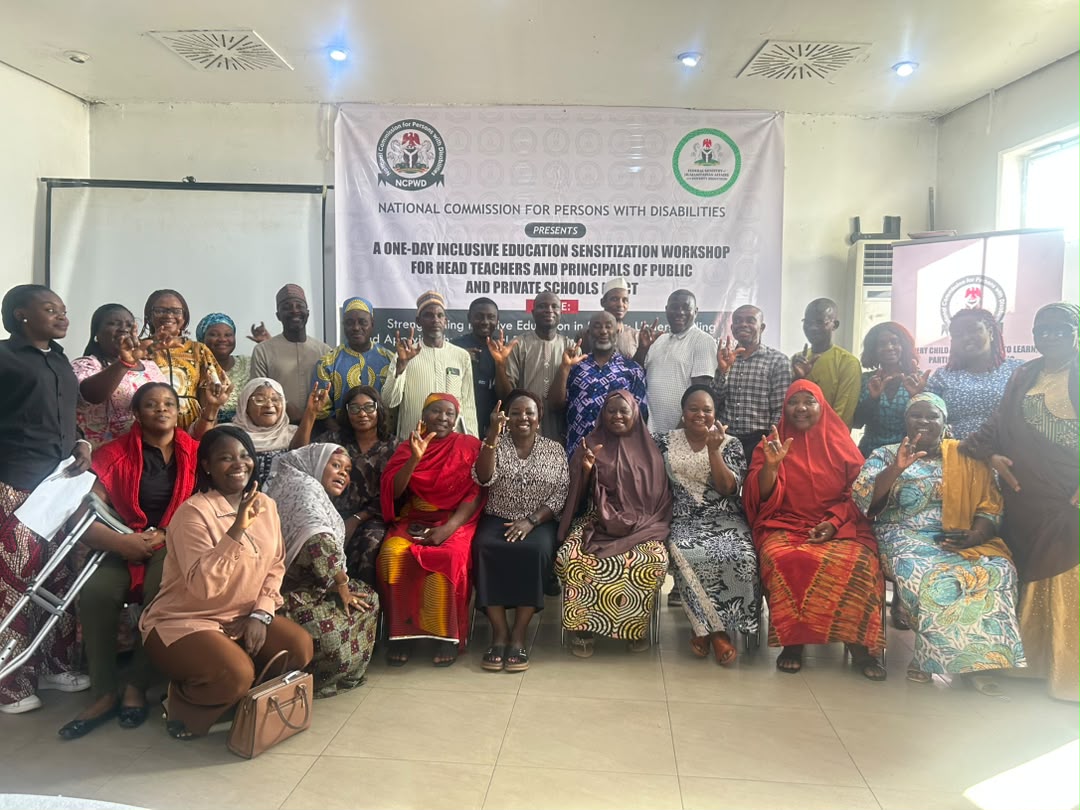
That reality was at the heart of a one-day sensitisation workshop organised by the National Commission for Persons with Disabilities (NCPWD) for head teachers and principals of public and private schools across the Federal Capital Territory.
The workshop, held in Abuja by the Commission’s Education Unit, seeks to move Nigeria’s inclusive education agenda from policy to practice.
It focused on the implementation of the Discrimination Against Persons with Disabilities (Prohibition) Act, 2018, Persons with Disabilities Regulations, 2023, National Policy on Inclusive Education, 2023, and the National Standard Operating Procedures on Inclusion and Access of Persons with Disabilities to Pre-tertiary Education, 2025.
Declaring the programme open on behalf of Executive Secretary, Hon. Ayuba Burki Gufwan, Dr. Kehinde Ogunbiyitan, Head of the Education Unit, challenged school leaders to rethink what inclusion means.
He stressed that inclusive education is not simply putting a child with a disability in a mainstream classroom.
It means creating an environment where the child can access, participate, learn and achieve.
“It requires us to identify and remove barriers in our school environments, teaching practices, communication, assessment, infrastructure, and school policies.”
According to Gufwan, school leaders occupy a critical position in determining whether children with disabilities feel welcomed and valued or experience exclusion.
He urged participants to return to their schools as champions of inclusion and help build learning environments where every child belongs.
NCPWD: Create disability inclusion committees
Ogunbiyitan said the workshop was designed to equip school leaders with practical knowledge of the Inclusive Education Policy and the Standard Operating Procedures.
He urged every participating school to establish a School-Based Committee for Disability Inclusion.
The committees, he said, should monitor implementation, identify accessibility challenges and conduct audits of school facilities.
Schools facing accessibility challenges are encouraged to engage NCPWD for technical support and guidance.
Ogunbiyitan also called on participants to step down the training for teachers in their respective schools.
‘Money can never be enough’
While acknowledging funding challenges, Ogunbiyitan said limited resources should not become an excuse for inaction.
“Money can never be enough.”
He stressed that political will and effective utilisation of available resources are critical to achieving meaningful inclusion.
The Commission, he added, plans to continue the sensitisation and capacity-building process through additional programmes, including activities that require little or no capital.
The difference between being present and being included
Ogunbiyitan said one of the major concerns behind the initiative is that many learners with disabilities remain excluded despite being enrolled in schools.
He drew attention to the difference between integration and genuine inclusion.
A child may be physically present in school yet face inaccessible classrooms, inadequate learning materials, communication barriers, untrained teachers or discriminatory practices.
The workshop therefore seeks to address the barriers—whether physical, institutional, communication-related or educational—that stand between children with disabilities and meaningful participation.
Braille, interpreters and accessible schools are not optional
NCPWD Technical Adviser, Dr. Adebayo Adebukola, reinforced the need for schools to provide more than classrooms, security and teachers.
He called for special education teachers and accessible physical environments that allow children with disabilities to reach and navigate schools safely.
He also highlighted the importance of appropriate learning and communication tools.
“You should have all the necessary equipment that will help a child with disabilities learn, like the Braille for the blind, interpreters for the deaf, and other adaptive learning tools.”
For the Commission, these are not luxury additions to education. They are essential elements of meaningful participation.
The workshop ended with school leaders committing to champion inclusive education and strengthen implementation within their institutions.
The message from NCPWD was unmistakable: a child with a disability should not merely have a place in school. The child should have a real opportunity to learn, participate and succeed.


