

Stakeholders Call for OPDs to Move Beyond Participation to Meaningful Influence in Policy Decisions
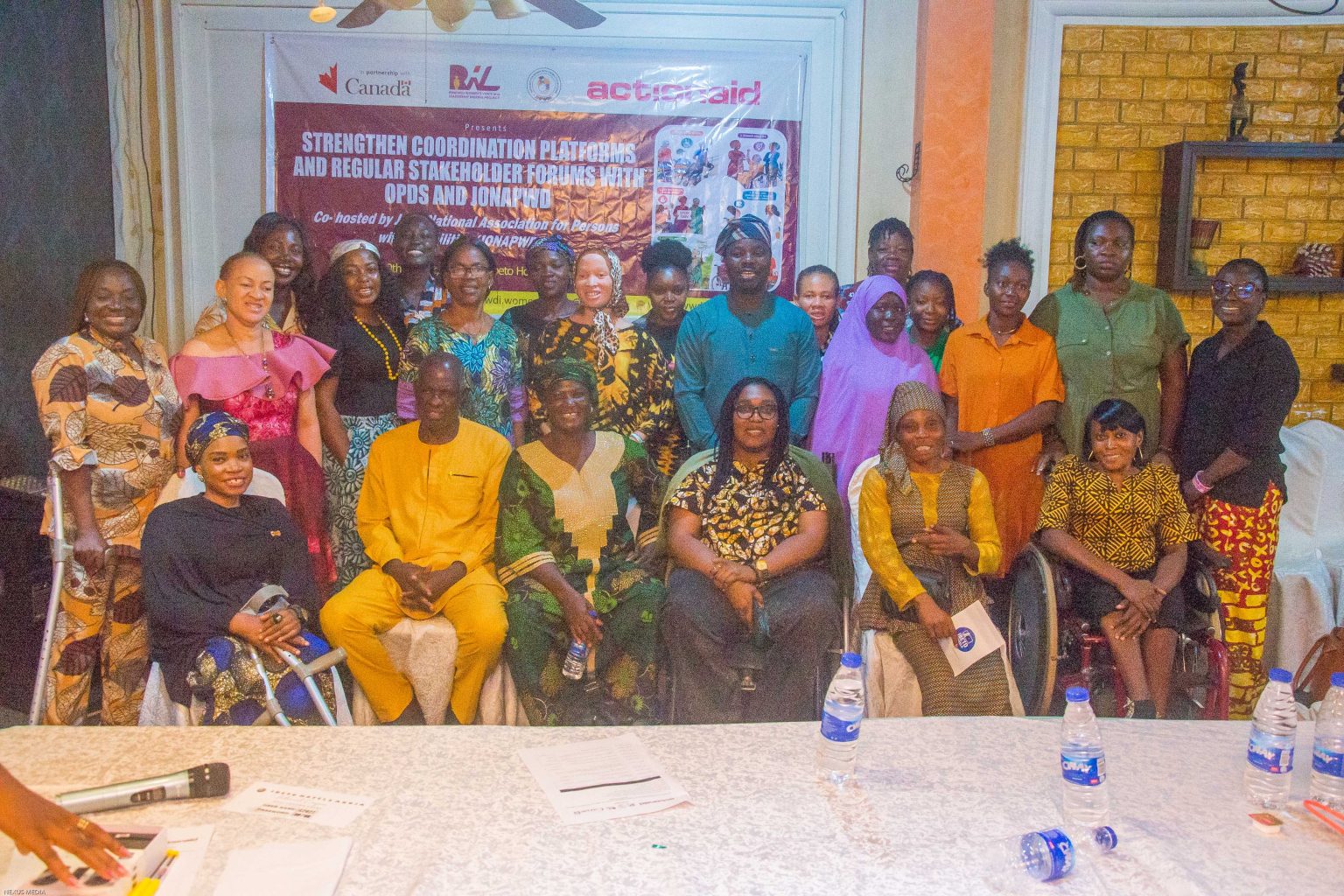
ABUJA, August 20, 2026 — The Advocacy for Women with Disabilities Initiative (AWWDI), with support from ActionAid Nigeria and funding from Global Affairs Canada under the Renewed Women’s Voice & Leadership Nigeria (RWVL-N) Project, has convened disability stakeholders in Abuja to strengthen coordination, collective advocacy and policy influence among Organisations of Persons with Disabilities (OPDs).
The stakeholder forum, titled “Strengthen Coordination Platforms and Regular Stakeholder Forums with OPDs and JONAPWD,” was held at Ibeto Hotel, Abuja, and co-hosted by the Joint National Association of Persons with Disabilities (JONAPWD).
The engagement brought together OPDs and other stakeholders to assess progress in advancing disability-inclusive policies, identify persistent barriers and develop practical strategies for strengthening collective action and influencing decisions that directly affect persons with disabilities.
The forum formed part of AWWDI’s AMPLIFY Disability-Inclusion Policies and Programmes intervention under the RWVL-N Project, which focuses on advancing disability and gender equality, preventing and responding to gender-based violence (GBV), promoting sexual and reproductive health and rights (SRHR), strengthening climate justice, expanding economic empowerment and building an inclusive feminist movement.
Beyond Being Seen: OPDs Must Influence Decisions
A major theme of the engagement was the need to move Organisations of Persons with Disabilities beyond simply having a seat at the table to actually influencing what happens at the table.
A presentation by JONAPWD highlighted a policy influence pathway that moves from access and participation to representation, influence, policy change and accountability.
Participants noted that meaningful participation is achieved when the lived experiences, expertise and evidence generated by persons with disabilities are reflected in policy recommendations, government decisions, budgets, programmes and institutional practices.
This prompted a critical question for stakeholders:
Are OPDs participating in decision-making spaces, or are they actually influencing the decisions being made?
The discussion underscored the growing role of OPDs in engaging government institutions, development partners and civil society, while also acknowledging the barriers that continue to weaken their policy influence.
Tokenism, Accessibility and Weak Coordination Remain Challenges
Participants identified several obstacles, including tokenistic participation, late engagement in policy processes, accessibility barriers, weak coordination, limited resources, inadequate disability-disaggregated data, poor feedback mechanisms and gaps between policy commitments and implementation.
Stakeholders observed that advocacy can lose its impact when organisations work in isolation or when recommendations presented to decision-makers are not followed by sustained engagement and accountability.
The forum therefore called for a shift from fragmented advocacy towards coordinated, evidence-based and strategic collective action.
OPDs were encouraged to strengthen evidence generation, develop common policy positions, coordinate advocacy campaigns, establish strategic partnerships and consistently track commitments made by policymakers.
Building Bridges Beyond the Disability Movement
The engagement also emphasised that disability inclusion cannot be achieved by OPDs working alone.
Participants called for stronger collaboration between OPDs and the women’s rights and feminist movements, GBV and SRHR actors, climate justice advocates, youth organisations, government institutions, the private sector, media and development partners.
Such collaboration is considered particularly important for women and young persons with disabilities, whose experiences are often shaped by intersecting inequalities linked to disability, gender, age, poverty and other social factors.
Rather than merely asking other organisations to “include disability” in existing programmes, stakeholders advocated for a more transformative approach—jointly designing policies and programmes that address the intersecting inequalities experienced by persons with disabilities.
From Coordination to Collective Power
The forum provided an opportunity for stakeholders to identify practical steps towards stronger disability-inclusive policy influence.
OPDs were encouraged to strengthen coordination, evidence generation and common policy positions, while JONAPWD was urged to continue deepening movement-wide coordination, representation, documentation and advocacy linkages through its national and state structures.
Development partners were encouraged to adequately resource meaningful participation and involve OPDs throughout the programme cycle—from design and implementation to monitoring and evaluation.
Government institutions were also urged to institutionalise accessible and meaningful participation of OPDs in policy development, budgeting, implementation and accountability processes.
Turning Commitments into Action
The engagement concluded with stakeholders reflecting on what they need to start, stop and strengthen to improve collective policy influence.
The emphasis was not simply on generating another set of recommendations, but on translating commitments into action and accountability.
For AWWDI, effective coordination is about more than bringing organisations together for meetings. It is about building stronger relationships, developing common positions, amplifying lived experiences and ensuring that the collective voice of persons with disabilities carries greater weight in policy and programme decisions.
The engagement contributes to the broader objectives of the Renewed Women’s Voice & Leadership Nigeria Project, supported by ActionAid Nigeria and funded by Global Affairs Canada, which seeks to strengthen women’s rights organisations and movements and advance inclusive, gender-transformative change.
Through its AMPLIFY Disability-Inclusion Policies and Programmes intervention, AWWDI is working towards a future where persons with disabilities—particularly women with disabilities—are not merely invited into policy spaces but have the power, platforms and partnerships to shape decisions, influence policies and hold institutions accountable.
The message from Abuja was clear: representation is important, but influence is the real measure of inclusion.


