

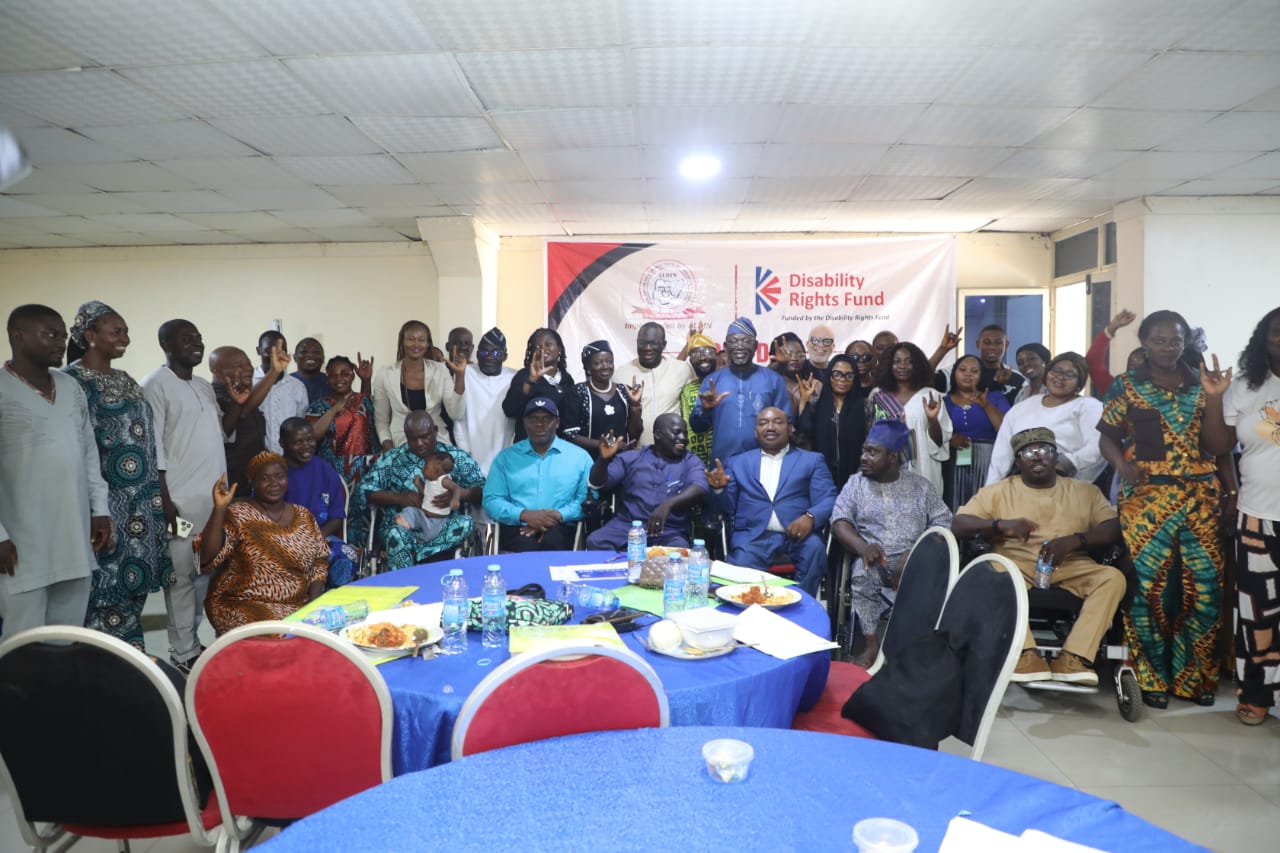
ABUJA, Nigeria — In a decisive move to tackle the deep-rooted barriers limiting access to financial services for millions of Nigerians with disabilities, the Association of Lawyers with Disabilities in Nigeria (ALDIN) has convened a high-level one-day validation workshop aimed at strengthening financial inclusion through evidence-based action.
The workshop, held in Abuja on Friday, brought together a powerful coalition of stakeholders—including government representatives, financial service providers, civil society organisations, and Organisations of Persons with Disabilities (OPDs)—to critically examine findings from a comprehensive baseline survey, accessibility audit, and policy review. These studies were conducted under ALDIN’s flagship project titled “Strengthening Financial Inclusion of Persons with Disabilities in Nigeria.”
At the heart of the engagement was a shared commitment to confront the systemic, physical, digital, and attitudinal barriers that continue to exclude over 35.5 million Nigerians with disabilities from fully participating in the country’s financial ecosystem.
From Advocacy to Action: A Turning Point
Representing the Executive Secretary of the National Commission for Persons with Disabilities (NCPWD), Mr. Ayuba Burki Gufwan, Barr. Mariam Mekpagili commended ALDIN for its strategic leadership in advancing disability rights through research-driven advocacy.
She described financial exclusion as a persistent and critical challenge, noting that limited access to banking services, credit facilities, insurance products, and digital finance platforms continues to undermine the economic empowerment of persons with disabilities.
“Financial inclusion is not just a development goal—it is a fundamental right,” she stated. “What ALDIN is doing represents a shift from rhetoric to reality, from advocacy to evidence-based action.”
According to her, the validation workshop serves as a crucial platform where data meets lived experience—ensuring that policies and recommendations are not only technically sound but also grounded in the everyday realities of persons with disabilities.
She further reaffirmed the commitment of NCPWD to enforcing the provisions of the Discrimination Against Persons with Disabilities (Prohibition) Act, 2018, emphasizing that inclusive financial systems are essential to achieving national development goals.
Unpacking the Barriers
In his address, Ikem Uchegbulam, National President of ALDIN and Project Lead, highlighted the core objective of the initiative—to uncover and address the real-life challenges faced by persons with disabilities in accessing financial services.
Despite the existence of progressive laws and policies, Uchegbulam noted that many persons with disabilities still struggle with:
- Inaccessible banking infrastructure
- Complex and exclusionary documentation requirements
- Digital platforms not designed for assistive technologies
- Persistent stigma and discriminatory attitudes
“These barriers are not abstract—they are lived realities,” he said. “This project is about bringing those realities to the forefront and ensuring they shape the solutions we design.”
He emphasized that the validation process is critical, not just for presenting findings, but for testing their accuracy against real experiences and refining them into practical, impactful recommendations.
A Collaborative Push for Inclusive Finance
The workshop created a dynamic space for dialogue, where participants interrogated data, shared insights, and co-created solutions aimed at transforming Nigeria’s financial landscape into one that is inclusive, accessible, and equitable.
Stakeholders unanimously called for stronger collaboration among regulators, financial institutions, fintech companies, government agencies, and OPDs to drive meaningful change.
There was a clear consensus that achieving financial inclusion for persons with disabilities requires:
- Intentional policy enforcement
- Inclusive product design by financial institutions
- Investment in accessible financial technologies
- Continuous engagement with disability communities
Beyond the Workshop: A Roadmap for Change
As the workshop concluded, it became evident that this was more than just a technical exercise—it was a strategic milestone in a broader movement to dismantle exclusion and unlock economic opportunities for millions.
The validation process will feed into ALDIN’s final report and policy recommendations, which are expected to guide advocacy efforts, influence regulatory frameworks, and shape inclusive financial practices across Nigeria.
For many participants, the message was clear: financial inclusion is not optional—it is essential.
And as Nigeria continues its journey toward economic growth and digital transformation, ensuring that persons with disabilities are not left behind is not just a moral imperative—it is a necessity for sustainable development.
As momentum builds, one thing stands out: the future of Nigeria’s financial system must be inclusive—by design, by policy, and by practice.


