

By TQM News
As climate change continues to increase the frequency and severity of disasters across Nigeria, the Hope Alive for Possibilities Initiative (HAPI) has taken a significant step toward ensuring that young girls with disabilities are not left behind in climate action and disaster response efforts.
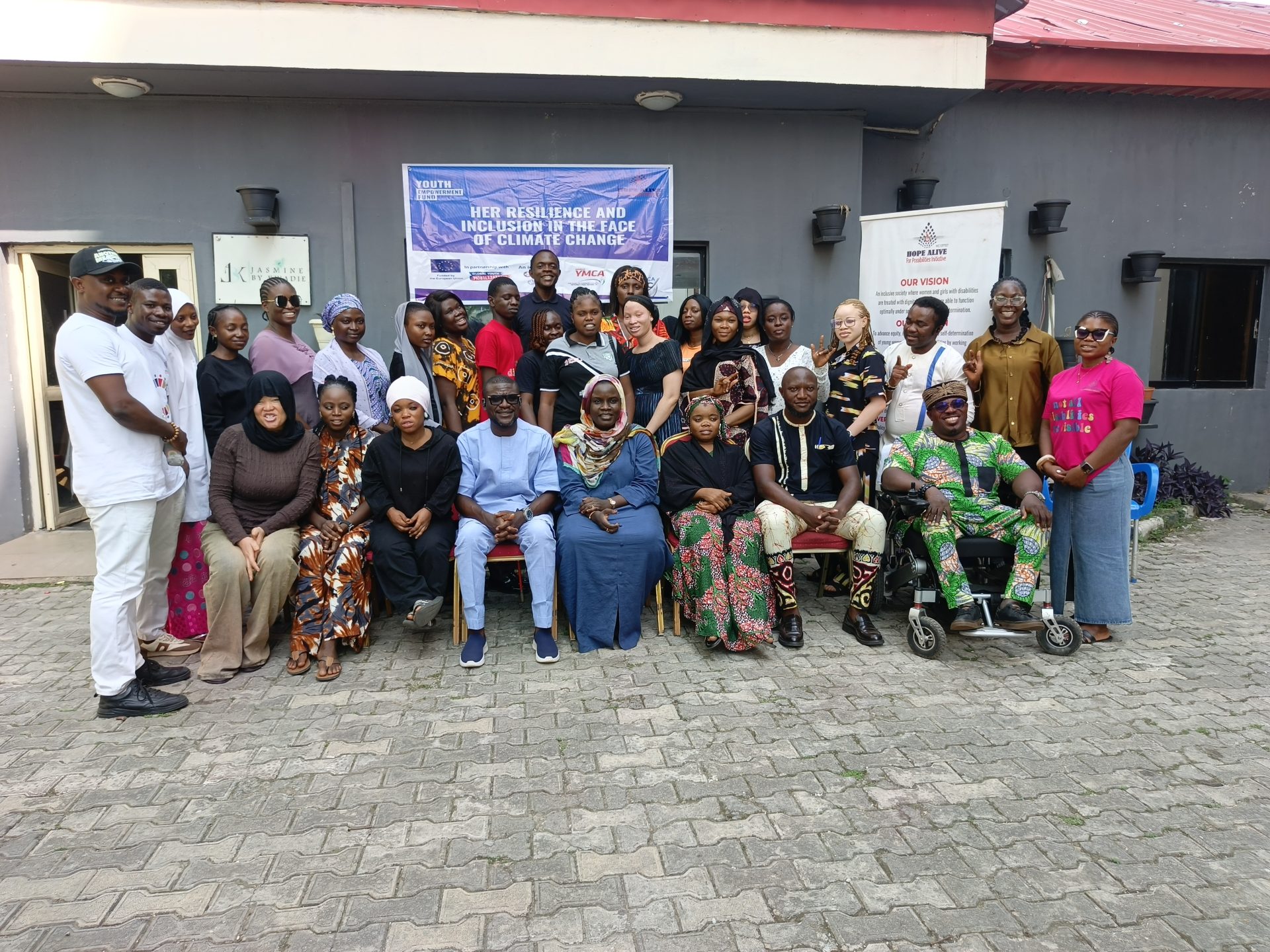
HAPI, on Wednesday in Abuja, organized a One-Day Capacity Building Training on Climate Resilience and Disaster Preparedness for young girls with disabilities, aimed at equipping them with the knowledge, skills, and confidence needed to prepare for, respond to, and adapt to climate-related challenges and emergencies.
The training is being implemented in partnership with the Global Youth Mobilization and funded by the European Union as part of efforts to build a more inclusive and resilient society where persons with disabilities, especially girls and young women, are actively involved in climate governance and disaster risk reduction initiatives.
The event brought together young girls with disabilities, climate experts, development practitioners, and stakeholders committed to promoting disability-inclusive climate action.
Speaking at the opening ceremony, the Executive Director of HAPI, Aver Akighir, represented by Agyesopa Isaac Onyatikpo, Programmes Intern, welcomed participants, facilitators, and members of the media, stressing the urgent need to strengthen inclusive responses to climate change and disasters.
According to him, climate-related emergencies disproportionately affect vulnerable groups, particularly persons with disabilities, who often encounter barriers in accessing information, emergency services, humanitarian assistance, and support systems during crises.
He noted that the training was designed to enhance participants’ understanding of climate resilience and disaster preparedness while promoting practical and disability-inclusive approaches to community action and emergency response.
“We are grateful for your presence and commitment to strengthening inclusive responses to the growing impacts of climate change and disasters within our communities,” he said.
“Across Nigeria, climate-related emergencies continue to disproportionately affect vulnerable populations, particularly persons with disabilities, who often face barriers in accessing information, services, and support during emergencies.”
He further acknowledged the support of Global Youth Mobilization and the Youth Empowerment Fund for making the initiative possible and encouraged participants to actively engage throughout the training by sharing experiences and learning from one another.
The Program Officer of HAPI, Mercy Jovkyundan, explained that the initiative forms part of a broader strategy to strengthen the capacity of young persons with disabilities to participate meaningfully in climate governance across North-Central Nigeria.
She revealed that previous engagements with young girls with disabilities showed a significant knowledge gap regarding climate change and environmental issues, making it necessary to invest in targeted capacity-building programmes.
According to her, the training will prepare participants to engage effectively in climate negotiations and advocacy processes while providing them with practical tools to influence government policies and programmes toward greater inclusion.
“This event is part of our broader effort to strengthen the capacity of young people with disabilities to influence climate governance in North-Central Nigeria,” she stated.
“From our previous engagements with young girls with disabilities, we discovered a need to build their capacity on climate change issues. This will support them to participate in climate negotiations and equip them with the tools required to engage government institutions and advocate for inclusive climate policies and programmes.”
She further disclosed that HAPI intends to facilitate engagements between the trained girls and key government agencies, including the National Emergency Management Agency (NEMA), to demand greater recognition of the rights and needs of persons with disabilities in climate-related policies and disaster management frameworks.
Mercy also announced plans by the organization to convene a National Climate Negotiation Programme that will prepare young persons with disabilities for participation in national and international climate conferences, including future global climate change negotiations.
A climate instructor and researcher Dr. Tine Agernor, who served as the lead facilitator, highlighted the importance of climate education for women and girls with disabilities.
He expressed concern that persons with disabilities, particularly women and girls, are frequently excluded from climate action discussions, policy formulation, emergency planning, adaptation programmes, and disaster response mechanisms.
According to him, disability inclusion must become a central component of climate policies and programmes if societies are to achieve sustainable and equitable climate solutions.
“It is imperative that women and girls with disabilities receive climate education and are actively involved in climate action,” he said.
“It is disheartening that persons with disabilities, especially women and girls, are often left out of climate policies, planning, and response efforts. We must intentionally include them in climate action to achieve truly disability-inclusive climate responses.”
Participants described the training as transformative and empowering, noting that it enhanced their understanding of climate change and their role in promoting inclusive climate action.
One of the participants, Divine Love, a blind young woman, expressed gratitude to HAPI for organizing the programme, describing it as an eye-opening experience.
She said the training had broadened her understanding of climate issues and strengthened her capacity to advocate for the inclusion of girls with disabilities in climate action initiatives across Nigeria.
“This programme has given me a better understanding of climate change and equipped me with the knowledge and confidence to advocate for greater inclusion of girls with disabilities in climate-related activities and policies,” she said.
Another participant, Peter Happiness, a 16-year-old amputee, said she gained valuable lessons on personal safety and disaster preparedness.
According to her, the training taught her the importance of paying attention to climate information and early warning signals, maintaining emergency contacts, and taking precautionary measures during emergencies.
She added that she learned practical safety tips such as avoiding overcrowded places during emergencies and remaining alert to signs that may indicate potential climate-related disasters.
Similarly, Susan Adams, a blind participant, told TQM that the knowledge gained during the training would help her become more proactive in climate advocacy and disaster preparedness.
She said she now understands the importance of regularly monitoring weather forecasts, taking preventive measures against climate-related risks, and conducting further research to deepen her knowledge of climate change.
“I will use what I have learned to engage others in my community and promote awareness about climate change. I also intend to regularly monitor weather forecasts and continue learning more about climate-related issues,” she said.
The training concluded with a renewed commitment from participants to become advocates for disability-inclusive climate action and disaster preparedness within their communities.
For many of the young girls in attendance, the programme represented more than a learning opportunity—it was a platform for empowerment, leadership development, and active participation in shaping a climate-resilient future.
As climate change continues to pose serious challenges across Nigeria and beyond, stakeholders at the event emphasized that meaningful climate action cannot be achieved without the inclusion of persons with disabilities, particularly women and girls whose voices have historically been marginalized in climate governance discussions.
Through initiatives such as this, HAPI is helping to ensure that young girls with disabilities are not only protected from the impacts of climate change but are also empowered to become leaders, advocates, and agents of change in the movement toward a safer, more inclusive, and climate-resilient society.
Click the link below to join our WhatsApp channel


