

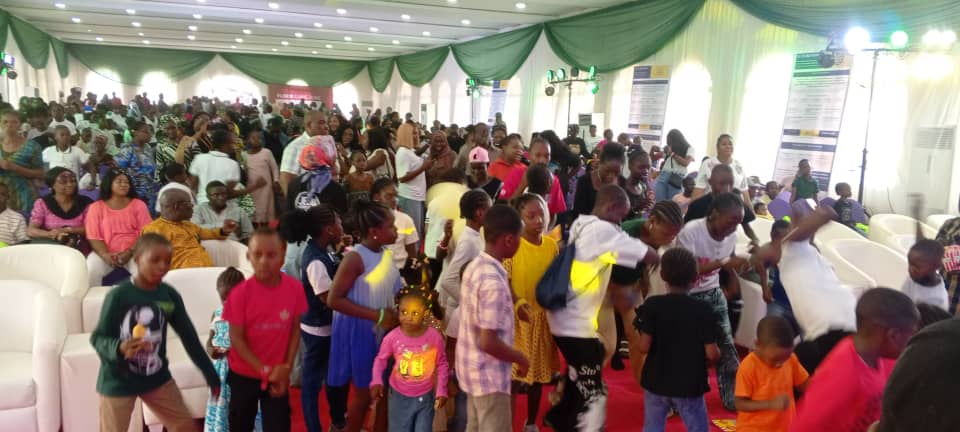
The National Commission for Persons with Disabilities has made a passionate call for the full inclusion, protection, and empowerment of children with disabilities across Nigeria, warning that millions of vulnerable children continue to face discrimination, neglect, and exclusion from basic opportunities meant for every Nigerian child.
The call was made by the Executive Secretary of the Commission, Hon. Ayuba Burki Gufwan, in a stirring message to commemorate the 2026 Children’s Day celebration.
Speaking on the theme, “For Every Child, Every Right: Leaving No Child Behind,” Gufwan described the theme as both timely and deeply reflective of the harsh realities confronting children with disabilities in Nigeria.
In an emotional and strongly worded address, the NCPWD boss challenged Nigerians to rethink how society treats children with disabilities, insisting that they must no longer remain invisible in national development conversations.
“Today, I ask Nigeria to do something special: to see the children we often do not see and to hear the voices we often do not hear,” he declared.
According to him, more than seven million children with disabilities spread across Nigeria’s 8,804 wards continue to suffer exclusion from education, healthcare, recreation, and social participation because of stigma, poverty, inaccessible infrastructure, and weak implementation of inclusive policies.
He lamented that many children who are blind, deaf, autistic, living with cerebral palsy, albinism, intellectual disabilities, or mobility challenges are still denied opportunities that many other children take for granted.
“Too many of them wake up to locked school gates. Too many sit at home while their peers recite the National Anthem in classrooms. Too many are hidden because of stigma, poverty, and buildings that were never built with them in mind. That must end,” Gufwan stated passionately.
The NCPWD Executive Secretary stressed that under the Renewed Hope Agenda of President Bola Ahmed Tinubu, Nigeria has another opportunity to build a nation where no child is excluded because of disability.
He noted that the treatment of vulnerable citizens remains one of the strongest indicators of a nation’s moral and developmental strength.
“A nation is not measured by how it treats its strongest, but by how it lifts its most vulnerable,” he said.
“A child in a wheelchair who cannot enter her classroom is not just her family’s problem; it is Nigeria’s loss. A deaf child who has no teacher who signs is not just silent; our future is silent.”
Gufwan emphasized that investing in inclusive education, accessible playgrounds, disability-friendly schools, assistive devices, and early intervention services should not be viewed as charity, but as a strategic investment in Nigeria’s future.
“Disability is not inability,” he affirmed.
Highlighting some of the achievements recorded by the Commission over the past year, the NCPWD boss disclosed that more than 50,000 assistive devices, including wheelchairs, hearing aids, white canes, and educational learning kits, had been distributed to children with disabilities across 24 states of the federation.
He further revealed that the Commission partnered with State Universal Basic Education Boards (SUBEBs) to train over 1,200 teachers on inclusive education and sign language communication.
According to him, the Commission also launched the “No Child Left Behind” Ward Initiative aimed at taking disability screening, support services, and awareness campaigns to grassroots communities nationwide.
Gufwan stated that the Commission has continued to push for the full enforcement of Section 18 of the Discrimination Against Persons with Disabilities (Prohibition) Act 2018, which guarantees free and inclusive education for children with disabilities.
Despite the progress made, he maintained that more urgent action is required from governments, institutions, communities, and stakeholders across the country.
He called on state governments and education authorities to ensure that all newly constructed schools are fully accessible to children with disabilities while also making budgetary provisions for inclusive education and special needs support.
The NCPWD boss also advocated for the implementation of the not-less-than five percent employment and empowerment quota for persons with disabilities, stressing that empowering parents and caregivers would significantly improve the welfare and future of children with disabilities.
Addressing parents directly, Gufwan urged families to reject shame and stigma and instead embrace their children with pride, dignity, and confidence.
“Your child is not a curse. Your child is a gift. Do not hide them. Bring them out. Enroll them. Let them play. The Commission stands with you,” he stated.
In one of the most emotional moments of his address, the NCPWD Executive Secretary delivered a powerful message of hope to children with disabilities across Nigeria, encouraging them not to allow society’s limitations define their dreams.
“To children with disabilities: You are seen. You are heard. You are loved. Your wheelchair can take you to Aso Rock. Your white cane can lead a nation. Your silence can write laws. Never let anyone tell you otherwise. Nigeria needs your brilliance,” he declared.
He concluded by urging Nigerians to collectively build an inclusive society through accessible schools, compassionate communities, stronger policies, and respect for the dignity and rights of every child regardless of disability status.
“May all Nigerian children grow in wisdom, strength, and joy. May Nigeria grow because of you,” he added.
The National Commission for Persons with Disabilities reaffirmed its commitment to promoting the rights, welfare, inclusion, and empowerment of persons with disabilities in line with the provisions of the Discrimination Against Persons with Disabilities (Prohibition) Act 2018.
The statement has continued to generate reactions among disability advocates, education stakeholders, and human rights groups who believe that genuine national development cannot be achieved while millions of children with disabilities remain excluded from opportunities and participation in society.
Click the link below to join our WhatsApp channel


