

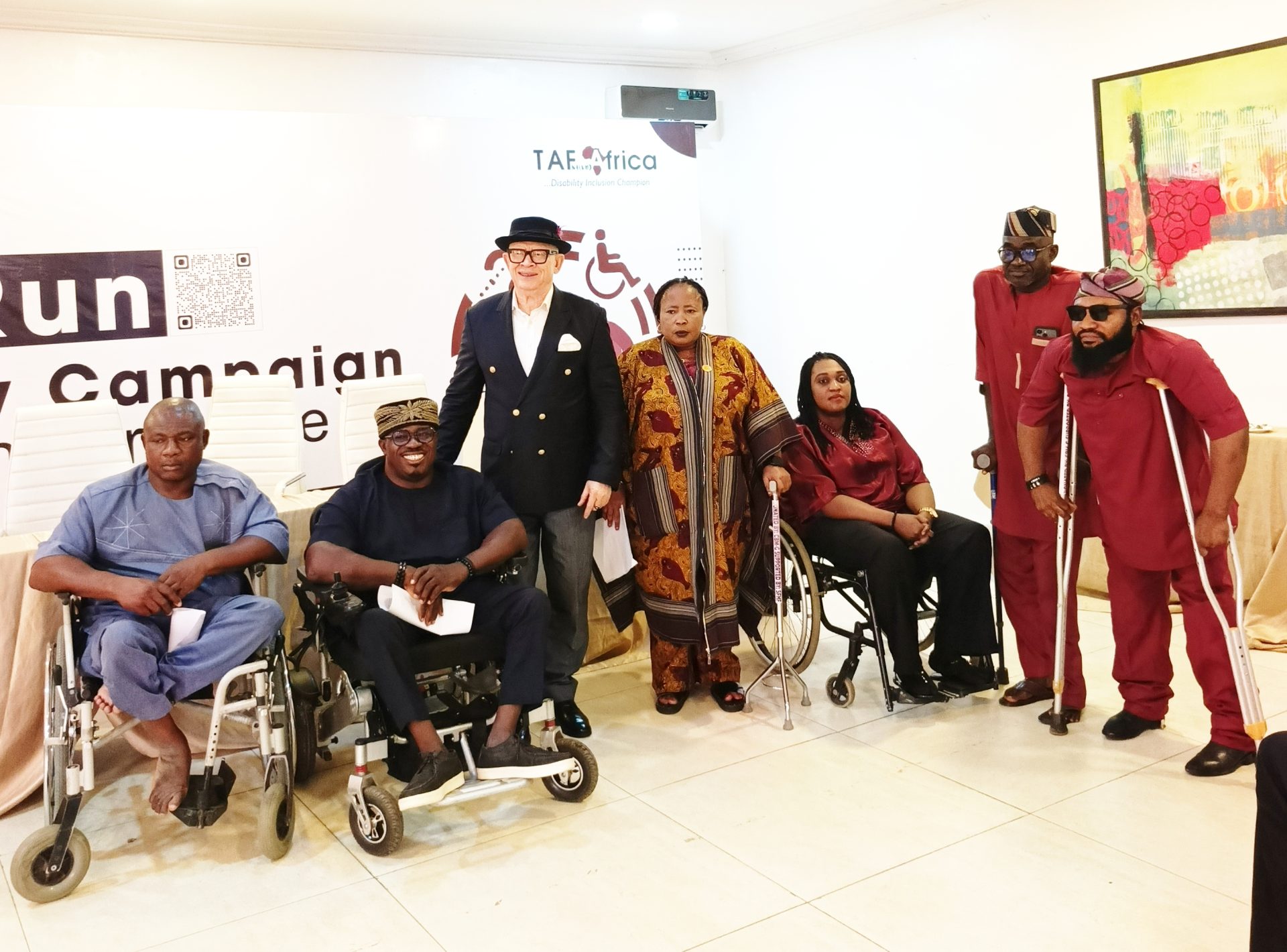
The Founder of The All-Rights Foundation Africa, TAF Africa, Amb. Jake Epelle, has called on political parties, electoral stakeholders and democratic institutions in Nigeria to move beyond symbolic inclusion of Persons With Disabilities (PWDs) and begin supporting them as candidates in the 2027 general elections.
Epelle made the call on Tuesday in Abuja during the inauguration of the Able2Run Electability Campaign, an initiative supported by the European Union and aimed at strengthening the political participation of persons with disabilities across Nigeria.
Speaking passionately at the event, Epelle said Nigeria’s democracy would remain incomplete if millions of persons with disabilities continued to be sidelined from leadership positions, elective offices and political decision-making processes.
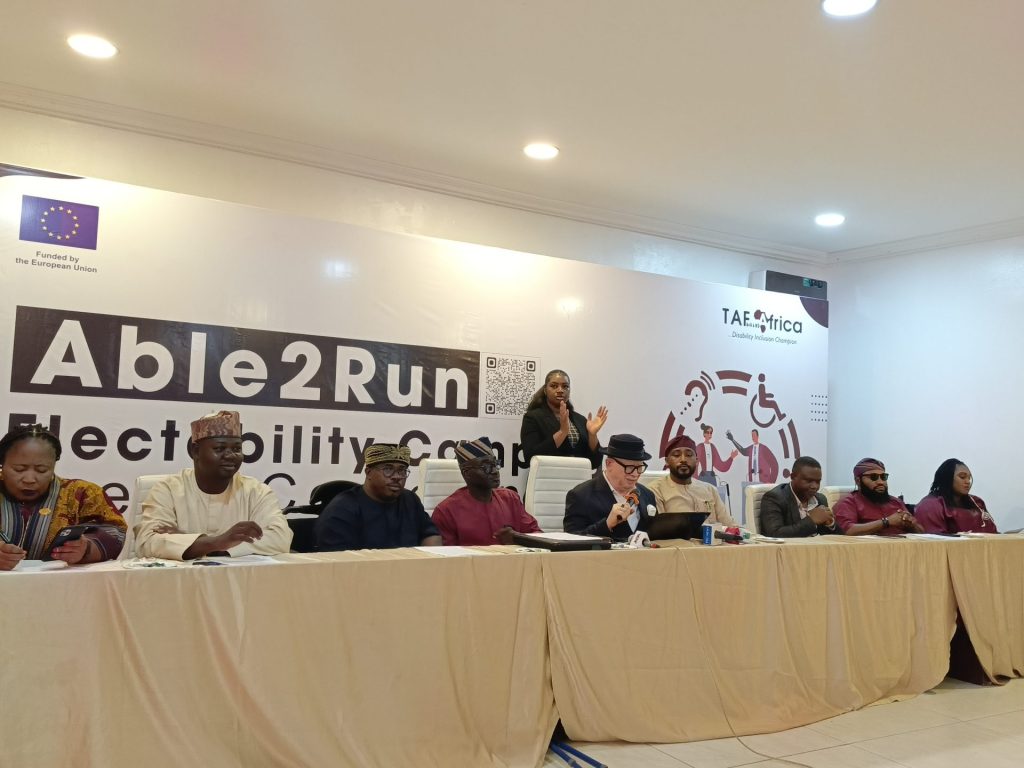
According to him, disability inclusion must go beyond allowing persons with disabilities to vote during elections, stressing that they should also be given equal opportunities to contest and occupy elective positions at all levels of governance.
“We want elections where the winner will truly emerge through credible democratic processes,
elections free from insecurity and vote-buying, and elections the international community can proudly describe as democratic,” Epelle stated.
He challenged political parties to deliberately create enabling environments for aspiring politicians with disabilities, lamenting that most party manifestos fail to provide clear opportunities for PWDs seeking elective positions.
“Tell me one political party manifesto that intentionally creates opportunities for persons with disabilities to contest for elective positions. Democracy must first begin within the political parties themselves,” he said.
Epelle further condemned what he described as tokenistic representation of persons with disabilities in governance structures, insisting that disability desk officers in political parties and public institutions should themselves be persons living with disabilities in order to ensure genuine and effective representation.
According to him, the Able2Run Campaign was designed to deepen national conversations around disability inclusion while confronting stereotypes and societal misconceptions that wrongly associate disability with inability.
“Disability is not incapacity. The real barriers are the structural and societal obstacles that prevent participation. Throughout history, disability has never stopped great leadership,” Epelle declared.
He also commended the Independent National Electoral Commission for efforts made toward inclusive electoral reforms, while urging Nigerians, political institutions and democratic actors to intensify efforts toward building a truly inclusive democracy.
In his remarks, disability inclusion advocate Esrom Ajanya described persons with disabilities as a major political constituency capable of significantly influencing electoral outcomes if adequately mobilised ahead of future elections.
Ajanya cited estimates by the World Health Organization showing that approximately 16 per cent of the global population lives with one form of disability or another.
Applying the estimate to Nigeria’s population, he said the country currently has about 34.9 million persons with disabilities, representing a powerful electoral bloc that can no longer be ignored in Nigeria’s democratic equation.
“Applying this estimate to Nigeria means there are approximately 34.9 million persons with disabilities, which represents a huge political and electoral force,” Ajanya noted.
Despite constitutional protections and legal frameworks promoting equal participation, Ajanya lamented what he described as the alarming political exclusion of persons with disabilities across Nigeria.
He revealed that studies conducted by TAF Africa between 2019 and 2025 showed that fewer than four elected persons with disabilities currently occupy elective positions across all tiers of government nationwide.
“This accounts for less than 0.1 per cent of elective positions in Nigeria, and more disturbing is the fact that none of them are women with disabilities,” he said.
Ajanya further disclosed that over 99 per cent of political positions occupied by persons with disabilities in Nigeria were appointive rather than elective, a situation he said raises serious concerns about tokenism and weak democratic representation.
According to him, only 116 persons with disabilities contested elective offices across Nigeria between 2019 and 2025 despite growing advocacy for inclusion and constitutional guarantees protecting their political rights.
“Political power is rarely handed over voluntarily. It is contested, negotiated and earned. The time has come for persons with disabilities to move from the political margins to the centre of leadership,” Ajanya stressed.
He identified inaccessible polling units, discriminatory attitudes, widespread poverty and exclusion within political parties as some of the major barriers preventing persons with disabilities from fully participating in Nigeria’s political and electoral processes.
Ajanya also alleged that fewer than 100,000 registered voters currently have their disability data captured by INEC, describing the figure as grossly inadequate and reflective of deep institutional gaps in Nigeria’s electoral system.
He therefore called on political parties to adopt deliberate disability inclusion policies, affirmative action measures and disability quotas for both elective and appointive positions.
As part of efforts to address the challenge, Ajanya announced that TAF Africa had launched a free national mentorship and coaching programme for aspiring politicians with disabilities under the EU-Support to Democratic Governance Programme.
He explained that the initiative would establish political incubation hubs across Nigeria’s six geopolitical zones while mentoring at least 180 aspiring politicians with disabilities in leadership development, political strategy and campaign management.
“This programme is completely free. What is needed is commitment, courage and the determination to lead,” Ajanya stated while encouraging persons with disabilities to actively participate in politics and governance.
He also urged religious leaders, traditional rulers, civil society organisations, the media and other stakeholders to champion disability-inclusive democracy and support increased political representation for persons with disabilities across Nigeria.
The inauguration of the Able2Run Electability Campaign is expected to further strengthen advocacy efforts aimed at ensuring that persons with disabilities are not merely seen as voters during elections, but as credible leaders, policymakers and active participants in Nigeria’s democratic development.
Click the link below to join our WhatsApp channel


