

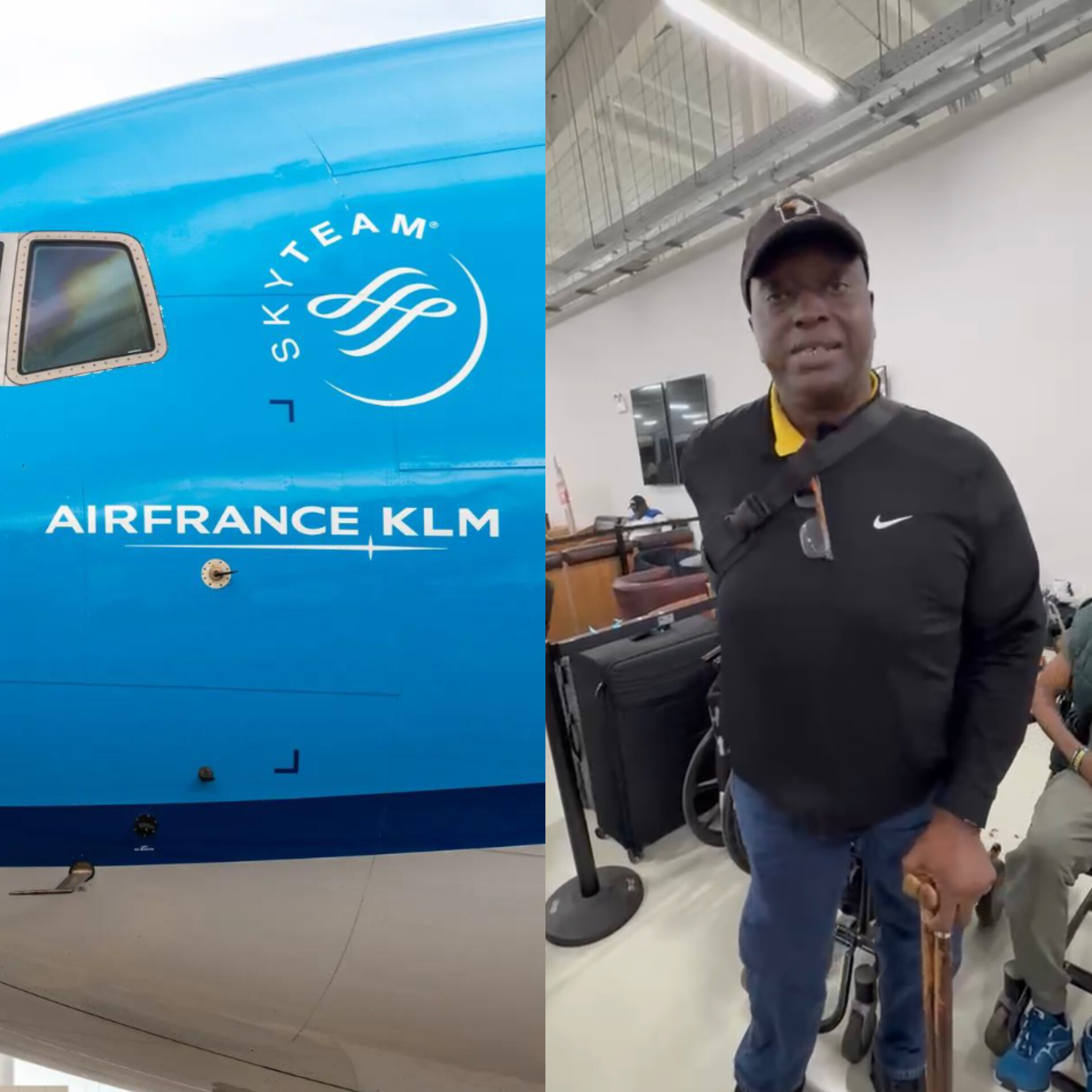
A fresh controversy has erupted in Nigeria’s aviation sector after a United Kingdom-based Nigerian businessman and polio survivor, Mr. Bode Ojuri, accused airline officials and airport authorities of discrimination, humiliation, and violation of his rights after he was allegedly denied boarding at the Murtala Muhammed International Airport, Lagos, because he uses a wheelchair.
The incident, which occurred on April 20 and 21, 2026, has sparked outrage among disability rights advocates, who say the development exposes the persistent barriers and discrimination faced by Persons With Disabilities (PWDs) in Nigeria despite existing disability laws.
According to Bode Ojuri, a 54-year-old real estate consultant based in the United Kingdom, he travelled to Nigeria aboard a KLM flight without any difficulty. He explained that during his arrival in Nigeria, his wheelchair was properly handled and he experienced no form of discrimination or obstruction.
However, trouble reportedly began when he attempted to return to the UK through the Murtala Muhammed International Airport, Lagos.
Narrating his ordeal, Ojuri said he arrived at the airport early on April 20, expecting to receive the same assistance and priority usually accorded to passengers with disabilities. Instead, he was allegedly shocked when KLM agents refused to process him for boarding.
According to him, airline officials informed him that wheelchair users could not be boarded on the aircraft because the airport’s Ambi-Lift — the equipment used to lift passengers with mobility impairments into aircraft — was not functional.
Determined not to miss his flight, Ojuri reportedly volunteered to walk up the aircraft stairs himself. Despite this, he said he was still denied boarding.
For several hours, he remained stranded at the airport while efforts to resolve the issue proved unsuccessful. He reportedly contacted KLM officials in the Netherlands in a desperate attempt to intervene, but the situation remained unresolved.
Eventually, Ojuri missed his flight and was allegedly informed that he would be rescheduled for the following day.
Left stranded in Lagos, the businessman said he had to secure accommodation at a nearby hotel and spend the night at his own expense.
More shocking, according to him, was the instruction allegedly given by KLM agents that he should return the next day without his wheelchair because they would not board it.
The following day, April 21, Ojuri returned to the airport hoping the issue had been resolved. However, he claimed the airline initially slammed him with a $1,010 charge for missing his previous flight.
He said it took lengthy conversations involving KLM representatives in the United Kingdom and the Netherlands before the fee was eventually waived after he explained the circumstances surrounding his inability to board.
But the drama was far from over.
Ojuri alleged that a female KLM agent insisted he must publicly demonstrate his ability to walk before he could be allowed to board the aircraft.
Ironically, according to him, airport personnel and security officials had already witnessed him walking through security checks because he had complied with instructions not to come with his wheelchair.
Nevertheless, in what he described as a humiliating and degrading experience, Ojuri said he was compelled to showcase how he walked in front of airline officials simply to prove he could board the plane.
“Just for peace to reign and because I needed to return to London urgently for appointments, I had to comply,” he reportedly said.
Even after complying, the situation allegedly worsened when the same airline official reportedly accused him of making threats and again refused to check him in.
The incident soon attracted attention from passengers, onlookers, and airport security officials, who reportedly intervened as tensions escalated.
It reportedly took the intervention of the airline manager before the matter was eventually resolved and Ojuri was finally allowed to board the flight to the United Kingdom.
Upon arriving in the UK, Ojuri said he was forced to purchase another wheelchair after leaving his previous one behind in Nigeria due to the restrictions allegedly imposed on him.
Refusing to let the matter go unresolved, Ojuri formally wrote to KLM demanding explanations and accountability over the incident.
According to him, the airline responded by stating that its agents were merely complying with directives allegedly issued by Nigerian aviation authorities, which instructed airlines not to board wheelchair users because the airport’s Ambi-Lift facilities were faulty.
The revelation has triggered widespread criticism from disability rights advocates, who argue that denying passengers with disabilities access to flights because of infrastructural failures amounts to blatant discrimination and a violation of both local and international disability rights laws.
Ojuri has vowed to pursue justice through every available legal and diplomatic channel.
He maintained that his fundamental rights were violated and insisted he would continue to escalate the matter until those responsible are held accountable.
“I cannot have peace of mind until justice is done,” he said.
In a sharp criticism of the Nigerian government, Ojuri also took a swipe at President Bola Ahmed Tinubu, questioning how the government could actively engage Nigerians in the diaspora abroad while failing to guarantee basic dignity and accessibility for citizens with disabilities at home.
The incident has renewed concerns over the poor state of accessibility infrastructure across Nigerian airports and the apparent lack of adequate protection for Persons With Disabilities despite the existence of the Discrimination Against Persons with Disabilities (Prohibition) Act.
Stakeholders are now calling on the Minister of Aviation, Festus Keyamo, the Nigerian Civil Aviation Authority (NCAA), and the Federal Airports Authority of Nigeria (FAAN) to urgently investigate the matter and address the growing concerns over accessibility and discriminatory treatment of passengers with disabilities in Nigerian airports.
Advocates say the issue goes beyond one individual’s experience, warning that it reflects a systemic problem capable of discouraging Persons With Disabilities from travelling, working, and participating fully in society.
Many are also questioning why Nigerian authorities would allegedly issue directives restricting wheelchair users from boarding flights instead of urgently fixing essential accessibility equipment such as Ambi-Lifts.
As public outrage continues to grow, disability rights groups are expected to intensify demands for accountability, policy reforms, and improved accessibility standards across Nigeria’s aviation sector.
Click the link below to join our WhatsApp channel


