

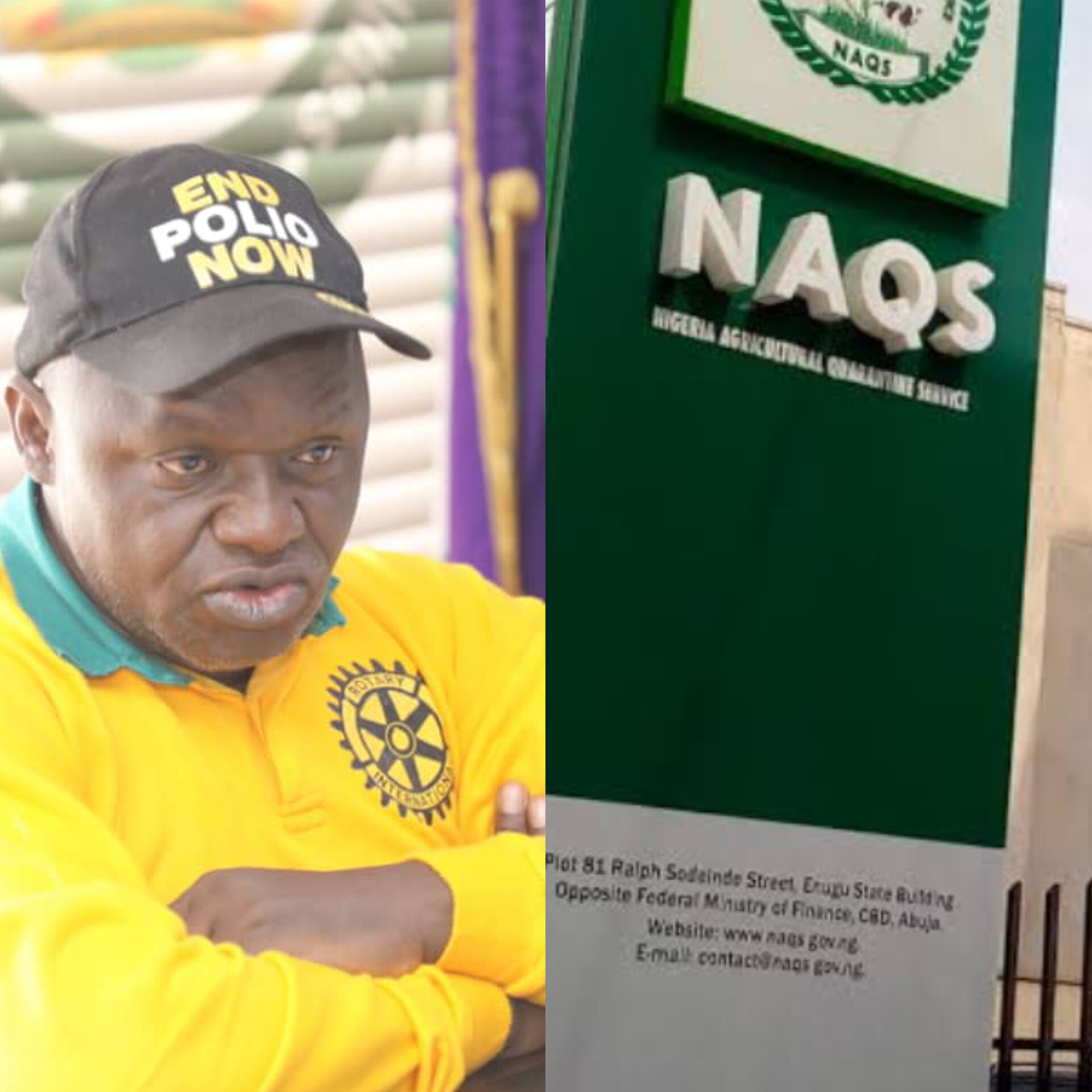
By TQM News,
The National Commission for Persons with Disabilities (NCPWD) has strongly condemned the recruitment advertisement issued by the Nigeria Agricultural Quarantine Service (NAQS), describing it as discriminatory, unlawful, and a direct violation of the rights of millions of Nigerians with disabilities.
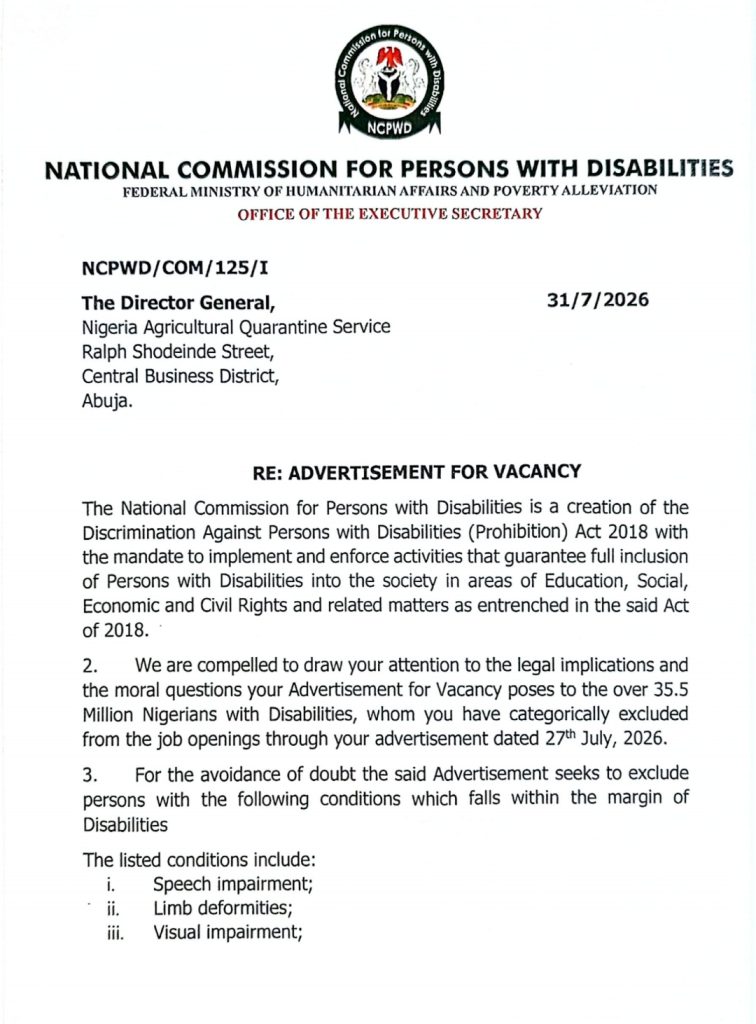
In a strongly worded letter dated July 31, 2026, and signed by the Executive Secretary of the Commission, Chief Ayuba Burki Gufwan, the Commission called on the Director General of the Nigeria Agricultural Quarantine Service to immediately withdraw the controversial vacancy advertisement and re-advertise the positions in line with Nigeria’s disability inclusion laws.
The Commission argued that the recruitment notice, published on July 27, 2026, unfairly excluded persons with disabilities from applying for employment, despite existing national laws that prohibit discrimination in recruitment and employment.
Recruitment Advert Sparks Outrage
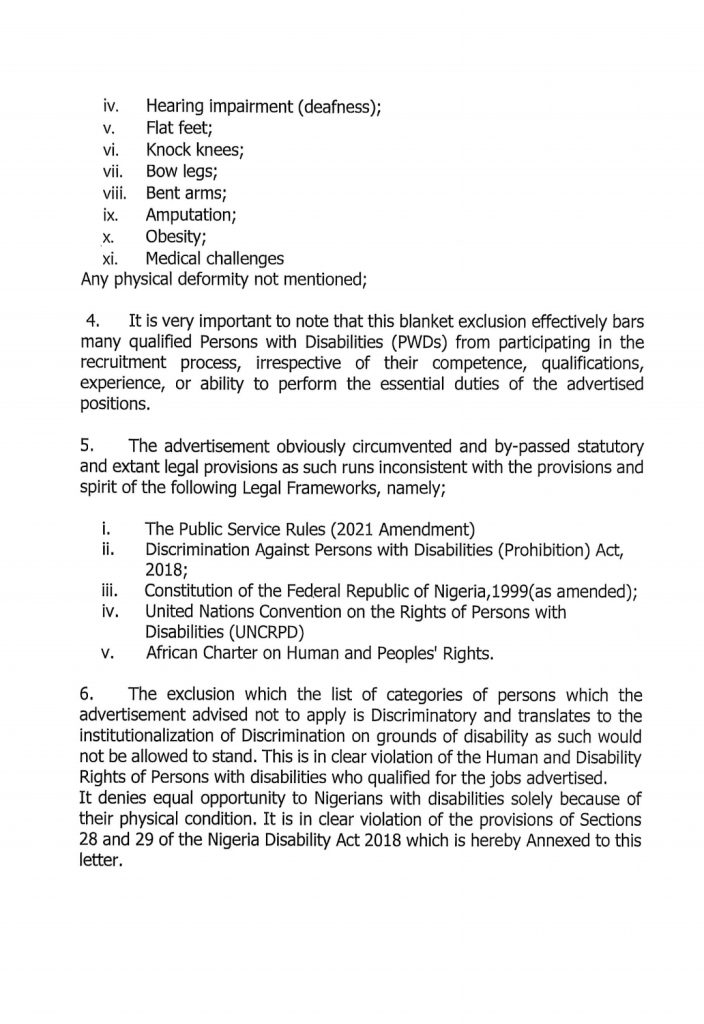
According to the NCPWD, the recruitment advertisement specifically listed several medical conditions and physical characteristics as grounds for disqualification. These include speech impairment, hearing impairment (deafness), visual impairment, limb deformities, amputation, bow legs, knock knees, bent arms, flat feet, obesity, medical challenges, and even “any physical deformity not mentioned.”
The Commission said these conditions clearly fall within the definition of disability under the Discrimination Against Persons with Disabilities (Prohibition) Act, 2018, making the exclusions both discriminatory and illegal.
Describing the advertisement as a blanket exclusion, the Commission noted that it effectively denies qualified Nigerians with disabilities the opportunity to compete for public service jobs regardless of their educational qualifications, professional competence, work experience, or ability to perform the essential functions of the advertised positions.
“A Violation of Nigerian and International Laws”
The Commission emphasized that the recruitment policy runs contrary to several legal frameworks that protect the rights of persons with disabilities.
These include:
- The Public Service Rules (2021 Amendment);
- The Discrimination Against Persons with Disabilities (Prohibition) Act, 2018;
- The Constitution of the Federal Republic of Nigeria, 1999 (as amended);
- The United Nations Convention on the Rights of Persons with Disabilities (UNCRPD); and
- The African Charter on Human and Peoples’ Rights.
According to the Commission, the recruitment exercise institutionalizes discrimination solely on the basis of disability and violates Sections 28 and 29 of the Disability Act, which prohibit discrimination in employment and guarantee equal opportunities for qualified persons with disabilities.
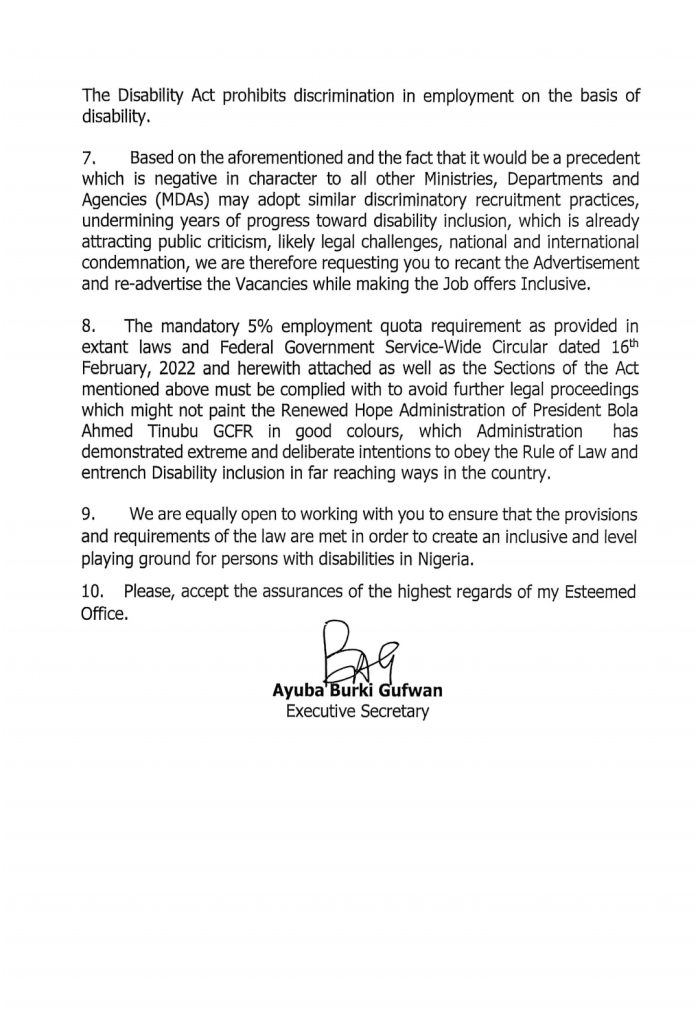
The Commission reminded the agency that the Disability Act expressly prohibits discrimination in employment on the basis of disability.
Over 35.5 Million Nigerians Affected
The NCPWD stated that the implications of the advertisement extend far beyond a single recruitment exercise.
It noted that more than 35.5 million Nigerians with disabilities stand to be affected by such exclusionary policies, warning that allowing the advertisement to stand would set a dangerous precedent for other Ministries, Departments and Agencies (MDAs).
According to the Commission, if unchecked, other government institutions could adopt similar discriminatory recruitment practices, reversing years of progress made toward disability inclusion in Nigeria.
The Commission further warned that such actions could expose the Federal Government to public criticism, legal challenges, and international condemnation over violations of disability rights.

NCPWD Demands Immediate Action
To prevent further violations, the Commission urged the Nigeria Agricultural Quarantine Service to immediately withdraw the advertisement and publish a fresh recruitment notice that complies with the provisions of the Disability Act.
It also reminded the agency of the mandatory 5% employment quota for persons with disabilities as provided under the Federal Government Service-Wide Circular issued on February 16, 2022, stressing that compliance is not optional but a legal obligation.
According to the Commission, adherence to the quota and other disability inclusion provisions would help avoid unnecessary legal proceedings and reinforce the Federal Government’s commitment to the rule of law and inclusive governance.
The Commission also observed that compliance would align with the Renewed Hope Agenda of President Bola Ahmed Tinubu, GCFR, whose administration has repeatedly demonstrated its commitment to strengthening disability inclusion and ensuring respect for the rights of persons with disabilities.
Commission Offers Collaboration
Rather than limiting its intervention to criticism, the NCPWD extended a hand of partnership to the Nigeria Agricultural Quarantine Service.
The Commission expressed its willingness to work closely with the agency to ensure that future recruitment exercises fully comply with disability laws and create an equitable recruitment process where qualified Nigerians with disabilities can compete on merit.
It maintained that creating an inclusive public service is not only a legal requirement but also essential for national development and equal opportunity.
A Defining Test for Inclusive Governance
The Commission’s intervention has once again brought national attention to the persistent barriers persons with disabilities continue to face in accessing employment opportunities despite the existence of robust legal protections.
Disability rights advocates have long argued that inclusive employment should be based on competence and the ability to perform essential job functions, rather than assumptions about disability or physical appearance.
As the Nigeria Agricultural Quarantine Service considers the Commission’s demands, many stakeholders will be watching closely to see whether the agency revises its recruitment policy and aligns it with Nigeria’s Disability Act and international human rights obligations.
The outcome of this matter is expected to serve as an important test of the Federal Government’s commitment to enforcing disability rights, promoting equal opportunity, and ensuring that no qualified Nigerian is denied employment solely because of disability.


