

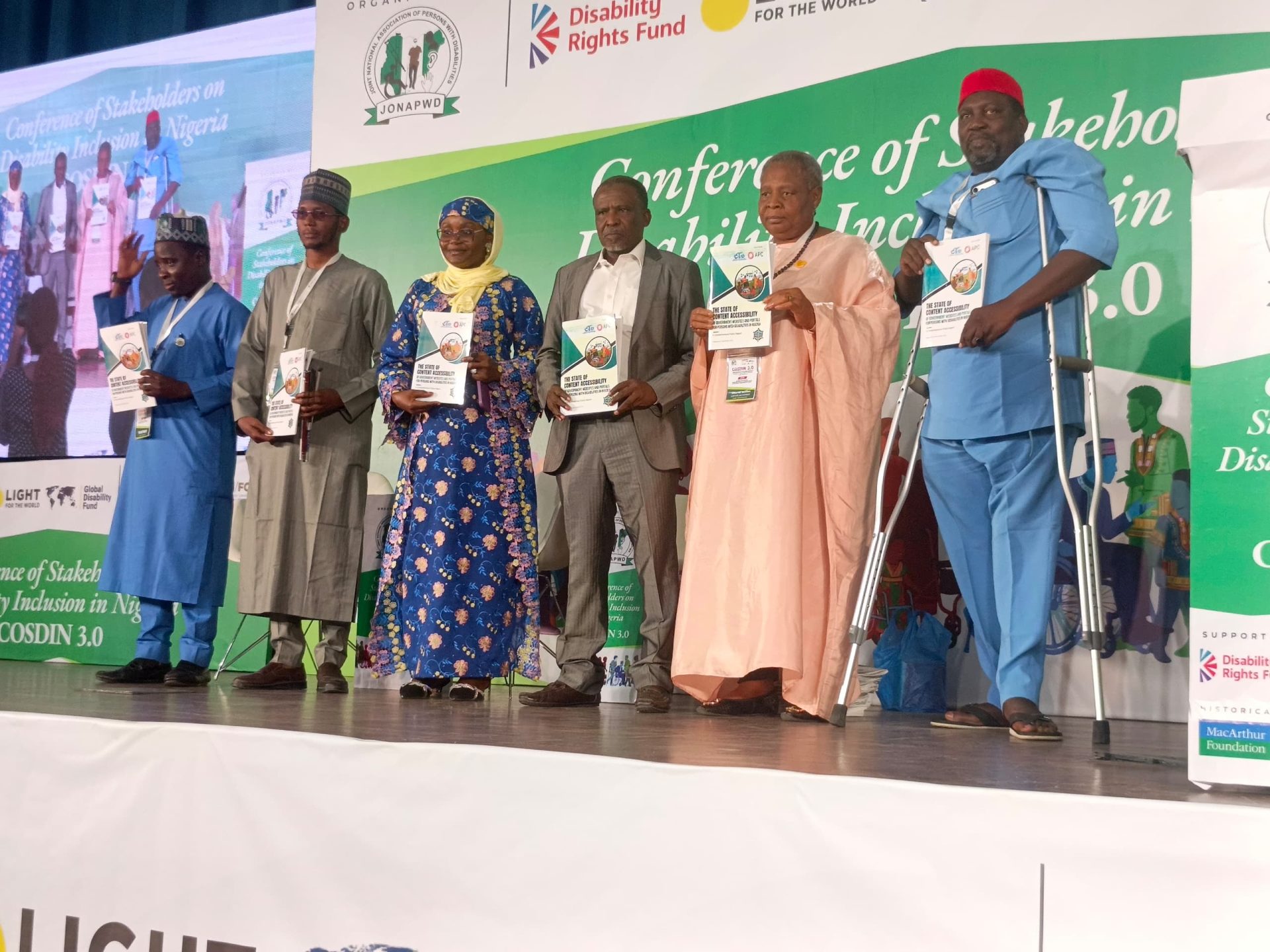
JONAPWD National President Abdullahi Adamu Aliyu has challenged political parties, government institutions and other stakeholders to move beyond tokenistic disability inclusion and ensure meaningful political representation, leadership, accountability and participation of persons with disabilities ahead of Nigeria’s 2027 general elections.
The Joint National Association of Persons with Disabilities (JONAPWD) has renewed its call for meaningful representation, stronger institutional accountability and full implementation of disability rights in Nigeria, insisting that the country’s estimated 35.5 million persons with disabilities must no longer be sidelined in political decision-making and governance.
The call was made by the National President of JONAPWD, Abdullahi Adamu Aliyu, during the third edition of the Conference of Stakeholders on Disability Inclusion in Nigeria (COSDIN 3.0), an annual gathering convened by the association to bring together government officials, civil society organisations, development partners, disability advocates and other stakeholders to advance disability inclusion.
Speaking under the theme “Beyond Participation: Advancing Disability Leadership and Accountable Governance in Nigeria,” Aliyu stressed that the disability community is tired of policy declarations, conferences and promises that do not translate into tangible improvements in the lives of persons with disabilities.
He said the disability community wants to see inclusion beyond paper policies, demanding meaningful leadership, decision-making power, institutional influence and the effective implementation of disability rights across the country.
“We want to see the full implementation of disability inclusion in this country. We are tired of seeing policies talking about inclusion, inclusion and whatever, but nothing translates into actual implementation. We really want to see inclusion in practice,” he emphasised.
JONAPWD demands adequately funded disability commissions
Aliyu called on the Federal Government and state governments to prioritise the full implementation of the Discrimination Against Persons with Disabilities (Prohibition) Act, 2018, noting that although the National Commission for Persons with Disabilities (NCPWD) has been established and several states have enacted disability laws and created disability commissions, many of these institutions remain inadequately funded and lack the resources to discharge their responsibilities effectively.
He expressed concern that the establishment of disability commissions in some states has become a symbolic exercise, with little accountability, inadequate funding and limited institutional capacity to deliver on their mandates.
According to him, the mere existence of a disability commission is not enough if it lacks the financial resources, personnel and operational support required to promote and protect the rights of persons with disabilities.
Aliyu questioned the disparity between the population of persons with disabilities and the budgetary allocation to institutions responsible for their welfare and rights, arguing that the National Commission for Persons with Disabilities deserves significantly stronger financial support.
He urged governments at all levels to move beyond merely signing disability laws and establishing commissions to ensuring that these institutions are adequately funded, accountable and empowered to implement disability inclusion programmes.
“Nothing about us without us”: OPDs must lead disability advocacy
The JONAPWD President also emphasised the need for Organisations of Persons with Disabilities (OPDs) to take ownership of disability advocacy and leadership, insisting that persons with disabilities must be at the centre of conversations, policies and decisions affecting their lives.
He challenged the practice of allowing people without disabilities to speak on behalf of persons with disabilities when members of the disability community themselves are capable of articulating their needs, experiences and aspirations.
Aliyu argued that physical disabilities must never be mistaken for intellectual incapacity, stressing that mobility challenges do not diminish an individual’s ability to think, lead, advocate or make decisions.
“Being a person with a disability only means that I may not be able to walk without crutches. It does not mean that my brain cannot work without crutches. I know myself, and I am the one who should tell you what I want and what I do not want,” he said.
He called for stronger, more independent and better-equipped OPDs capable of engaging government, influencing policies, demanding accountability and championing the rights of their constituencies.

Economic empowerment and dignity remain central to inclusion
Aliyu further stressed that disability inclusion must extend beyond political participation to economic independence, dignity and access to opportunities.
He called for inclusive education, decent employment, entrepreneurship opportunities, accessible public infrastructure and stronger social protection systems to enable persons with disabilities to live independently and participate meaningfully in society.
He also urged government institutions, development partners, private sector organisations and OPDs to ensure that disability-inclusive projects are not implemented as isolated interventions but are integrated into broader development programmes and institutional reforms.
According to him, sustainable disability inclusion requires coordinated efforts, strong institutions, adequate funding, accountability and continuous engagement with persons with disabilities and their representative organisations.
2027 elections: Persons with disabilities must become a political force
As Nigeria approaches the 2027 general elections, Aliyu warned political parties and aspirants against using persons with disabilities merely to fulfil symbolic representation or tick inclusion boxes in campaign structures.
He maintained that persons with disabilities constitute a significant voting population capable of influencing electoral outcomes if they are mobilised, organised and politically engaged.
He challenged political parties and candidates seeking the support of persons with disabilities to engage directly with the disability community, present clear inclusion agendas and demonstrate concrete commitments to disability rights, representation and participation in governance.
According to him, appointing a few persons with disabilities into campaign councils without consulting the broader disability community or addressing their priorities is not meaningful political inclusion.
He insisted that the disability community must be recognised as an important constituency in Nigeria’s democratic process, with the capacity to demand accountability, negotiate political commitments and influence public policy.
Canada reaffirms commitment to disability rights and inclusive governance
In his goodwill message, Mr Omar Alihashi, Political Affairs representative of the Canadian High Commission in Nigeria, reaffirmed Canada’s commitment to advancing disability rights, inclusive governance and equal opportunities.
He described the COSDIN 3.0 theme as timely and important, noting that persons with disabilities are voters, entrepreneurs, professionals, community leaders and potential public office holders whose perspectives and leadership are essential to Nigeria’s democratic, economic and social development.
Alihashi stressed that meaningful inclusion requires persons with disabilities to exercise their rights, access opportunities and participate fully in decisions affecting their lives and communities.
He acknowledged Nigeria’s Discrimination Against Persons with Disabilities Act as an important framework for advancing disability rights, but stressed that the real challenge lies in translating its provisions into tangible improvements through accessible institutions, effective implementation and accountability.
As Nigeria approaches the 2027 elections, he said political inclusion must go beyond voting to include opportunities to contest elections, influence public policy, hold leadership positions and contribute to governance at every level.
He highlighted Canada’s longstanding engagement with JONAPWD and other Nigerian partners through initiatives supported by the Canada Fund for Local Initiatives, including programmes promoting disability rights, addressing gender-based violence and strengthening the participation of persons with disabilities in democratic processes.
He also noted Canada’s engagement in disability-inclusive sports and community activities, which create opportunities for persons with disabilities to demonstrate their abilities, build connections and participate in society.
Alihashi reaffirmed Canada’s commitment to working with Nigerian partners to advance human rights, inclusive governance and equal opportunities.
Disability commissions alone cannot guarantee inclusion — Dr Yunusa Ya’u
Dr Yunusa Ya’u of the Nigeria Civil Society Situation Room commended JONAPWD for its sustained advocacy and efforts towards advancing disability inclusion across the country.
He acknowledged that the establishment of disability commissions in several states represents an important achievement of the disability movement but warned that institutions alone cannot guarantee inclusion without sustained advocacy, political engagement and accountability.
Ya’u said persons with disabilities continue to encounter barriers in classrooms, public institutions, decision-making spaces and other areas of society, despite existing laws and policy commitments.
He called for more proactive advocacy to ensure that promises contained in legislation, policies and public commitments are translated into concrete implementation.
With the 2027 elections approaching, he urged the disability community to develop a comprehensive inclusion agenda that can serve as a tool for engaging political parties, candidates and government institutions.
He stressed that persons with disabilities must actively participate in political processes to influence policies and ensure that their priorities are reflected in governance.
Ya’u argued that persons with disabilities, having experienced exclusion and marginalisation firsthand, are well positioned to understand and articulate the imperatives of inclusion and drive sustainable reforms.
ECOWAS highlights regional disability inclusion efforts
Mrs Abimbola Oyelohunnu, Programme Officer and representative of the President of the ECOWAS Commission, commended JONAPWD for sustaining the COSDIN platform and creating opportunities for stakeholders to discuss disability inclusion.
She explained that ECOWAS has increasingly recognised the importance of disability and social inclusion in regional integration, noting that economic integration cannot be achieved without ensuring that all members of society are included.
She highlighted the ECOWAS Regional Action Plan on Disability Inclusion, adopted by ministers in 2024, alongside ongoing programmes focused on assistive devices for children with disabilities, disability data collection and institutional capacity building.
According to her, the assistive device programme is currently in its third phase and has reached approximately 1,000 children in two member states.
She also highlighted the development of the ECOWAS Disability Data Framework, designed to facilitate disability-disaggregated data collection across the region, strengthen accountability, monitor progress and inform evidence-based policymaking.
Oyelohunnu further emphasised the importance of leveraging technology for disability inclusion, investing in disability data, training institutional staff and prioritising the early identification of children with disabilities.
She also called for greater recognition of the care economy within social protection systems, particularly the unpaid and often unrecognised labour of individuals caring for children with disabilities.
Inclusive societies are more prosperous — Westminster Foundation for Democracy
Mr Adebawale Olorunmola, Country Director of the Westminster Foundation for Democracy, emphasised the relationship between economic inclusion, political participation and national development.
Referencing the book Why Nations Fail: The Origins of Power, Prosperity, and Poverty, he argued that inclusive societies create opportunities for broader participation and are more likely to achieve sustainable development.
He stressed that economic inclusion and political inclusion are interconnected, noting that persons with disabilities cannot fully participate in political processes if they are excluded from education, employment and economic opportunities.
Olorunmola commended efforts towards developing a long-term disability inclusion strategy, stressing the need for sustained implementation, monitoring, public education and accountability.
He also underscored the importance of educating Nigerians, particularly political leaders and decision-makers, on disability inclusion, noting that even basic accessibility features such as ramps are still poorly understood or implemented in many parts of the country.
Disability rights require sustained advocacy and accountability
Barrister Theophilus Odaudu, Programme Manager, Sub-Saharan Africa, Disability Rights Fund, commended JONAPWD for sustaining the annual stakeholder conference and creating a platform for discussions on the challenges and opportunities facing persons with disabilities.
He noted that the conference theme underscores the importance of meaningful participation, disability leadership and accountable governance.
The conference brought together OPD leaders from different states, development partners, caregivers, academics, government officials, media organisations and private sector representatives to deliberate on issues including accessibility, employment, discrimination, transportation, inclusive education, inclusive budgeting, political participation and institutional accountability.
COSDIN 3.0 reinforced a critical message: disability inclusion in Nigeria must move beyond representation for symbolism and policy declarations to measurable commitments, adequately funded institutions, economic opportunities, accessible systems and meaningful participation in leadership and governance.
As the country approaches the 2027 general elections, the disability community’s demand is increasingly clear: persons with disabilities must not merely be counted as voters or included as campaign decorations; they must have a seat at the decision-making table and the power to influence the policies and governance systems that shape their lives.


