

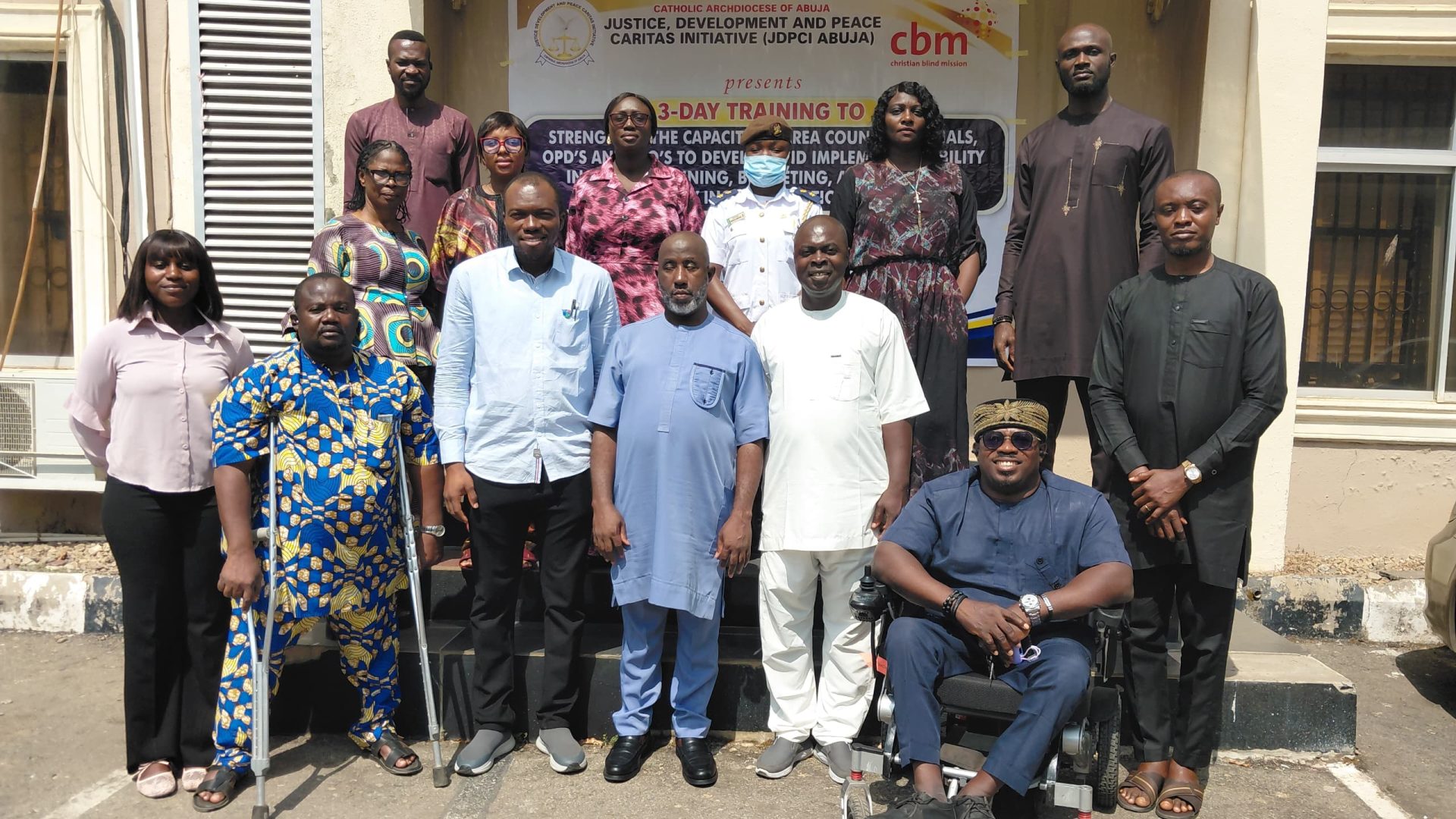
The three-day capacity-strengthening programme seeks to equip local government officials with the knowledge and practical skills to integrate disability inclusion into planning, budgeting, service delivery and employment.
The Justice, Development and Peace Caritas Initiative (JDPCI), Abuja Archdiocese, on Tuesday, November 24, 2026, commenced a three-day capacity-strengthening programme for Area Council officials, Organisations of Persons with Disabilities (OPDs) and Civil Society Organisations (CSOs) on disability-inclusive planning, budgeting and the development of Localised Disability Inclusion Action Plans.
The engagement is designed to strengthen the capacity of local government officials and other stakeholders to understand disability rights, integrate the needs of persons with disabilities into government policies and programmes, and ensure that public resources are allocated to address accessibility, reasonable accommodation and other inclusion priorities.
Speaking with The Qualitative Magazine (TQM), Timothy Eje, Director of Programmes, JDPCI, Abuja Archdiocese, who represented the Executive Director, Rev. Fr. Sebastian Sani, said the initiative was informed by the persistent exclusion of persons with disabilities from government planning and budgetary processes, particularly at the local government level.
According to him, many Ministries, Departments and Agencies (MDAs), as well as local governments, still develop budgets and implement programmes without adequately considering the needs of persons with disabilities.
He cited the accessibility challenges within the Abuja Municipal Area Council (AMAC) as an example of the consequences of inadequate disability inclusion in public planning and infrastructure development.
“We want to see how Area Council officials can develop and implement disability-inclusive plans and budgets. They need to understand how to make provisions for persons with disabilities from the beginning of their budget cycle rather than treating inclusion as an afterthought,” he said.
Eje explained that the programme would equip participants with practical knowledge to make budgetary provisions for reasonable accommodation, accessible infrastructure, assistive support and meaningful participation of persons with disabilities in governance.
He expressed the expectation that, at the end of the training, participating officials would return to their respective departments as champions of disability inclusion and begin to translate the knowledge gained into concrete institutional changes.
Local Governments Must Lead the Disability Inclusion Agenda
Highlighting the importance of local government participation in disability inclusion, Eje stressed that the three tiers of government—federal, state and local—must work together to guarantee the rights of persons with disabilities.
He noted that local governments are particularly strategic because they are closest to the people and have direct responsibility for delivering essential services to communities.
“Majority of persons with disabilities are at the local government level. They are closer to the people, and if local governments do not understand disability inclusion, there will be a huge gap in whatever they are doing,” he stated.
He further emphasised the need for Area Council officials to understand and implement the provisions of the Discrimination Against Persons with Disabilities (Prohibition) Act, 2018, particularly those relating to reasonable accommodation, accessibility, participation and equal opportunities.
Eje maintained that disability inclusion must go beyond making assumptions about what persons with disabilities need. Instead, government institutions must actively involve them in designing policies, programmes and interventions that affect their lives.
He advocated a co-creation approach in which persons with disabilities are brought into decision-making spaces to contribute their experiences and perspectives.
According to him, meaningful participation will produce more sustainable outcomes and ensure that government interventions respond to the actual needs of the disability community.
JDPCI Pushes Area Councils to Implement 5% Employment Quota
On employment, Eje welcomed the opportunity to engage Area Council officials on Section 29 of the Discrimination Against Persons with Disabilities (Prohibition) Act, 2018, which provides for a minimum of five per cent employment of qualified persons with disabilities in public organisations and private establishments.
He said the programme would use the opportunity to secure stronger commitment from participating institutions towards implementing the employment provision.
“We are going to push for them to have that at the back of their minds as they go back to their offices. They must find ways to ensure that they respect the provision of the law that says persons with disabilities should be employed,” he said.
Questioning the continued exclusion of qualified persons with disabilities from employment opportunities, Eje argued that inaccessible environments and discriminatory attitudes should not be used as excuses to deny people their right to work.
“Why would you not employ somebody who has capacity? Is it because the environment is limiting the person? So why this injustice?” he queried.
He called for a value reorientation that recognises the dignity, abilities and contributions of persons with disabilities, irrespective of their physical, sensory or intellectual conditions.
Eje also stressed the importance of eliminating derogatory expressions and discriminatory language, urging participants to become advocates of respectful communication and disability-inclusive practices within their offices and communities.
He expressed confidence that the training would produce a network of disability inclusion champions capable of influencing institutional attitudes, policies and practices beyond the duration of the programme.
NCPWD Calls for Stronger Local Government Frameworks
Speaking during the opening session, Dr. Adebukola Adebayo, the main facilitator, highlighted the strategic importance of local governments in advancing disability inclusion across Nigeria.

He emphasised the need to deepen and operationalise the local government frameworks developed by the National Commission for Persons with Disabilities (NCPWD), stressing that these frameworks must translate into practical interventions that improve the lives of persons with disabilities at the grassroots.
Adebayo noted that local governments are closer to communities and therefore better positioned to identify the specific challenges confronting persons with disabilities and respond to them through targeted planning and budgeting.
He explained that local government authorities should understand the diverse needs of persons with disabilities and make adequate provisions for essential services, including accessible infrastructure, employment opportunities, assistive devices and other support services.
He further underscored the importance of moving beyond policy commitments to measurable implementation, ensuring that disability inclusion becomes an integral part of local government administration and service delivery.
From Policy Commitments to Grassroots Action
The three-day engagement represents an important opportunity to bridge the gap between disability rights legislation and practical implementation at the grassroots level.
Although Nigeria has the Discrimination Against Persons with Disabilities (Prohibition) Act, 2018, the existence of legislation alone cannot guarantee inclusion. Its effectiveness depends largely on the willingness and capacity of government institutions to translate its provisions into policies, budgetary allocations, accessible infrastructure, employment opportunities and inclusive public services.
For Area Councils, this responsibility is particularly significant. They are often the first point of contact between government and citizens, yet persons with disabilities continue to encounter inaccessible public facilities, limited economic opportunities, inadequate assistive support and exclusion from local decision-making processes.
The real test of the JDPCI initiative, therefore, will not simply be the knowledge participants acquire during the three days, but the commitments they make and the institutional changes they implement when they return to their respective councils and organisations.
Ultimately, disability inclusion must become a budgetary priority, an administrative responsibility and a measurable development outcome—not merely a subject discussed at workshops.
Persons with disabilities must not only be considered when government plans are completed; they must be involved from the beginning, their needs must be reflected in public budgets, and their rights must be protected through effective implementation.


