

TQM News,
ABUJA — A new disability rights initiative aimed at strengthening inclusion, participation and access to opportunities for persons with disabilities in North Central Nigeria has been officially launched in Abuja.
The BASICC II Project — “Bold Action for Advancing Disability Rights and Inclusive Development in North Central Nigeria” was launched on Friday, September 11, 2026, at the Pope John Paul Catholic Centre, 27 Bangui Street, Wuse 2, Abuja.
The project is being implemented by the Justice, Development and Peace Caritas Initiative (JDPCI) Abuja, in collaboration with HOH, CEGHAD and ELIM, with support from Christian Blind Mission (CBM) International.
The initiative covers Benue State, Plateau State and the Federal Capital Territory (FCT) and brings together government institutions, Organisations of Persons with Disabilities (OPDs), civil society organisations, religious and traditional leaders, development partners and the media.
JDPCI: Inclusion Must Move Beyond Rhetoric
Delivering the welcome address, the Executive Director of JDPCI Abuja, Rev. Fr. Sebastian Sanni, PhD, described the project as more than the launch of another development intervention, saying it represents a renewed commitment to ensuring that persons with disabilities are recognised as equal participants and contributors to society.
According to him, disability inclusion cannot be achieved by persons with disabilities alone but requires collective action from government, civil society, religious and traditional institutions, communities, development partners and the private sector.
He stressed that the success of the project would not be measured merely by the number of activities conducted or people reached, but by tangible changes in attitudes, policies, systems, practices and opportunities for persons with disabilities.
Fr. Sanni also expressed appreciation to CBM International for its longstanding partnership and support for disability-inclusive development through JDPCI.
Presidency Calls for Stronger Disability Inclusion
Representing the President, Hon. Mohammed Abba Isa, Senior Special Assistant to the President on Special Needs and Equal Opportunities, commended JDPCI, CBM and their partners for what he described as a timely and laudable initiative.
He said disability inclusion must go beyond treating persons with disabilities as beneficiaries of government programmes.
“They must be recognised as equal citizens, partners and contributors to national development.”
He identified physical, institutional, attitudinal, communication and economic barriers as some of the obstacles preventing persons with disabilities from fully participating in society.
Abba Isa further called for disability perspectives to be incorporated into policies, programmes, budgets, infrastructure, education, healthcare, employment, social protection, technology and transportation.
He also emphasised the need to expand opportunities for young persons with disabilities in education, skills acquisition, entrepreneurship, employment, technology, political participation and leadership.
SSA Seeks Structured Partnership with JDPCI
A major point raised by the Presidential aide was the need for a stronger and structured partnership between JDPCI and the Office of the Senior Special Assistant to the President on Special Needs and Equal Opportunities.
He requested that the Office be involved in the planning, implementation, monitoring and evaluation of the BASICC II Project.
He also asked JDPCI and its partners to invite the Office to monitor activities across Benue, Plateau and the FCT, noting that such engagement would help identify areas requiring government support and enable successful interventions to be replicated.
CBM: Disability Inclusion Is at the Heart of Our Programming
Speaking on behalf of the Country Director of CBM International, Mr. Emmanuel Abah, CBM’s representative, reaffirmed the organisation’s commitment to disability inclusion.
He explained that disability inclusion and disability programming remain central to CBM’s interventions, noting that the BASICC II Project is specifically focused on persons with disabilities.
He also highlighted CBM-supported interventions such as the D-RAPID Project, which includes components on national-level disability-inclusive coordination as well as programme implementation in Delta and Benue States.
Abah urged participants to actively engage in the stakeholders’ roundtable, particularly on the challenges confronting disability inclusion in the FCT.
He said the discussion should examine the current situation regarding legislation, implementation and enforcement, while generating practical recommendations for strengthening support to the disability community.
NCPWD: Nigeria Has Made Progress, But More Needs to Be Done
Representing the Executive Secretary of the National Commission for Persons with Disabilities (NCPWD), Chief Barrister Ayuba Burki Gufwan, Dr. Adebukola Adebayo, a World Bank consultant attached to the Commission, reaffirmed the Federal Government’s commitment to disability inclusion.
He linked the BASICC II Project to the objectives of the Discrimination Against Persons with Disabilities (Prohibition) Act, 2018, which seeks to promote equal opportunities and protect the rights of persons with disabilities.
According to him, about 30 states have domesticated the Disability Act, including the three locations covered by the project.
He noted that Plateau and Benue States have disability legislation, while the FCT Administration has recently developed a disability policy to provide a framework for disability inclusion within the territory.
He, however, acknowledged that Nigeria is still on a journey towards full implementation and impact, stressing the importance of projects such as BASICC II in advancing the process.
DRF: Persons with Disabilities Must Be at the Centre
The Project Manager, Africa, Disability Rights Fund (DRF), Theophilus Odaudu, welcomed the initiative and commended JDPCI and CBM for their commitment to disability rights.
He emphasised the importance of meaningful inclusion, particularly ensuring that persons with disabilities are involved in the design and implementation of programmes intended to benefit them.
Odaudu drew attention to the vulnerability of persons with disabilities during crises, particularly in Benue and Plateau, where insecurity and displacement have created additional challenges.
He called for persons with disabilities affected by conflict and emergencies to be deliberately included in relief and humanitarian interventions.
He further stressed that organisations cannot achieve meaningful disability inclusion without the active participation of persons with disabilities themselves.

JONAPWD: The Challenge Is Now Implementation
Representing the National President of the Joint National Association of Persons with Disabilities (JONAPWD), Aliyu Abdullahi Usman, the North Central Coordinator, Micheal Gideon, declared the association’s support for the project.
He noted that while disability laws are increasingly being enacted across the country, the major challenge remains giving those laws practical effect.
He cited the need for stronger implementation in the FCT, Benue and Plateau States and called for increased attention to persons with disabilities affected by insecurity.
Gideon also appealed for intervention in other North Central states, including Niger State, where he said a disability law exists but the relevant board has yet to be inaugurated.
NSCDC Promises Enforcement and Protection
The Nigeria Security and Civil Defence Corps (NSCDC) also pledged its support to the initiative.
Representing the Corps, a senior official said NSCDC was ready to partner with JDPCI and other stakeholders in enforcing the Discrimination Against Persons with Disabilities (Prohibition) Act, 2018.
The Corps disclosed that disability desk offices have been established across its formations, including the FCT, to address complaints relating to abuse, discrimination and violations of the rights of persons with disabilities.
The NSCDC representative also disclosed that about 100 personnel have received sign language training, strengthening the Corps’ capacity to communicate with Deaf persons.
FCT Women Affairs Backs Inclusive Policy
Representing the Mandate Secretary of the FCT Women Affairs Secretariat, Amb. Beatrice Awala Mube, said disability inclusion should be regarded as everyone’s responsibility.
She shared a personal experience of becoming a wheelchair user following a domestic accident, stressing that disability can affect anyone at any time.
She disclosed that efforts were ongoing towards developing an inclusive policy for the FCT, and called on stakeholders to lend their voices and support to the process.
Budget Planning: Disability Inclusion Must Be Part of Development Planning
Dr. Brenda Max-Nduaguibe, Deputy Director, Federal Ministry of Budget and Economic PlanningA representative of the Federal Ministry of Budget and Economic Planning said disability inclusion must be integrated into development planning rather than treated solely as a welfare issue.
The representative commended JDPCI and CBM, stressing that effective development planning must be inclusive, evidence-based and responsive to the realities of diverse populations.
Stakeholders were urged to prioritise reliable data, document successful interventions and ensure that persons with disabilities and their representative organisations are meaningfully involved in planning, implementation, monitoring and evaluation.
“It Is Time for Action” — JDPCI
The Deanery Coordinator, Kubwa, JDPCI, Uche Fabian Eze, said the time had come to move beyond policies and rhetoric to concrete action.
He said JDPCI’s interventions extend to the grassroots and community level, where persons with disabilities are encouraged to participate in programmes and decision-making processes.
He also stressed the importance of political participation and said persons with disabilities must continue to have a voice in elections and governance.
“It is time for action, and we are ready for that action,” he said.
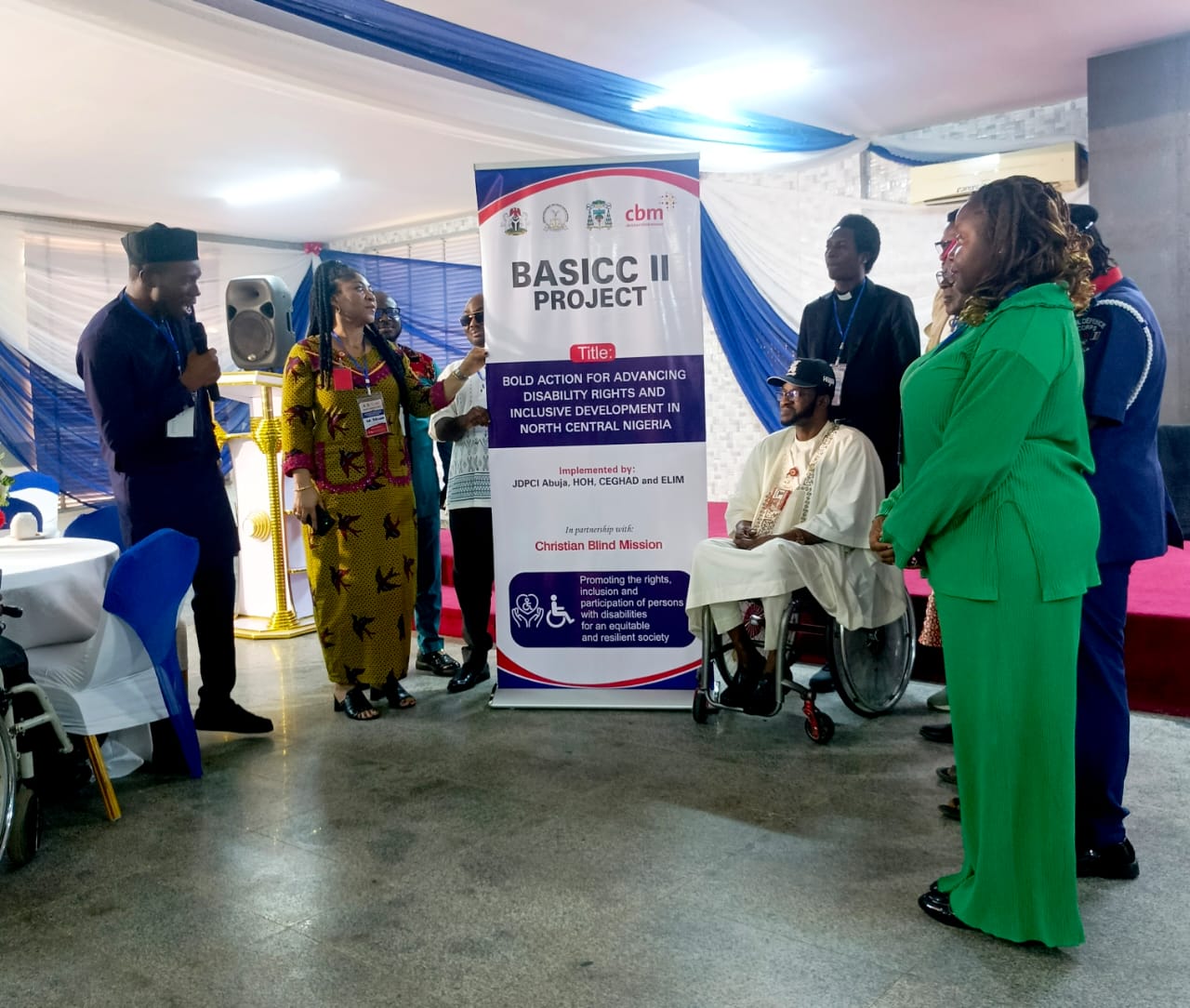
Project Banner Unveiled
A major highlight of the event was the official unveiling of the BASICC II Project banner, performed by the Senior Special Assistant to the President on Special Needs and Equal Opportunities alongside other dignitaries.
The banner carries the project’s central message:
BASICC II PROJECT
Bold Action for Advancing Disability Rights and Inclusive Development in North Central Nigeria
Implemented by:
JDPCI Abuja, HOH, CEGHAD and ELIM
In partnership with:
Christian Blind Mission (CBM)
“Promoting the rights, inclusion and participation of persons with disabilities for an equitable and resilient society.”
The launch subsequently transitioned into a stakeholders’ roundtable discussion, providing an opportunity for participants to examine existing gaps in disability legislation, implementation, enforcement, accessibility, social protection and participation, while proposing practical solutions for advancing disability-inclusive development across the North Central region.
The message from the gathering was clear: Nigeria has moved beyond talking about inclusion. The next challenge is turning laws, policies and commitments into measurable action that improves the everyday lives of persons with disabilities.


