

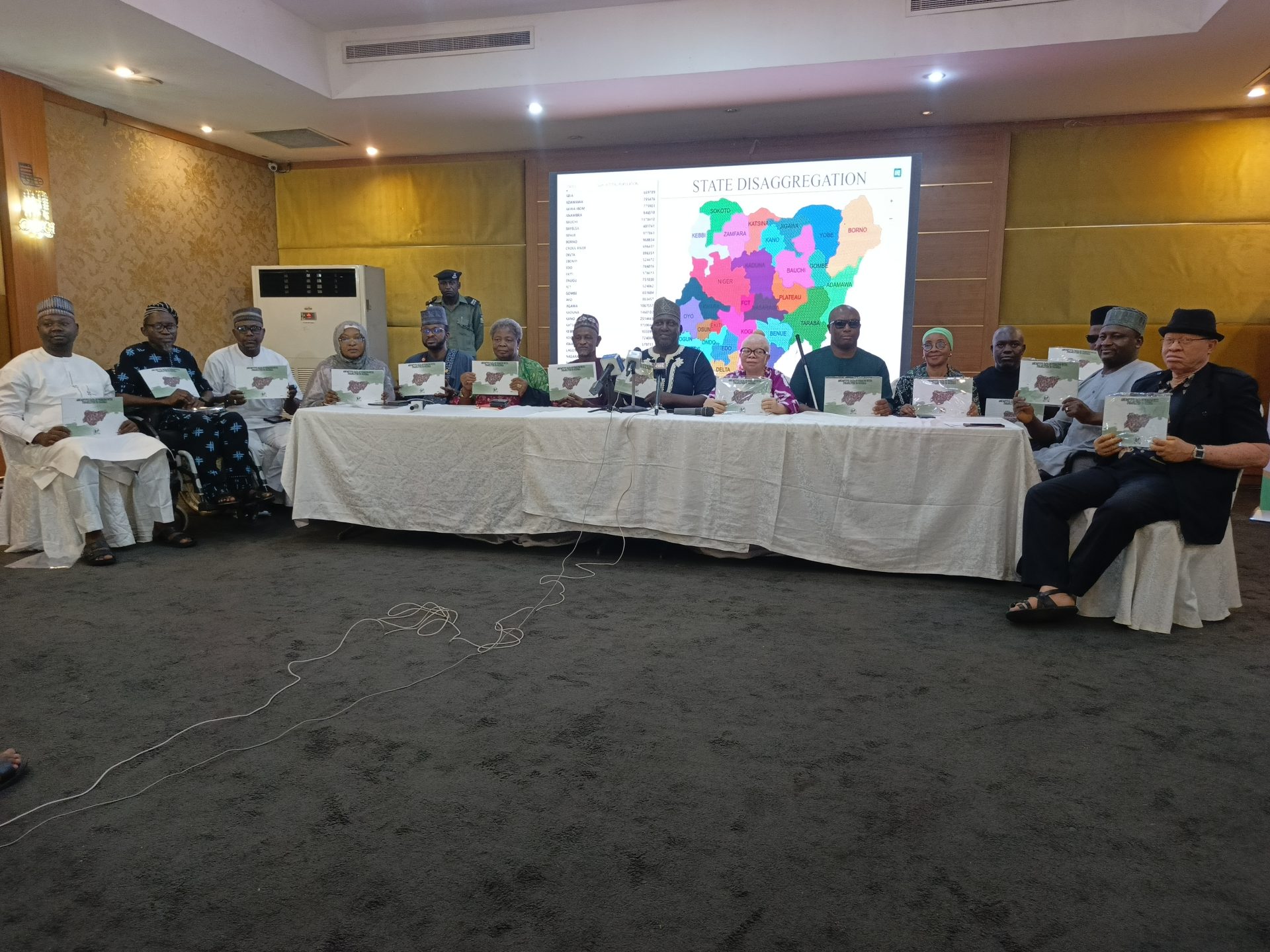
Nigeria has taken a historic step toward evidence-based disability inclusion as the Joint National Association of Persons with Disabilities (JONAPWD) officially unveiled a groundbreaking document titled “Assumptive Disaggregated Data for Persons with Disabilities in Nigeria.”
The landmark publication, presented at a high-level press conference on Wednesday in Abuja, is being celebrated as a long-awaited milestone that finally provides an empirical foundation for inclusive planning, policymaking, and targeted interventions for Persons with Disabilities (PWDs) across the country.
For decades, stakeholders have struggled with the absence of credible national data on disability—an information gap that has hindered effective planning, equitable resource allocation, and the design of meaningful development programs.
With this new dataset, JONAPWD seeks to close that gap.
Ending Decades of Data Blind Spots
Speaking at the event, the National President of JONAPWD, Abdullahi A. Usman, described the report as a turning point for disability advocacy and governance in Nigeria.
He stressed that for many years, the disability community has operated without reliable demographic information—an absence that weakened policy planning and slowed progress toward inclusion.
“For decades, the disability community in this country has operated without a reliable baseline of demographic information that is fundamental for meaningful planning, inclusive policymaking, and targeted integration,” he said.
“Without appropriate data, inclusion remains an aspiration rather than an achievable standard.”
The report applies the widely accepted global estimate that about 15 percent of every national population lives with some form of disability, a benchmark recognized by the World Health Organization and the United Nations.
Using the 2025 population projections from the National Population Commission, the document estimates that approximately 35 million Nigerians are persons with disabilities, providing detailed disaggregation across Nigeria’s 36 states and the Federal Capital Territory.
A Data Revolution for Disability Policy
Representing President Bola Ahmed Tinubu at the event, the Senior Special Assistant to the President on Special Needs and Equal Opportunities, Mohammed Abba Isa, formally endorsed the database as a critical instrument for governance and national development.
According to him, credible data remains the backbone of effective policymaking.
“Data is the foundation of effective planning, policy formulation, and project implementation,” he stated.
“This document represents a significant milestone in the collective effort to advance inclusive development.”
He commended JONAPWD for undertaking what he described as a bold and ambitious initiative to address one of the most persistent barriers to disability inclusion in Nigeria.
“I must thank JONAPWD sincerely for making our work easier. I will present this database to the government, and it will assist Mr. President in achieving the Renewed Hope Agenda,” he said.
Key Findings: Nigeria’s Disability Landscape
The exploratory dataset provides a detailed breakdown of disability demographics across the country, offering insights that stakeholders say will transform planning and service delivery.
Among its key findings:
Nigeria’s disability population is estimated at about 35 million people.
Kano State has the highest estimated number of persons with disabilities at approximately 2.5 million.
Lagos State follows closely with about 2.1 million persons with disabilities.
The report also highlights the distribution across disability clusters.
Physical disabilities represent the largest group with about 8.2 million persons.
The Deaf community follows closely with an estimated 7.7 million people.
Gender analysis within the dataset shows that:
Male persons with disabilities number over 17.6 million
Female persons with disabilities account for approximately 17.2 million
Experts say such detailed disaggregation—covering states, gender, and disability clusters—has never been available in a structured national format before.
Addressing Emerging Disability Trends
Beyond the statistics, JONAPWD emphasized that disability in Nigeria is evolving.
According to Usman, the narrative is shifting from focusing solely on visible disabilities to acknowledging the growing number of people living with psychosocial disabilities, mental health conditions, and other less visible impairments.
He also raised concerns about the rising number of acquired disabilities, driven by:
Road traffic accidents
Environmental hazards
Chronic illnesses
Conflict-related injuries
“These emerging realities demand improved data systems and proactive national responses,” he said.
Gender Dimensions Cannot Be Ignored
The report also highlights the unique challenges faced by women with disabilities, who often experience multiple layers of marginalization.
These include:
Limited access to education
Economic exclusion
Increased vulnerability to gender-based violence
Cultural norms that silence their voices
The JONAPWD president stressed that addressing disability without integrating gender considerations would leave millions behind.
NCPWD Applauds Initiative
The Executive Secretary of the National Commission for Persons with Disabilities (NCPWD), Ayuba Burki Gufwan, also commended the initiative through his representative, Hajiah Fatima Doki.
She noted that development partners frequently request reliable data before committing resources to programs.
“This data has been long awaited because most partners ask for credible statistics that will guide their interventions,” she said.
She acknowledged that the Commission has faced funding constraints in conducting nationwide disability data collection, but noted that it continues to engage development partners to support such initiatives.
A Political and Development Advantage
Representing the National Population Commission, Comrade Onah Adeyi described the estimated 35 million disability population as not only a demographic reality but also a powerful political and development force.
According to him, if the disability community is effectively mobilized, it could significantly influence electoral outcomes.
“If properly mobilized, persons with disabilities can decide who becomes president, governors, and leaders across the country,” he said.
He also explained that the disaggregated dataset would help guide budget allocation, development programming, and targeted government interventions.
A Call to Action for Inclusive Nigeria
The publication was supported and recognized by several international and national institutions, including the African Disability Forum, International Disability Alliance, United Nations, and the National Bureau of Statistics.
Stakeholders at the event described the document not just as a statistical report, but as a call to action for governments, development partners, civil society organizations, and researchers.
For JONAPWD, the objective is clear: transform numbers into policies, policies into programs, and programs into tangible improvements in the lives of millions of Nigerians with disabilities.
As Usman concluded in his address:
“It is my hope that this document serves not merely as a record of numbers, but as a catalyst for action. Together, let us build a Nigeria where no one is left behind.”
Click the link below to join our WhatsApp channel


