

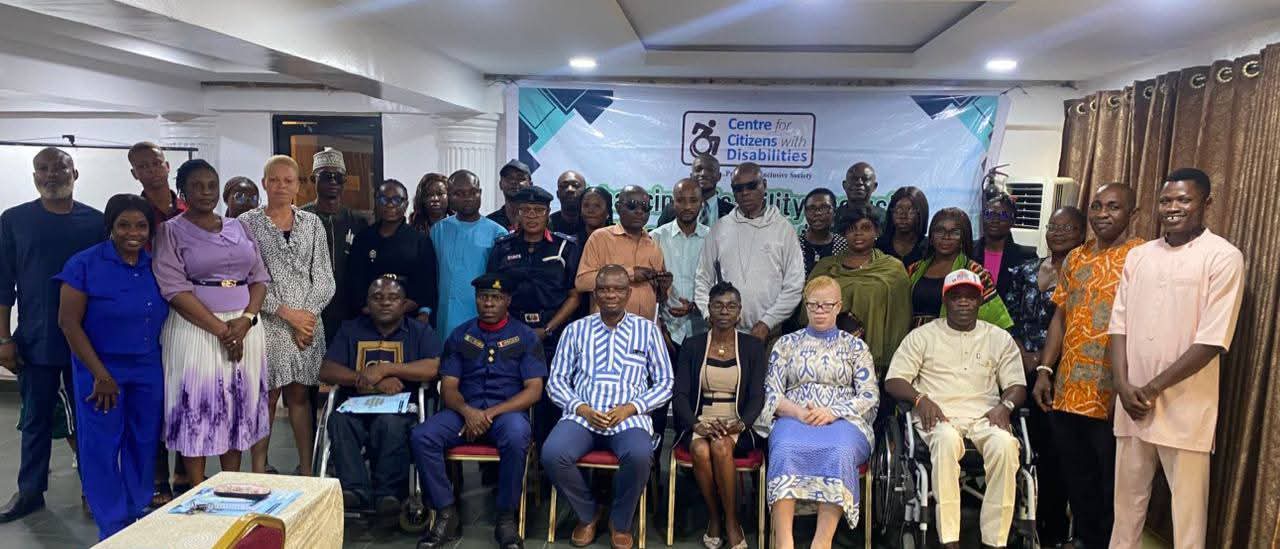
Stakeholders have called for urgent reforms to Nigeria’s climate governance framework to ensure that Persons with Disabilities (PWDs) are no longer excluded from climate planning and response efforts.
The call was made during a high-level validation meeting convened in Akwa Ibom State by the Centre for Citizens with Disabilities (CCD), with support from the International Climate Initiative (IKI).
The meeting brought together government officials, civil society organisations, disability advocates, legal representatives and security agencies to review research findings on the impact of climate change on persons with disabilities and to identify gaps in policies and implementation frameworks.
Participants acknowledged that while climate change is a global crisis, its impact is not felt equally. Persons with disabilities, they noted, are among the most vulnerable groups during environmental disasters, pollution exposure and emergency situations due to systemic exclusion, inaccessible infrastructure and poor early warning systems.
Speaking at the opening session, Acting Director of CCD, Mr. Godwin Unumeri, emphasised the importance of credible, evidence-based research in shaping effective climate policies.
He stated that without accurate and disability-disaggregated data, governments risk designing programmes that overlook the specific needs of persons with disabilities.
“Policies must be driven by data and lived realities,” he said, stressing that inclusive climate governance is not optional but necessary.
Representing the Joint National Association of Persons with Disabilities (JONAPWD), Mr. Anietie Jackson commended CCD for its leadership in advancing disability rights within environmental discourse. He maintained that inclusion of persons with disabilities in climate action is a fundamental right.
“Inclusion is a right, not a privilege,” he said.
Founder of CCD, Mr. David Anyaele, highlighted industrial and environmental differences between Akwa Ibom State and Lagos State, particularly in relation to greenhouse gas emissions and environmental exposure risks. He called for stronger political participation of persons with disabilities and statutory representation in governance processes.
Government representatives at the meeting expressed support for disability inclusion efforts.
Mrs. Nnene Bassey, Senior Special Assistant to the Governor of Akwa Ibom State on Persons with Disabilities, reaffirmed that climate change disproportionately affects persons with disabilities and emphasised the need for their visibility in policy and decision-making spaces.
Assistant Superintendent Ifiok Ekanem, Deputy Commandant of the Nigeria Security and Civil Defence Corps (NSCDC) in Akwa Ibom, stressed the importance of emergency preparedness systems that adequately protect vulnerable groups during climate-related disasters.
Also speaking, Mr. Ubong Ikpe, Personal Assistant to the Governor on Persons with Disabilities, underscored the need for collaboration between government and disability stakeholders to address environmental challenges effectively.
Representing the Honourable Attorney General of Akwa Ibom State, Mr. Etariapu Ikoni noted that existing legal frameworks can be reviewed and amended to better reflect inclusive and disability-responsive realities.
During the technical presentation, Mr. Unumeri shared key findings from CCD’s research, pointing to significant gaps in disability inclusion within current climate policies. Participants observed the absence of disability-specific indicators, lack of disaggregated data and limited representation of persons with disabilities in climate planning processes.
Several contributors shared experiences of exclusion from climate programmes, health risks linked to environmental pollution and inaccessible emergency response mechanisms.
At the end of the deliberations, stakeholders recommended amending the Climate Change Act to explicitly recognise persons with disabilities, establishing disability desks at national and state levels, standardising disability-disaggregated data collection, ensuring statutory representation of persons with disabilities in climate governance structures, providing accessible early warning systems and emergency infrastructure, and strengthening funding and capacity building for disability organisations.
The validation meeting underscored a growing consensus: climate justice cannot be achieved without disability inclusion.
As Nigeria advances its climate commitments, stakeholders insist that equitable and inclusive frameworks must guide policy development to ensure that no one is left behind.
Click the link below to join our WhatsApp channel


