
Persons with Disabilities (PWDs) in Nigeria have raised fresh concerns over what they describe as systematic neglect and exclusion in state budgeting processes, warning that the trend is deepening poverty, discrimination, and hardship within the disability community.
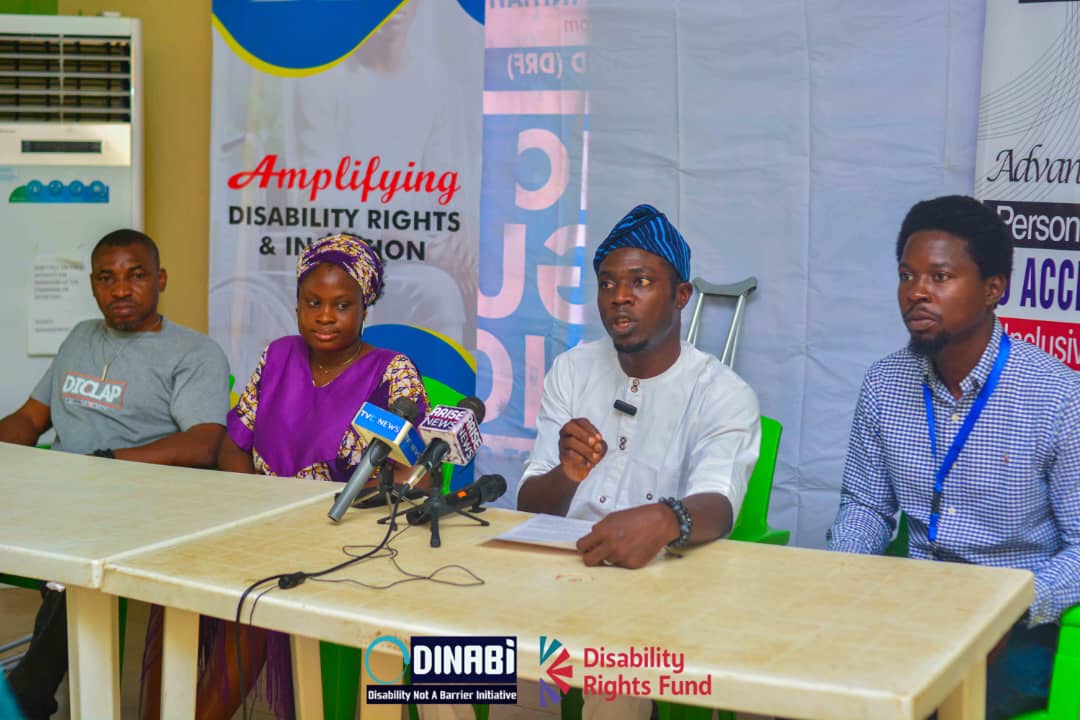
These concerns were brought to the fore on Friday in Ado-Ekiti, Ekiti State, during a press conference and the official unveiling of the ThisAbility Budget (TAB) 2025 Report and Portal, organized by Disability Not A Barrier Initiative (DINABI) Nigeria with support from the Disability Rights Fund (DRF).
The event, which attracted members of the disability community, civil society actors, and journalists, served as a platform to interrogate how state governments in Nigeria’s South-West zone have fared in allocating resources toward disability inclusion.
“Less Than 0.5% for Over 15% of the Population”
Speaking at the event, the Executive Director of DINABI Nigeria, Engr. Olajide Funso, expressed deep disappointment over what he described as the gross exclusion of persons with disabilities from the budgetary processes of the six South-West states.
According to him, findings from the TAB 2025 Report revealed that less than 0.5 per cent of state budgets across the region were allocated to disability-related interventions, despite persons with disabilities constituting over 15 per cent of the population.
Engr. Funso particularly criticised Ogun State, noting that the state failed to make any specific budgetary allocation for disability inclusion in its 2025 budget. He further lamented that the budget document was not readily accessible to citizens, making public engagement and accountability nearly impossible.
“How do you exclude more than 15 per cent of your population from development planning and still talk about inclusive governance?” he asked. “Budgets are moral documents, and when persons with disabilities are missing from them, it simply means they are not a priority.”
TAB Portal: A First of Its Kind in Nigeria
Engr. Funso explained that the ThisAbility Budget (TAB) Portal is the first initiative of its kind in Nigeria, designed to track, analyse, and present disability-specific budget lines on a state-by-state basis.
He said the platform would serve as a verified resource for persons with disabilities, civil society organisations, researchers, journalists, and policymakers to engage governments constructively on disability-inclusive governance.
“The TAB portal provides credible data that will strengthen advocacy, promote transparency, and improve accountability. It is a tool for evidence-based engagement with government,” he said.
“We Have Become Beggars in Our Own Land” — JONAPWD
In an emotional intervention, the General Secretary of the Joint National Association of Persons with Disabilities (JONAPWD) lamented the dire consequences of continued budgetary neglect.
“I can’t believe that out of over ₦6 trillion, only 0.048 per cent was allocated to disability matters in the South-West,” he said. “No wonder our people are suffering. We can’t eat, there are no jobs, no support for business, and no help is coming from anywhere.”
He added that meaningful development and social inclusion would remain elusive as long as governments continue to sideline a significant portion of their citizens.
“When government fails to allocate reasonable resources to 15 per cent of its population, how do we talk about development? We have become beggars in our own land,” he stated.
Key Findings: Oyo Leads, Ogun Bottoms the Table
Data presented from the TAB 2025 Report showed wide disparities among South-West states in disability-specific budgeting.
Oyo State emerged as the leading state in the region, allocating ₦1,222,500,000 to disability-related interventions out of a total budget of ₦684.15 billion, representing 0.179 per cent.
At the other end of the spectrum, Ogun State ranked last with zero allocation for disability inclusion. The report also revealed that while Lagos State allocated more funds in absolute terms compared to Ondo State, Ondo performed better when disability spending was measured as a percentage of its total budget.
Call for Action and Inclusive Budgeting
Responding to questions from journalists, Engr. Funso disclosed that the TAB 2025 Report is available for free download on the portal and can also be accessed via mobile phones for ease of use. He encouraged Nigerians to visit www.tab.dinabing.org and utilise the data to demand accountability from their state governments.
He further announced that the project, currently piloted in the South-West, would become an annual exercise, with plans to expand coverage to all 36 states and the Federal Capital Territory (FCT) in 2026.
The gathering concluded with a strong call on governments and stakeholders to:
Ensure active participation of persons with disabilities in budget formulation and implementation
Make budget documents accessible and available in inclusive formats
Prioritise disability-specific budget lines
Strengthen collaboration between Organisations of Persons with Disabilities (OPDs) and government institutions
Participants agreed that without deliberate financial commitments, disability inclusion would remain rhetoric rather than reality.
As the TAB 2025 findings reveal, the true measure of inclusive governance lies not in promises, but in budgets that reflect the rights, needs, and dignity of persons with disabilities.
Click the link below to join our WhatsApp channel


