

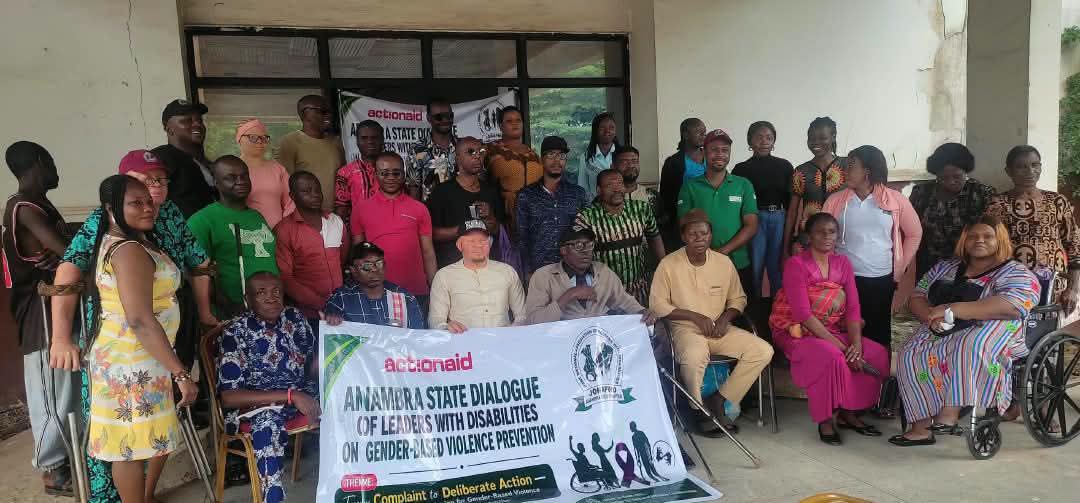
AWKA, Anambra State — Disability leaders in Anambra State have called for urgent and deliberate action to challenge harmful social attitudes, beliefs and practices that continue to expose persons with disabilities—particularly women and girls—to gender-based violence (GBV), abuse and exploitation.
The call was made during a disability-inclusive dialogue in Awka, themed “From Complaint to Deliberate Action: Defining Disability Inclusion for Gender-Based Violence Prevention and Community Protection.” The dialogue was organised with the support of ActionAid.
The participants stressed that preventing GBV against persons with disabilities must go beyond reacting to cases after they occur. Instead, disability inclusion should be embedded in Nigeria’s broader GBV prevention architecture, including accessible reporting, healthcare, referral, protection and justice systems.
‘We Must Prevent Violence Before It Happens’
Speaking at the dialogue, the Chairman of the Joint National Association of Persons with Disabilities (JONAPWD), Anambra State chapter, Okeke Ugochukwu Ernest, challenged disability leaders to move beyond responding to reported cases and take deliberate steps to prevent violence before it happens.
According to him, persons with disabilities must be equipped with adequate information about their rights, while survivors must have access to safe and confidential channels for reporting abuse.
“We must create an environment where a person who reports violence is believed, supported, protected and properly referred, not blamed, silenced or abandoned,” Okeke said.
He called for stronger collaboration among government institutions, security agencies, healthcare providers, justice institutions, civil society organisations and community leaders to establish systems capable of preventing and responding effectively to GBV involving persons with disabilities.
Okeke further warned against treating disability inclusion as an afterthought in government programmes.
“Persons with disabilities must not be an afterthought in GBV prevention and protection programmes.”
He demanded their inclusion from the planning stage through budgeting, awareness campaigns, reporting mechanisms, referral systems and community protection strategies.
For him, the success of GBV interventions should not be measured merely by the number of complaints received, but by how many vulnerable people are protected, how many survivors receive support and how many potential cases of violence are prevented.
Women and Girls With Disabilities Face Greater Vulnerability
Also speaking, the Muslim Co-Chairman on GBV in Anambra, Alhaji Sheriff Olanrewaju, expressed concern over the heightened vulnerability of women and girls with disabilities.
Olanrewaju said women and girls with disabilities face what he described as “ten times” the risk of GBV, citing factors including dependence on caregivers, mobility restrictions and communication barriers.
He urged government to investigate and regulate traditional practitioners allegedly linked to abusive practices and called for stronger access to justice for persons with hearing and communication disabilities.
He particularly emphasised the importance of sign language in the justice system, stressing that Deaf survivors must be able to report abuse, understand proceedings and participate meaningfully in the pursuit of justice.
‘If a Deaf Survivor Cannot Communicate, Where Is the Justice?’
The call highlights a critical gap in GBV response: a reporting system is not truly accessible if the survivor cannot communicate with those receiving the complaint.
For Deaf persons, the absence of sign language interpreters can create a barrier between experiencing violence and obtaining protection or justice.
The participants therefore stressed the need for accessible communication across police stations, hospitals, courts, shelters and other GBV response points.
Stronger Collaboration Promised
The Acting Head of the Anambra State Disability Rights Commission, Jane Ajaegbu, and ActionAid Focal Person, Perpetual Nwakelundu, pledged stronger collaboration with JONAPWD to advance disability-inclusive approaches to preventing and responding to GBV.
The dialogue brought together government officials, representatives of the Anambra State Disability Rights Commission, civil society organisations, religious leaders, security agencies and JONAPWD coordinators from the state’s 21 local government areas.
At the end of the dialogue, participants adopted action plans committing LGA coordinators and cluster leaders to prevent, protect, report, refer, follow up and demand accountability in cases involving persons with disabilities.
They also resolved to challenge attempts to use disability as an excuse or justification for violence, exploitation, discrimination and exclusion.
From Complaints to Prevention
The central message emerging from the dialogue was clear: persons with disabilities should not have to wait until violence happens before society takes action.
Prevention must begin within families, communities, religious institutions, schools, healthcare facilities, security agencies and government structures.
And when violence does occur, survivors must be able to report without fear, communicate without barriers, receive appropriate healthcare, access protection and pursue justice on an equal basis.
The real test of disability inclusion is not how loudly we condemn violence after it happens, but how effectively we build systems capable of preventing it in the first place.
For disability leaders in Anambra, the time has come to move from complaint to deliberate action.


