

Children with disabilities are being systematically left out of Nigeria’s public spending, not by accident but through what advocates describe as a dangerous pattern of budgetary silence. This was the stark warning raised by The Leprosy Mission Nigeria (TLMN) at a high-level media roundtable in Abuja, where stakeholders challenged government at all levels to confront what they called the “near-total invisibility” of children with disabilities in national and sub-national budgets.
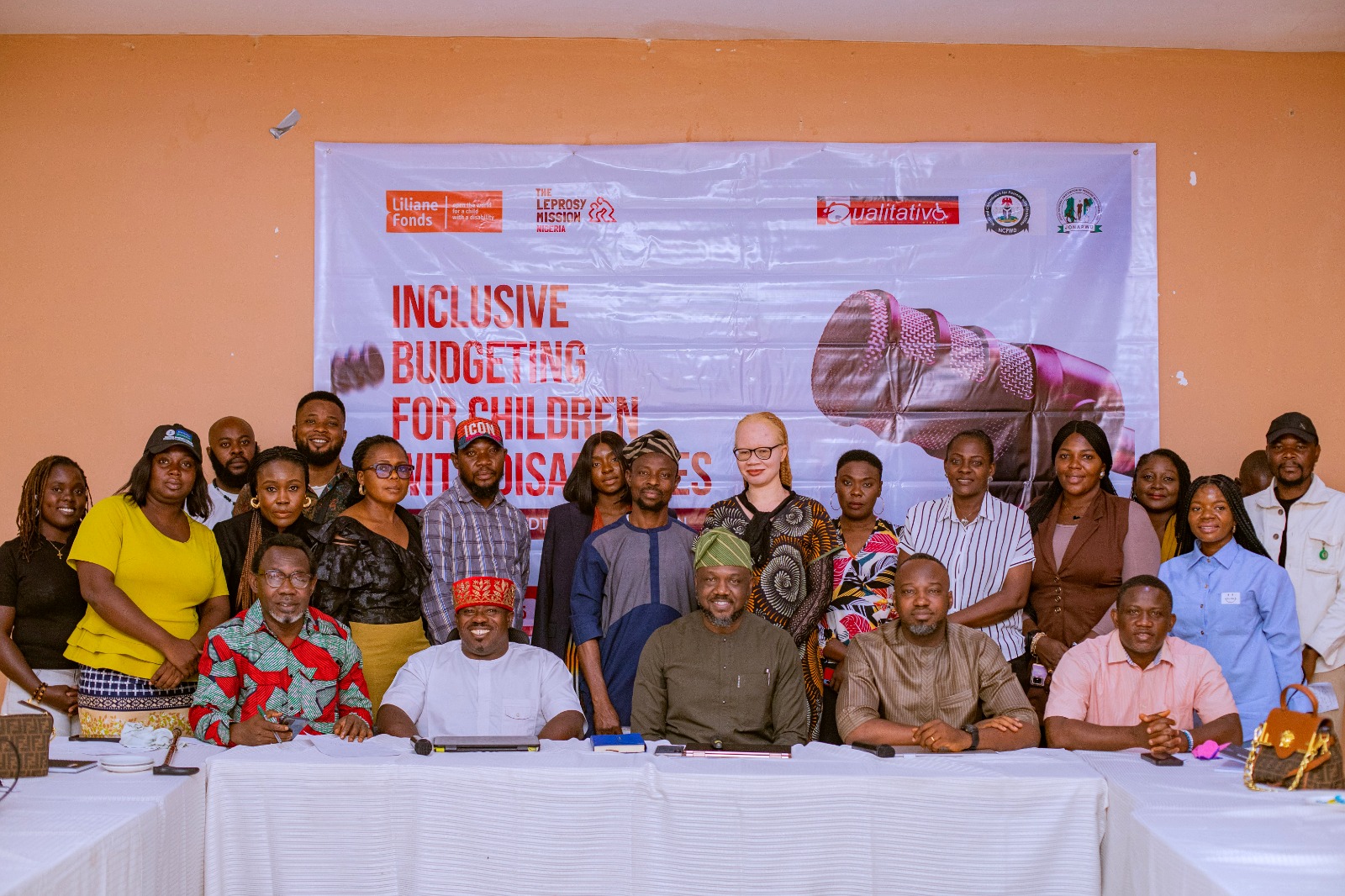
The alarm was sounded on Monday at the Media Roundtable on Budgeting for Children with Disabilities, organised by The Qualitative Magazine (TQM) with the support of The Leprosy Mission Nigeria. The gathering brought together journalists, disability rights advocates and development partners to interrogate how public budgets are planned, allocated and monitored—and who gets left behind when those processes fail.
Speaking at the event, the National Director of TLMN, Dr. Sunday Udo, revealed findings from a desk review of federal and state budget documents spanning 2023 to 2025, which exposed what he described as a troubling and consistent pattern of neglect.
According to Dr. Udo, while government budgets often make broad references to disability, social welfare, health and education, they rarely contain specific, intentional and traceable budget lines for children with disabilities.
“What we found is deeply concerning,” he said. “Children with disabilities are frequently assumed to be ‘covered’ under general programmes, yet there is no assurance—no evidence—that funds are actually reaching them.”
He warned that this assumption-driven approach effectively excludes children with disabilities from public spending, regardless of how inclusive government policies may appear on paper.
“If children with disabilities are not clearly budgeted for, they are effectively excluded—no matter how good our policies sound,” Udo stated.
He explained that children with disabilities face multiple and overlapping disadvantages, including limited access to education, delayed or inadequate healthcare, heightened protection risks and an increased likelihood of lifelong poverty. Despite these realities, he said, budgets continue to treat them as an afterthought rather than a priority.
“This is not just a technical oversight,” Udo stressed. “It is a fundamental issue of equity, accountability and justice.”
Describing budgets as “moral documents,” he noted that they reveal a society’s true values and priorities more than policy speeches or official statements ever could.
“What is not budgeted for is not prioritised,” he said. “And what is not prioritised leaves children behind. Budgets show us who counts—and who remains invisible.”
Dr. Udo emphasised that the media roundtable was convened to push evidence-based action, not abstract conversations. According to him, the exclusion of children with disabilities is not hidden; it is clearly visible in the numbers—or the absence of them.
“The evidence is in the budget figures,” he said. “The action begins with visibility.”
He challenged journalists to go beyond reporting budget totals and interrogate who actually benefits from public spending.
“You have the power to turn budget tables into public accountability,” Udo told media practitioners. “Ask the hard questions: Where is the money? Who is it meant to reach? And why are children with disabilities still missing from the numbers?”
Calling for urgent reform, he urged government to move beyond vague commitments and adopt specific, costed and trackable budget provisions for children with disabilities, warning that without deliberate planning and monitoring, inclusion would remain an empty promise.
“Inclusion must be planned, costed and monitored,” he said. “Without deliberate budgeting, children with disabilities will continue to be excluded from national development.”
He added that TLMN would share detailed findings from its budget review and work closely with journalists to ensure sustained media scrutiny of disability-related budgetary issues.
Also speaking at the roundtable, the Executive Director of The Qualitative Magazine (TQM), Comrade Chris Agbo, issued a strong call to the media to intensify oversight of government budgeting processes, warning that the continued invisibility of children with disabilities poses a grave threat to their rights and future.
“Across Nigeria, millions of children with disabilities remain invisible in public planning and budgeting,” Agbo said in his opening remarks. “When budgets are silent, services fail. When services fail, rights are denied. And when rights are denied, the future of an entire generation is placed at risk.”
He underscored the critical role of the media in shaping public discourse, influencing policy priorities and holding duty bearers accountable—especially on issues affecting marginalised and underrepresented groups.
According to him, accurate, ethical and inclusive journalism is essential to ensuring that budgeting processes reflect the real needs of children with disabilities, rather than burying them under vague and non-specific social welfare allocations.
“This roundtable is designed to strengthen your capacity to interrogate budgets, ask the right questions, amplify marginalised voices, and tell stories that drive action and reform,” Agbo told participants.
Reaffirming TQM’s commitment to disability inclusion, he stressed that inclusive budgeting must be understood not as charity, but as a matter of justice and legal obligation.
“Inclusive budgeting is not charity; it is justice,” Agbo said. “It is not an option; it is an obligation.”
He urged journalists to move beyond event-driven reporting and embrace sustained, data-driven and people-centred coverage that places children with disabilities at the heart of development planning and public accountability.
The media roundtable concluded with a shared resolve among participants to deepen scrutiny of public budgets and ensure that children with disabilities are no longer excluded from Nigeria’s development agenda—not in policy, not in practice, and not in the numbers that matter most.
Click the link below to join our WhatsApp channel


