

By TQM News,
JOS, Nigeria – In a major boost for disability rights and inclusive development in Nigeria, the Christian Blind Mission (CBM) has launched an ambitious three-year intervention designed to strengthen the protection of the rights of persons with disabilities and promote their full participation in society across Plateau State, Benue State and the Federal Capital Territory (FCT).
The project, titled Bold Actions for Advancing Disability Rights and Inclusive Development in North Central Nigeria (BASICC II), will run from July 2026 to June 2029. It seeks to bridge long-standing gaps in disability inclusion by strengthening advocacy, empowering communities, improving access to essential services and enhancing the capacity of Organisations of Persons with Disabilities (OPDs), government institutions and civil society organisations.
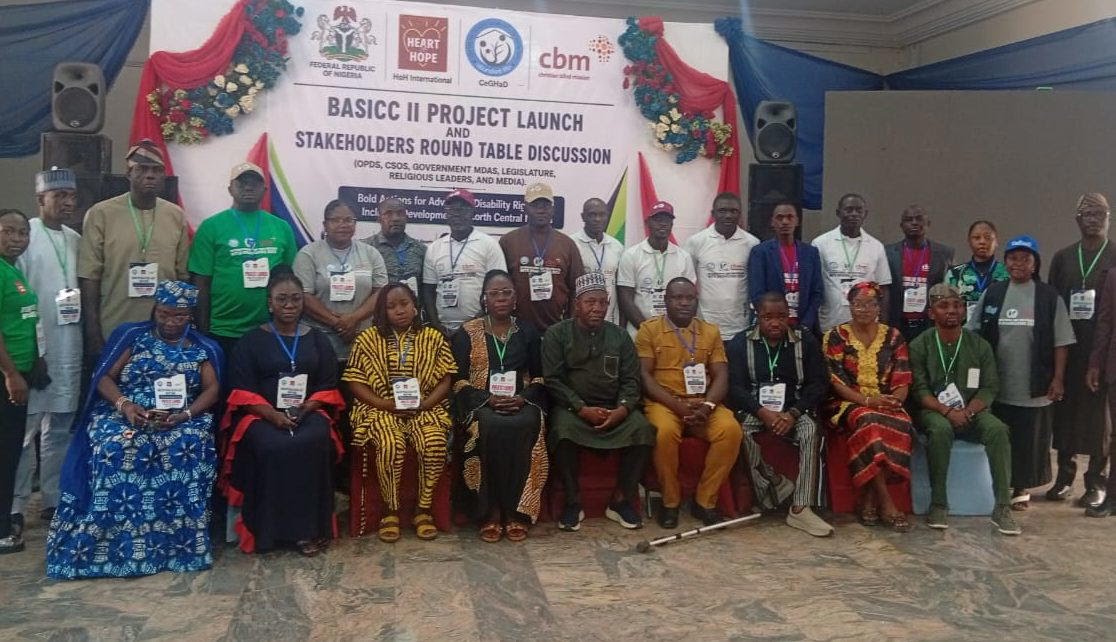
The initiative was officially launched in Jos, Plateau State, where government officials, development partners, disability advocates and representatives of Organisations of Persons with Disabilities gathered to reaffirm their commitment to building a society where persons with disabilities can live with dignity, enjoy equal opportunities and participate fully in national development.

In Plateau State, the project will be implemented by the Centre for Gospel Health and Development (CeGHaD) and Heart of Hope Foundation, two organisations with extensive experience in community development and disability inclusion.
CeGHaD will oversee implementation in Pushit Central, Puka, Makor, Gindiri Town, Kwergoro and Tongzong in Mangu Local Government Area, while Heart of Hope Foundation will coordinate activities in Fwil-Vom, Dahwol-Vwana in Jos South Local Government Area, as well as Rahoss, Tahoss, Riyom and Kogo in Riyom Local Government Area.
Speaking during the launch, CBM Country Director, Samuel Omoi, represented by Programme Coordinator Innocent Onyemaechi, described BASICC II as a strategic intervention that builds on previous achievements while responding to the persistent challenges faced by persons with disabilities in Nigeria.
He said the project reflects CBM’s unwavering commitment to ensuring that disability inclusion remains at the centre of sustainable development efforts.
“Today marks an important milestone in our collective journey toward a more inclusive society where the rights, dignity and potential of persons with disabilities are fully recognised, respected and protected,” he stated.
According to him, despite the existence of disability-related laws and policies in Nigeria, many persons with disabilities continue to encounter barriers that limit their access to quality education, healthcare services, employment opportunities, livelihoods, public services and participation in governance and decision-making processes.
Omoi stressed that the implementation of BASICC II would help close these gaps by strengthening institutions and communities to better understand, promote and enforce disability rights.
He explained that the project would support Organisations of Persons with Disabilities and civil society organisations through advocacy, institutional strengthening and community mobilisation. It will also improve the socio-economic well-being of persons with disabilities by facilitating self-help groups, expanding access to assistive devices and creating sustainable livelihood opportunities.
“The success of BASICC II will depend on the collective efforts of government institutions, development partners, civil society organisations, communities, the media and, most importantly, persons with disabilities themselves, whose voices and leadership remain at the heart of this initiative,” he added.
Programme Officer of CeGHaD, Anna Dimka, expressed optimism that the intervention would significantly improve the quality of life of persons with disabilities while strengthening the resilience of participating communities.
She noted that the project goes beyond providing support, focusing instead on empowering persons with disabilities to become active contributors to community development.
“At the end of BASICC II, we expect to see more interventions benefiting persons with disabilities. Lives will be transformed, communities will become stronger, and people will move from vulnerability to resilience,” she said.
Similarly, the Monitoring and Evaluation Officer of Heart of Hope Foundation, Kefas Bulus, reaffirmed the organisation’s commitment to ensuring that the project delivers measurable and sustainable outcomes in all implementing communities.
One of the major highlights of the launch was the endorsement of the Plateau Disability Inclusive Advocacy Forum, a multi-sectoral platform established to promote stronger collaboration among government agencies, development partners, civil society organisations and disability groups.
The forum is expected to champion disability-inclusive budgeting, monitor the implementation of disability policies, advocate for improved access to public services and strengthen social inclusion across Plateau State.
The formal handover of BASICC II to CeGHaD and Heart of Hope Foundation marked the beginning of what stakeholders described as a new chapter in disability-inclusive development within North Central Nigeria.
Representatives of the Plateau State Contributory Healthcare Management Agency (PLASCHEMA), the Joint National Association of Persons with Disabilities (JONAPWD), the National Directorate of Employment (NDE) and several other stakeholders pledged their support for the successful implementation of the initiative.
Participants emphasised that while policy dialogues and advocacy remain essential, the true measure of the project’s success will be reflected in tangible improvements in the lives of persons with disabilities. They expressed hope that BASICC II would increase access to education, healthcare, employment opportunities, social protection, assistive technology and inclusive community participation.
As Nigeria continues its efforts to implement the Discrimination Against Persons with Disabilities (Prohibition) Act, 2018, stakeholders believe BASICC II represents another significant step towards ensuring that no person with a disability is excluded from development because of barriers created by society.
With strong partnerships, sustained advocacy and active participation from persons with disabilities themselves, the initiative is expected to serve as a model for inclusive development and rights-based programming across the country, helping to build communities where everyone, regardless of ability, has the opportunity to thrive.


