

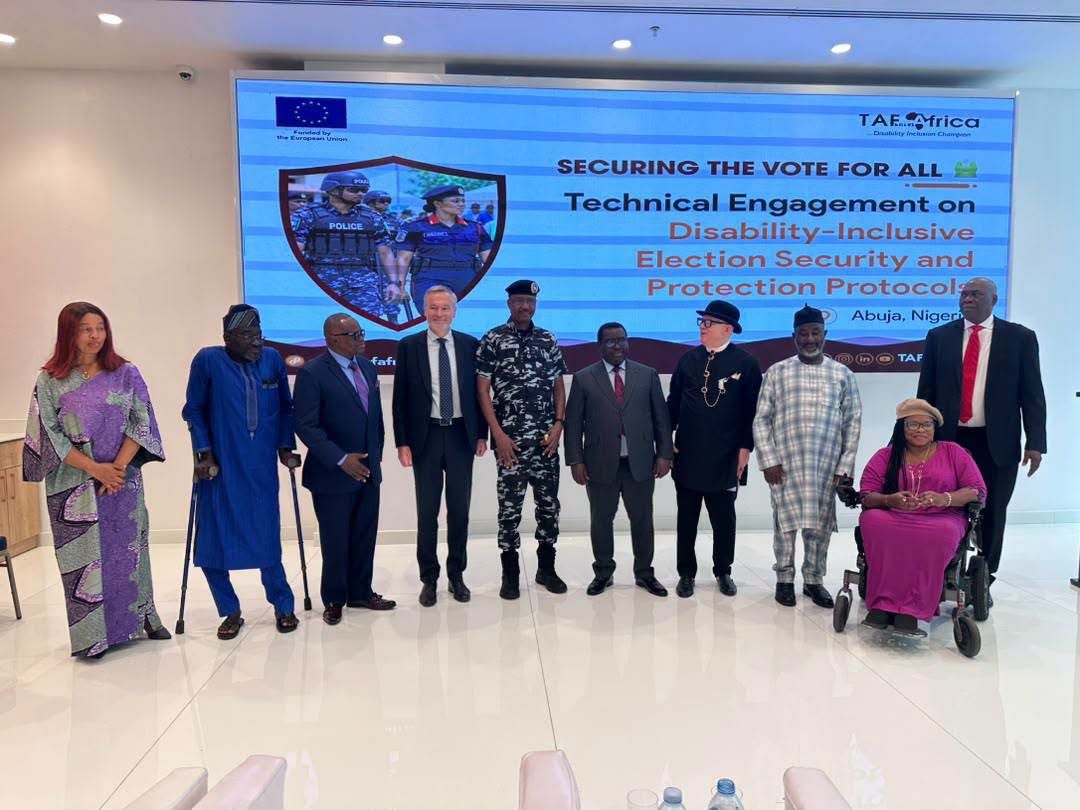
INEC, Police, EU and TAF Africa call for stronger protection, accessible voting arrangements and zero tolerance for discrimination against persons with disabilities.
ABUJA — The Nigeria Police Force has pledged to strengthen disability-inclusive election security protocols and enforce its standard operating procedures to protect approximately 232,000 registered voters with disabilities from intimidation, harassment and discrimination ahead of the 2027 general elections.
The commitment was made during a high-level technical engagement on disability-inclusive election security and protection protocols organised by TAF Africa in Abuja on Friday.
The meeting brought together the Nigeria Police Force, the Independent National Electoral Commission (INEC), the European Union (EU) and disability rights stakeholders to develop practical measures for ensuring that persons with disabilities can participate in Nigeria’s electoral process safely, freely and with dignity.
The engagement was organised under Component 5B of the European Union Support to Democratic Governance in Nigeria Phase II programme, which seeks to strengthen the political and electoral participation of persons with disabilities.
Police: Disability Inclusion Is a Security Responsibility
The Inspector-General of Police, Olatunji Disu, represented by his Deputy, Dr. Isyaku Mohammed, said the police were committed to moving beyond traditional security approaches towards a more professional, human rights-based and citizen-centred policing system.
Disu said protecting persons with disabilities during elections was both a constitutional right and a professional responsibility that must be integrated into police operations.
According to him, the responsibility of security personnel extends beyond maintaining law and order to ensuring that every eligible voter can participate in the democratic process without fear of intimidation, harassment or discrimination.
“Disability inclusion is not an afterthought,” the police chief emphasised, stressing that protecting voters with disabilities and ensuring safe access to polling units must become core policing responsibilities.
He explained that the 27 police officers selected for the engagement would help drive the review of existing procedures and promote compliance with the proposed protection measures across their respective commands and formations.
The officers are expected to take the outcomes of the engagement back to their commands to strengthen election security arrangements and improve protection for persons with disabilities.
Disu also pledged to strengthen communication between police personnel and the disability community to improve the handling of electoral security incidents involving persons with disabilities.
INEC: 232,000 Voters With Disabilities Must Not Be Left Behind
The INEC Chairman, Prof. Joash Amupitan, reaffirmed the commission’s commitment to inclusive elections, stressing that electoral credibility depends not only on the conduct of voting but also on whether every eligible citizen can participate freely, safely and without discrimination.
Amupitan disclosed that INEC had identified approximately 232,000 registered voters with disabilities, representing about 0.23 per cent of the voter register, across 10 disability categories.
He said the figures underscored the need for sustained efforts to improve the identification, protection and participation of voters with disabilities.
According to him, an election cannot be considered inclusive if eligible voters face intimidation, insecurity or barriers that prevent them from exercising their democratic rights.
The INEC chairman said the commission had introduced online voter registration to improve accessibility, while its regulations and guidelines provided for priority access, appropriate assistance and assistive voting materials for persons with disabilities.
However, he acknowledged that translating legal provisions into practical protection remained a major challenge.
“Having laws and policies is not enough. What matters is ensuring that persons with disabilities can actually exercise their rights without barriers,” he said.
Amupitan noted that security arrangements must reflect the different needs of voters with disabilities, warning that uniform approaches might not adequately address the challenges confronting all voters.
He urged security personnel to respect the independence, dignity and privacy of persons with disabilities when providing assistance.
He explained that voters with hearing impairments might require visual communication, while persons with visual impairments could need verbal guidance. Voters with limited mobility, he added, required unobstructed access to polling units and voting areas.
2027 Elections: INEC Identifies Key Priorities
Amupitan identified several priorities for the 2027 general elections, including:
- Developing and implementing clear disability-inclusive election security protocols.
- Strengthening police training on disability rights and accessible communication.
- Improving coordination between INEC and security agencies.
- Establishing accessible channels for reporting electoral security incidents.
- Ensuring prompt responses to intimidation, harassment and discrimination.
- Engaging organisations of persons with disabilities in election security planning.
He said disability inclusion must be incorporated into security assessments, personnel training, deployment briefings and responses to electoral incidents well before election day.
The INEC chairman also disclosed that the commission would work with the police and other security agencies to convene another security summit to strengthen preparations for the elections.
He said INEC would collaborate with TAF Africa, the Nigeria Security and Civil Defence Corps, development partners and disability rights organisations to ensure that the engagement produced measurable improvements.
Amupitan stressed that voter protection must extend beyond election day to cover voter registration, political campaigns, rallies, voting, collation and the post-election period.
TAF Africa Raises Alarm Over Intimidation and Displacement
Earlier, the Chairman of TAF Africa’s Board, Prof. Vincent Anibogu, said persons with disabilities continued to face intimidation, harassment, discrimination, inaccessible communication and inadequate assistance during electoral activities.
He also highlighted the challenges confronting internally displaced persons, including insecurity, restrictions arising from displacement and limited access to electoral information.
Anibogu warned that persons with disabilities who were also internally displaced faced multiple barriers that could further undermine their participation in elections.
He urged the police to adopt a proactive, professional and human rights-based approach that takes these vulnerabilities into account when planning and executing security operations.
He described the engagement as an opportunity to identify operational gaps and develop practical measures for incorporating disability-inclusive and displacement-sensitive approaches into police policies, standard operating procedures, training and deployment arrangements.
According to him, the participation of security institutions was essential to ensuring that the protection needs of persons with disabilities and internally displaced voters were adequately reflected in election security planning.
EU: Protecting Voters With Disabilities Is a Fundamental Right
The European Union Ambassador to Nigeria, Gautier Mignon, said protecting persons with disabilities during elections was a matter of equality, human dignity and fundamental rights, rather than accessibility alone.
He commended TAF Africa for its advocacy and reaffirmed the EU’s commitment to supporting democratic governance, inclusive political participation and stronger institutions in Nigeria.
Mignon noted that police officers were often among the first officials voters encountered when security concerns arose at polling units and other locations associated with electoral activities.
He said the preparedness and conduct of security personnel could determine whether persons with disabilities felt sufficiently protected to exercise their democratic rights.
The ambassador urged the police to move beyond general commitments by integrating disability-inclusive provisions into operational plans, training curricula, deployment instructions, supervisory arrangements and procedures for reporting electoral security incidents.
He also called for designated institutional focal persons, effective monitoring mechanisms and stronger coordination between security agencies, INEC and organisations representing persons with disabilities.
Mignon stressed that protecting voters with disabilities was not a favour or special privilege but an essential expression of equal rights, human dignity and the rule of law.
He urged security institutions to sustain their collaboration with disability rights organisations to ensure that the guidelines adopted translated into practical measures ahead of the 2027 elections.
Jake Epelle Commends Stakeholders
TAF Africa Founder and Chief Executive Officer, Jake Epelle, commended the INEC chairman, the European Union and the police leadership for supporting efforts to make Nigeria’s elections more inclusive.
Epelle said the participation of senior officials demonstrated growing recognition of the need to address barriers confronting persons with disabilities in the country’s electoral system.
He particularly commended Amupitan for personally attending the engagement, describing his presence as evidence of commitment to credible and inclusive elections.
He also praised the EU ambassador for honouring his commitment to participate in the programme and commended the police leadership for supporting the initiative despite competing official engagements.
TAF Africa has consistently advocated greater participation of persons with disabilities in Nigeria’s political and electoral processes, including the removal of barriers that limit their access to voting and other forms of democratic participation.
From Promises to Action Ahead of 2027
The engagement comes as stakeholders intensify preparations for the 2027 general elections, with renewed calls for security institutions to ensure that persons with disabilities are not excluded from the democratic process.
The legal framework underpinning their electoral rights includes the 1999 Constitution, the Electoral Act and the Discrimination Against Persons With Disabilities (Prohibition) Act.
However, stakeholders emphasised that effective inclusion would depend on translating these legal protections into practical security measures, accessible communication, appropriate assistance and accountability for violations.
The engagement is expected to strengthen cooperation among electoral authorities, security institutions and disability rights organisations as Nigeria prepares for the 2027 general elections.
For the approximately 232,000 registered voters with disabilities identified by INEC, the challenge now is ensuring that the commitments made in Abuja translate into safer polling environments, accessible voting arrangements and protection from discrimination.
As the 2027 elections approach, stakeholders say the test of an inclusive democracy will be whether every eligible voter, regardless of disability, can vote freely, safely and with dignity.


