

ABUJA — The Federal Capital Territory Administration has been urged to move beyond policy pronouncements and take concrete steps to ensure the full inclusion of persons with intellectual disabilities in the implementation of educational policies across the FCT.
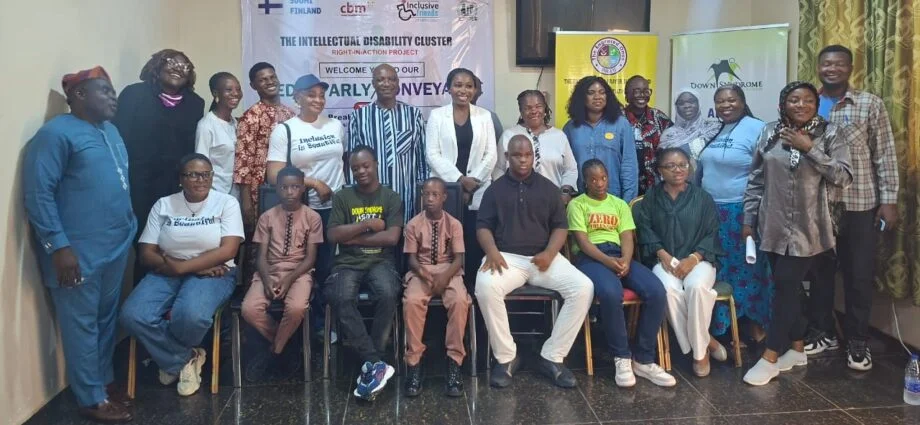
The call was made by the intellectual disability cluster of Right-in-Action (RIA), comprising The Engraced Ones Prayer Support and Advocacy Initiative, Down Syndrome Foundation of Nigeria, and RIA by Maria Autism Foundation, alongside parents of children with intellectual disabilities.
The groups made the demand during a media parley in Abuja themed “Breaking the Barriers on the Implementation of Inclusive Education Policies, Guidelines and Other Legal Instruments for Persons with Intellectual Disabilities in the FCT.”
The event, supported by the Finnish Government, brought together advocates, parents and stakeholders to examine the persistent barriers preventing children with intellectual disabilities from fully benefiting from Nigeria’s inclusive education policies.
‘Inclusive Education Must Move Beyond Paper’
Speaking during the engagement, representatives of the Right-in-Action cluster—Ayobami Adefioye, Programmes Manager, The Engraced Ones Prayer Support and Advocacy Initiative; Becky Selekere, Programmes Officer, RIA by Maria Autism Foundation; and Ijeoma Fynecontry, Legal Resources Person, Down Syndrome Foundation Nigeria—stressed that inclusive education should no longer remain a policy aspiration but must become a reality in schools.
According to the advocates, existing constitutional and legal provisions already guarantee access to education and protect the rights of persons with disabilities.
They argued that the continued exclusion of children with intellectual disabilities from mainstream educational settings contradicts the principles of inclusion and equal opportunity.
The cluster noted that Nigeria’s approach to educating children with intellectual disabilities has historically been characterised by segregation, with many children placed in separate schools or classrooms.
While such arrangements were once viewed as necessary, the advocates said the practice has contributed to a wider lack of understanding about intellectual disabilities and the experiences of affected children.
“In the past, it was common to campaign for separate classes for children with intellectual disabilities. That separation accounted for why many people in Nigeria don’t understand the challenges that children with intellectual disabilities go through.”
The group insisted that the solution is not further separation but meaningful inclusion.
“We need these children included in everything. We need inclusive education to be taken very seriously.”
FCT Education Budget: Advocates Demand 50% Increase
Beyond classroom inclusion, the Right-in-Action cluster called on the FCT Administration to significantly increase funding for education.
The advocates are demanding that the education budget in the FCT be increased by at least 50 per cent by 2027, citing international benchmarks associated with UNESCO and the African Union.
They argued that adequate funding is essential to building an education system capable of accommodating children with different forms of disabilities.
According to the cluster, increased investment should translate into accessible learning environments, appropriate educational resources, specialised support and better preparation of teachers to work effectively with children with intellectual disabilities.
Teachers Need More Training
The advocates also identified inadequate teacher training as one of the major barriers to effective inclusive education.
They called for more comprehensive and continuous training for teachers working with children with intellectual disabilities, stressing that placing children with disabilities in mainstream classrooms without equipping teachers with the necessary skills could undermine the very idea of inclusion.
They further called for parents of children with intellectual disabilities to have meaningful representation in policymaking processes.
According to them, parents should not merely be consulted after policies have been designed; they should be part of the decision-making process from the beginning.
Nigeria Needs Reliable Disability-In-Education Data
Another major demand from the cluster was the establishment of a functional national disability-in-education data system.
The advocates argued that without reliable and disaggregated data, government cannot properly determine how many children with intellectual disabilities are in school, how many are excluded, what barriers they face or what resources are required to support them.
They stressed that effective planning and budgeting must be based on evidence rather than assumptions.
‘Tell Our Stories With Inclusion’
The cluster also appealed to the media to change the way disability is reported.
The advocates urged journalists and media organisations to tell the stories of persons with disabilities with greater nuance and dignity, emphasising that disability should not overshadow the humanity of the individual.
“People with disabilities are human first before their disability.”
They called on the media to move away from narratives that portray persons with disabilities primarily through pity, charity or limitation, and instead highlight their rights, abilities, aspirations and contributions to society.
CBM Global: FCT Must Move Beyond Policies
Earlier, the Country Director of Christian Blind Mission Global (CBM Global), Abdulazeez Musa, urged the FCT Administration to move beyond the formulation of policies and focus on their effective implementation.
He emphasised that the existence of inclusive education policies and legal instruments would have little impact if they were not translated into practical action within schools and communities.
The call reflects a growing concern among disability advocates that Nigeria does not necessarily lack policies protecting the rights of persons with disabilities; rather, the major challenge remains the gap between policy commitments and implementation.
Millions of Nigerians Living With Disabilities
The discussion also highlighted the enormous scale of disability in Nigeria.
A report by the Joint National Association of Persons with Disabilities (JONAPWD) cited by the cluster estimated that about 7.8 million Nigerians have intellectual disabilities, while the overall population of persons with disabilities was estimated at approximately 22 million.
The figures underscore the importance of ensuring that disability inclusion is integrated into mainstream education planning rather than treated as a specialised or secondary issue.
A Call for Action, Not Another Policy Document
The intellectual disability cluster received technical support from CBM, while JONAPWD and the Inclusive Friends Association (IFA) served as project implementers.
For the advocates and parents who participated in the Abuja engagement, the message was clear: inclusive education cannot succeed merely because policies exist on paper.
It requires political will, adequate funding, trained teachers, accessible schools, reliable data, parental participation and sustained accountability.
For thousands of children with intellectual disabilities and their families, the question is no longer whether inclusive education is desirable.
The question is: when will the policies already designed to guarantee inclusion finally become a reality in the classroom?


