

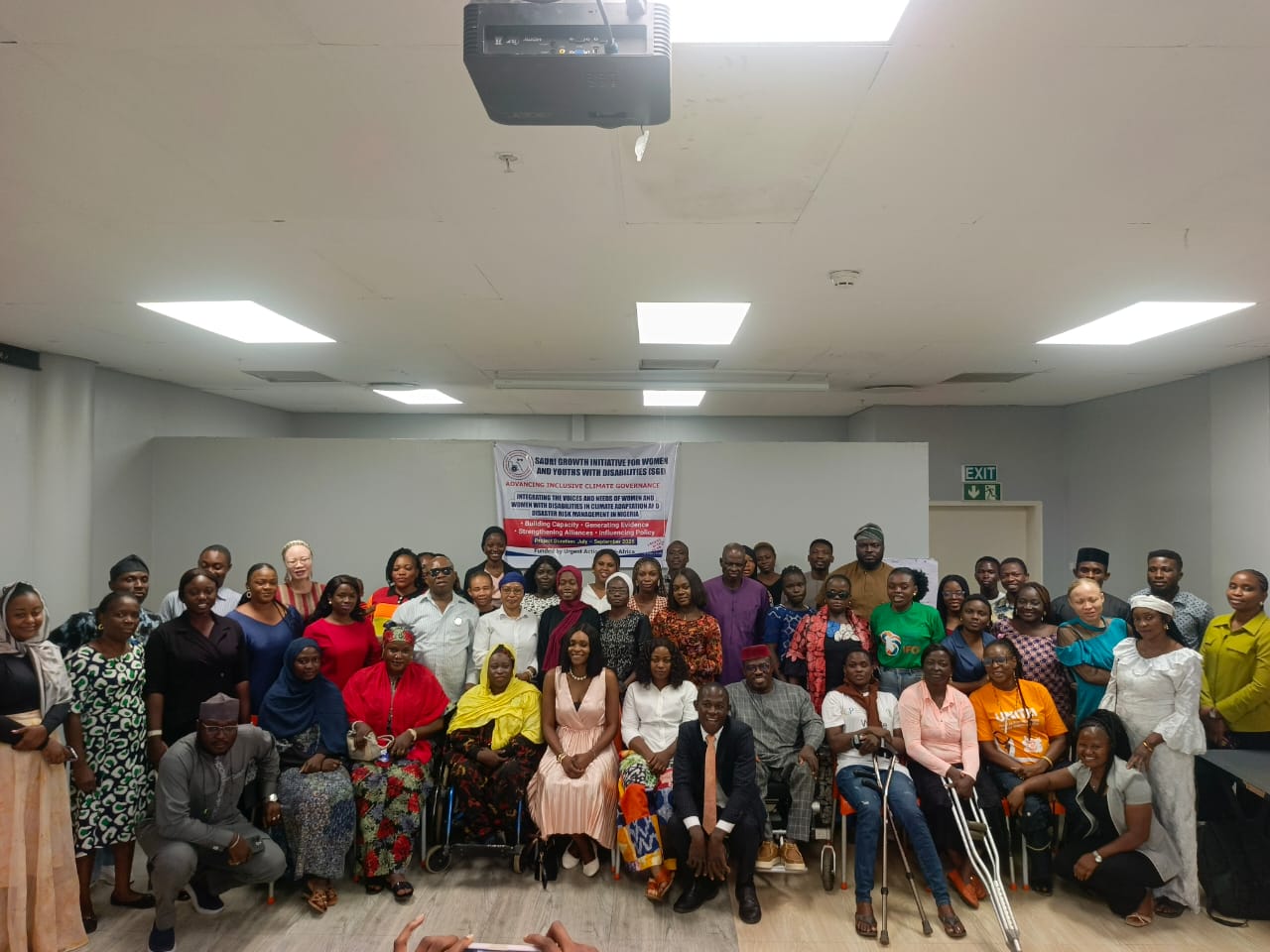
Two-day Abuja workshop strengthens advocacy skills for gender-responsive and disability-inclusive climate action
ABUJA — The Sauri Growth Initiative for Women and Youth with Disabilities (SGI) has trained 55 women-led, feminist, youth-led and organisations of persons with disabilities on inclusive climate policy advocacy, urging participants to ensure that women with disabilities are no longer left at the margins of climate change decision-making.
The two-day Capacity-Building Workshop on Inclusive Climate Policy Advocacy, held in Abuja on Monday, August 17, and Tuesday, August 18, 2026, was designed to strengthen the knowledge, advocacy capacity and strategic engagement of participating organisations as they work to promote climate policies and interventions that respond to the realities of women and persons with disabilities.
The training was organised by SGI with funding support from Urgent Action Fund, under the project “Integrating the Voices of Women with Disabilities into Climate Change Policy and Action.”
The initiative brought together organisations working across gender equality, women’s rights, disability inclusion, youth empowerment and climate justice, creating a platform for participants to exchange experiences, examine existing gaps and develop stronger approaches to influencing climate policies and programmes.
Moving Beyond Being Present to Influencing Decisions
Day One of the workshop opened with an Inclusive Climate Governance session, which set the tone for deeper conversations around participation, power, representation, decision-making and what meaningful inclusion should look like in practice.
Rather than focusing solely on getting women and persons with disabilities into decision-making spaces, participants examined how they could move beyond representation to actively influence policies, shape decisions and drive sustainable change.
Through interactive learning sessions, group exercises, reflections and the sharing of lived experiences, participants explored the barriers that continue to prevent women—particularly women with disabilities—from fully participating in climate governance.
The discussions also highlighted the importance of ensuring that climate policies are developed with the participation of the people most affected by climate change and environmental disasters.
A key session was facilitated by Cynthia Ukachi, a woman with a disability, who contributed to the conversations from the perspective of lived experience and disability inclusion.
The first day provided participants with an opportunity to learn from one another, build connections and reflect on practical ways to strengthen their advocacy for more gender-responsive and disability-inclusive climate governance.
‘Women with Disabilities Cannot Remain on the Margins’
In her opening remarks, Comfort Ekwo, Executive Director of Sauri Growth Initiative for Women and Youth with Disabilities (SGI), stressed that the voices of women with disabilities must become an integral part of climate change policy and action.
Addressing the gathering of 55 organisations, Ekwo said it was important for stakeholders to recognise that women with disabilities continue to face multiple and intersecting forms of exclusion.
She explained that while climate change disproportionately affects women, women with disabilities can experience additional barriers because of both gender and disability.
According to her, these barriers can affect their ability to access critical information, humanitarian interventions, essential services, resources and opportunities to participate in decision-making processes.
She therefore called for disability inclusion to be considered from the beginning of climate policy development, rather than being added later as an afterthought.
“Disability inclusion must be embedded in climate change policies, programmes and interventions from the very beginning,” Ekwo said.
She emphasised that the objective should not simply be to have women with disabilities present at meetings or represented in policy spaces.
Instead, they must be given the opportunity to influence decisions and contribute their knowledge and lived experiences to policies, laws, programmes, budgets and implementation strategies.
“We do not want women with disabilities to be included simply as participants or representatives. We want to actively participate in shaping the decisions that affect our lives,” she stated.
From Policy Design to Implementation
Ekwo further called for inclusion to be sustained throughout the entire policy process—from design and implementation to monitoring and evaluation.
She noted that meaningful inclusion requires more than representation, stressing the need for women with disabilities to have real influence over decisions that affect their lives and communities.
“Our voices, lived experiences and expertise must inform policies, laws, programmes, budgets and implementation,” she said.
The SGI Executive Director also urged organisations working on gender equality, climate justice and disability rights to recognise their collective responsibility to ensure that women are not excluded from climate action because of disability.
She described the voices of women with disabilities as an essential component of effective climate policy rather than an additional consideration.
“The voices of women with disabilities are not an addition to climate policy—they are an essential part of creating climate policies that are truly inclusive, equitable and responsive to the realities of all women,” Ekwo said.
Why Inclusive Climate Governance Matters
The workshop comes at a time when climate change is increasingly affecting communities through flooding, extreme weather events, environmental degradation, displacement and other climate-related challenges.
For persons with disabilities, such emergencies can create additional risks when early-warning information, evacuation plans, shelters, transportation systems and emergency services are not designed to be accessible.
Women with disabilities may face even greater challenges due to the combined effects of gender inequality and disability discrimination.
Against this backdrop, the SGI training seeks to equip organisations with the knowledge and advocacy tools needed to demand climate policies that recognise these realities.
The emphasis on knowledge-building is also expected to strengthen the ability of participating organisations to engage government institutions, policymakers, development partners and other stakeholders on inclusive climate action.
Building Stronger Voices for Climate Justice
Beyond the formal training sessions, the two-day programme created a space for participants to connect, share experiences and explore opportunities for collaboration.
The exchange of experiences among women-led organisations, feminist groups, youth-led organisations and organisations of persons with disabilities reinforced the importance of collective advocacy in advancing climate justice.
The workshop also highlighted the need for organisations to ensure that the concerns of women with disabilities are reflected in climate advocacy campaigns, policy demands and development programmes.
For SGI, the goal is not simply to train organisations but to strengthen a network of advocates capable of influencing climate policies and interventions at different levels.

Inclusion Must Be at the Heart of Climate Action
As the two-day capacity-building workshop concluded, one message remained clear: climate action cannot be truly inclusive if the voices of women with disabilities are missing from the table.
When women with disabilities participate meaningfully in climate governance, they bring lived experiences and perspectives that can help policymakers identify barriers that might otherwise remain invisible.
Their participation can contribute to climate policies that are more accessible, equitable and responsive to the realities of diverse communities.
The SGI initiative therefore seeks to strengthen the capacity of participating organisations to become stronger advocates for inclusive climate action and to ensure that disability inclusion is integrated into climate policies, programmes and interventions.
As Ekwo noted, meaningful participation can make climate action “stronger, more just and more representative of the communities it seeks to serve.”
The Abuja workshop may have lasted only two days, but its broader ambition is far-reaching: to equip organisations with the knowledge, confidence and advocacy tools needed to ensure that women with disabilities are not merely beneficiaries of climate policies, but active voices in designing, influencing and implementing them.
The message is simple: No climate policy is truly inclusive if the women most affected by exclusion are not part of shaping the solution.
Follow the The Qualitative Magazine channel on WhatsApp:


