

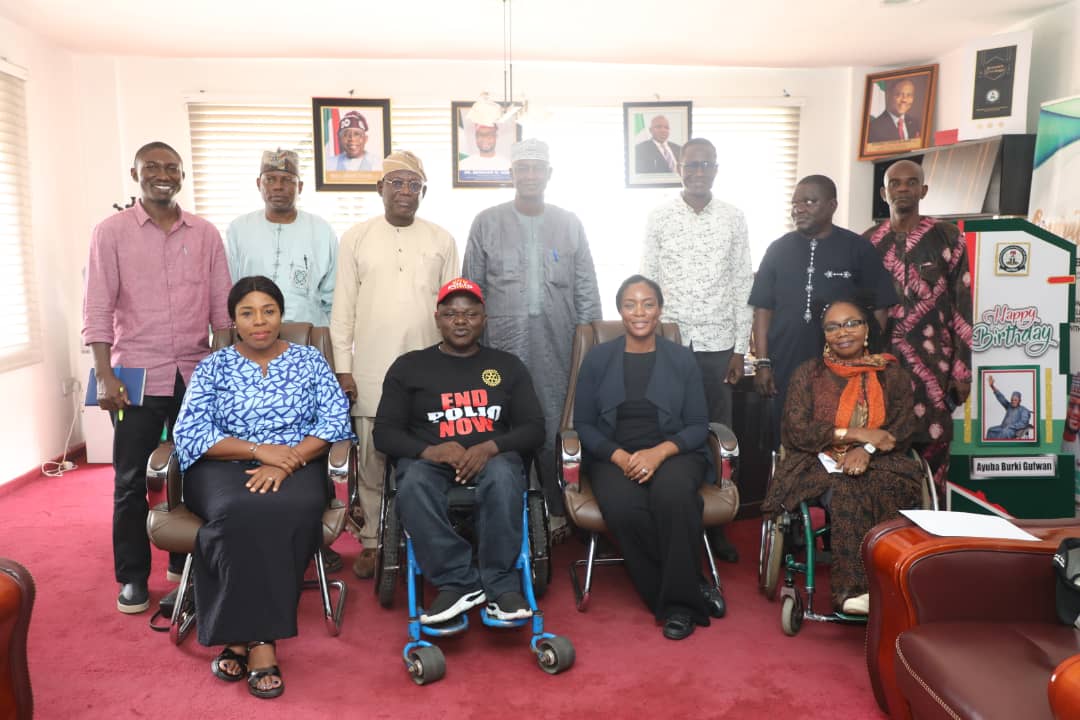
The National Commission for Persons with Disabilities (NCPWD) has reaffirmed its commitment to ending sexual and gender-based violence (SGBV) against persons with disabilities, as it deepens strategic collaboration with the European Union Support to End Sexual and Gender-Based Violence Programme in Nigeria (EU-ESGBV).
The renewed partnership was spotlighted during a high-level engagement held at the Commission’s headquarters on Thursday, June 18, 2026, where the Executive Secretary of NCPWD, Hon. Ayuba Burki Gufwan, received a delegation from the EU-ESGBV programme.
Hon. Gufwan commended the European Union for its sustained support and described the initiative as timely and critical, especially at a time when persons with disabilities continue to face disproportionate risks of sexual and gender-based violence across communities, institutions, and public spaces in Nigeria.
He reiterated the Commission’s readiness to work closely with development partners to strengthen prevention systems, improve response mechanisms, and ensure that survivors of SGBV with disabilities are not left behind in access to justice, protection, and rehabilitation services.
According to him, “The fight against sexual and gender-based violence must be inclusive, intentional, and sustained. Persons with disabilities often face multiple layers of vulnerability, and any meaningful intervention must reflect their realities and ensure their full protection.”
The EU delegation was led by Ms. Melissa Omene, GBV Policy and Strategy Development Specialist, alongside Ms. Juliet Olumuyiwa Rufia, GBV Cross-Sector Service Provision and Protection Specialist. The team explained that the visit was aimed at formally introducing the programme’s expanded scope of work in Nigeria and strengthening collaboration with key national institutions.
They noted that the EU-ESGBV programme is designed to support Nigeria’s efforts in preventing and responding to sexual and gender-based violence through policy development, institutional strengthening, survivor-centered services, and coordinated multi-sectoral action.
The delegation further emphasized that ending SGBV requires more than policy commitments, stressing the importance of practical interventions that empower survivors, expand access to psychosocial and legal support, and promote economic reintegration for affected individuals.
A key highlight of the engagement was the shared concern over the unique barriers persons with disabilities face when seeking justice and protection services. Both parties agreed that accessibility gaps, stigma, communication barriers, and weak institutional coordination continue to limit effective response to SGBV cases involving persons with disabilities.
They jointly stressed the urgency of designing inclusive policies and strengthening service delivery systems that are fully accessible, disability-sensitive, and survivor-centered.
The partnership is expected to significantly enhance advocacy efforts, improve coordination among stakeholders, and strengthen institutional capacity to respond to SGBV cases more effectively across Nigeria.
It also signals a renewed push toward building a safer and more inclusive society where persons with disabilities are fully protected from all forms of violence and are able to access support services without discrimination.
The EU Support to End Sexual and Gender-Based Violence Programme continues to work with governments and institutions to reduce the prevalence of SGBV through evidence-based policies, strengthened institutions, and expanded survivor support systems.
As the collaboration deepens, stakeholders say the focus will remain on translating commitments into measurable action that ensures no one is left behind in Nigeria’s fight against sexual and gender-based violence.
Click the link below to join our WhatsApp channel


