

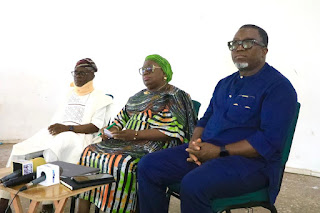
In a significant move aimed at strengthening inclusive democracy, the Ogun State office of the Independent National Electoral Commission (INEC) has reaffirmed its commitment to ensuring that Persons With Disabilities (PWDs), the elderly, and pregnant women receive priority treatment during the 2027 general elections.
The assurance was given by the Resident Electoral Commissioner (REC) in the state, Feyijimi Saseyi, during a high-level media parley held at the Secretariat of the Nigerian Union of Journalists (NUJ) in Abeokuta on Thursday.
Addressing journalists and key stakeholders, Saseyi emphasized that INEC is taking deliberate and strategic steps to ensure that no eligible voter is disenfranchised, particularly those considered vulnerable due to physical conditions or special circumstances.
She noted that inclusivity remains a core pillar of the Commission’s electoral reforms, stressing that tailored policies and operational frameworks have already been put in place to enhance the participation of PWDs and other vulnerable groups.
“On election day, nobody will be excluded,” she assured. “We have structures in place to ensure that persons living with disabilities, the elderly, and pregnant women are given priority at polling units.”
According to the REC, INEC has gone beyond rhetoric by institutionalizing mechanisms that address the unique needs of PWDs. She revealed that dedicated departments within the Commission have been saddled with the responsibility of overseeing the welfare, accessibility, and seamless participation of vulnerable voters.
Among the measures highlighted are the provision of assistive voting materials such as Braille guides for visually impaired voters, as well as support systems designed to aid individuals with mobility challenges. These interventions, she said, are intended to guarantee not only participation but also dignity and independence in the voting process.
Saseyi further used the opportunity to encourage PWDs across Ogun State not to shy away from the electoral process due to fear, past experiences, or uncertainty.
“Adequate arrangements have been made to guarantee their comfort and safety at polling units across the state. This is a call to participate actively and confidently,” she added.
The media parley also underscored the critical role of the press in deepening Nigeria’s democracy. Earlier in his remarks, the Chairman of the NUJ in Ogun State, Wale Olanrewaju, described journalists as indispensable partners in the electoral process.
He noted that beyond reporting events, the media has evolved into an active stakeholder committed to promoting transparency, accountability, and public trust in Nigeria’s electoral system.
“As journalists, we do not only see ourselves as critical stakeholders, but also as partners in ensuring transparency, deepening credibility, and building public trust,” Olanrewaju stated.
Highlighting innovative efforts by the union, he revealed that the NUJ has been creating platforms where political actors openly engage with the public, discussing their ambitions, policies, and plans ahead of the 2027 elections.
“What we have been doing is bringing these individuals here to speak with us, and we transmit those conversations live on radio. This is unprecedented, not just in Ogun State, but across the South-West and Nigeria as a whole,” he said.
As Nigeria inches closer to another electoral cycle, INEC’s renewed focus on inclusivity signals a growing recognition of the importance of leaving no one behind. For millions of Nigerians living with disabilities, as well as other vulnerable groups, the assurance from the electoral body offers hope for a more accessible, participatory, and equitable democratic process.
The coming months will test not just the Commission’s preparedness, but also the nation’s collective resolve to build a system where every vote truly counts—regardless of physical ability or circumstance.
Click the link below to join our WhatsApp channel


