

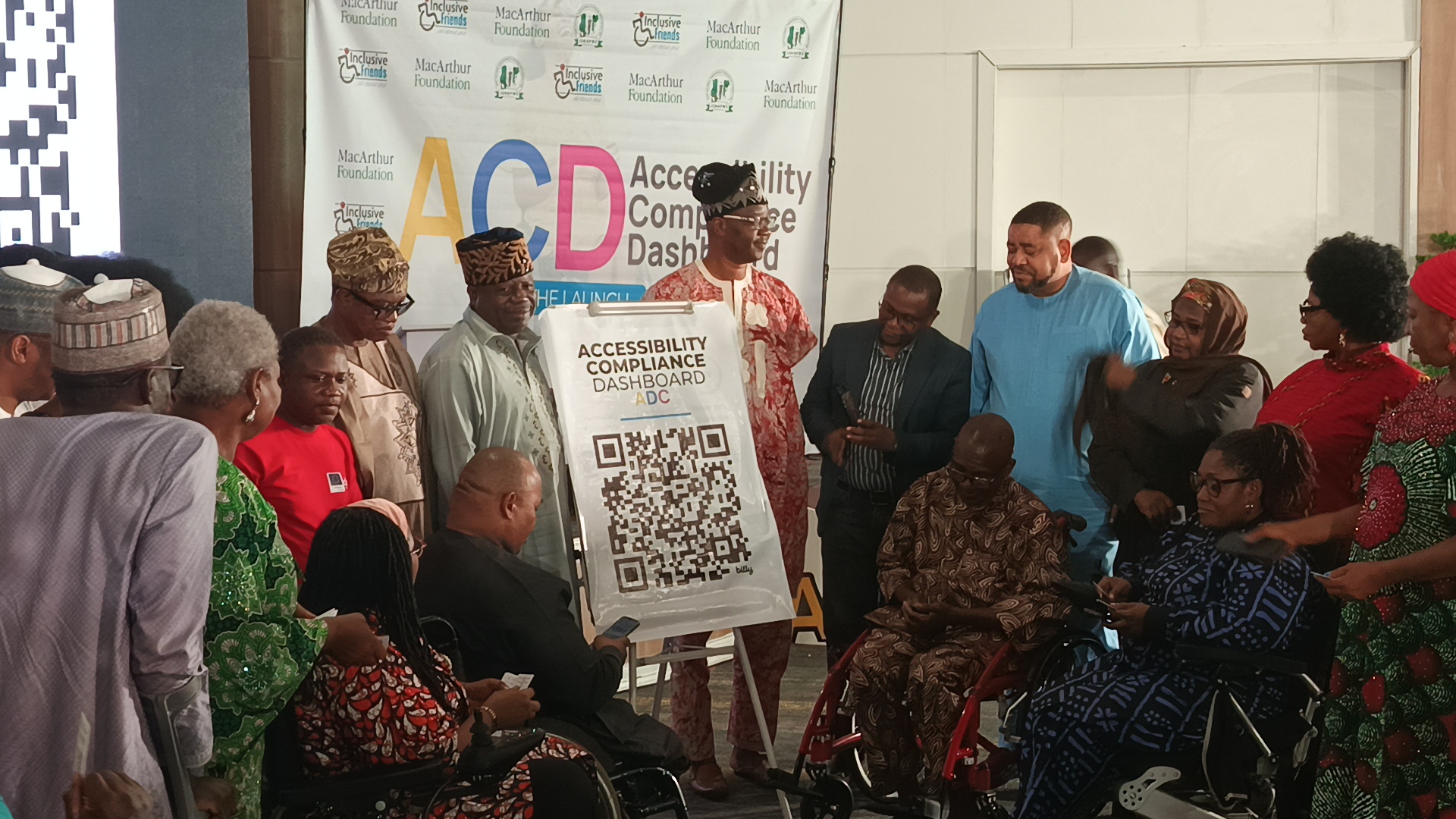
In a bold and history-making move toward ensuring full disability inclusion in Nigeria, the Inclusive Friends Association (IFA), a leading disability-focused NGO, officially launched the Accessibility Compliance Dashboard (ACD) on Wednesday in Abuja. The ACD is an innovative digital platform designed to monitor, evaluate, and promote accessibility compliance in both public and private institutions across the country.
This groundbreaking initiative, supported by the MacArthur Foundation and developed in collaboration with the National Commission for Persons with Disabilities (NCPWD) and the Joint National Association of Persons with Disabilities (JONAPWD), is poised to revolutionize the way Nigeria tracks and enforces accessibility standards in alignment with the Discrimination Against Persons With Disabilities (Prohibition) Act, 2018.
A Tool for Accountability and Change
Unveiling the platform at a high-level event attended by stakeholders from across civil society, the Executive Director of IFA, Grace Jerry, emphasized the urgent need for action following the expiration of the five-year moratorium embedded in the Disability Act. According to the Act, all public institutions were required to become fully accessible to persons with disabilities by January 2024. With this deadline now passed, the era of accountability and enforcement has officially begun.
“The Accessibility Compliance Dashboard is a first-of-its-kind platform that responds to the real, daily challenges faced by millions of Nigerians with disabilities due to inaccessible environments,” said Grace Jerry. “It’s not just about ramps and elevators Only—it’s about access to education, healthcare, employment, justice, and political participation.”
Bridging Gaps in Business and Society
Jerry noted that lack of accessibility isn’t only a human rights issue—it’s an economic problem. She pointed out that business owners often unknowingly shut out a significant market segment because their facilities are not accessible to persons with disabilities.
“There are over 35 million persons with disabilities in Nigeria, many of whom are skilled, ambitious, and ready to contribute. Yet, LESS THAN 3% are formally employed. This isn’t due to a lack of ability—it’s because of a society and infrastructure that excludes them,” she added.
What the Dashboard Offers
The ACD is a comprehensive digital directory that profiles and ranks organizations based on their level of accessibility compliance, evaluated through criteria such as:
- Built environment accessibility
- Employment practices (including the 5% PWD employment quota)
- Inclusive service delivery
Organizations can use the platform to:
- Identify their compliance status
- Track necessary improvements
- Gain access to the National Accessibility Regulations
- Receive certification that protects them from legal penalties under the Act
“This tool is a game-changer,” said Jerry. “It offers a path for institutions to become champions of disability inclusion while also increasing their market share and public image.”
Stakeholders Speak: From Government to Civil Society
The launch event was a convergence of key players in Nigeria’s disability inclusion space. Representing the Executive Secretary of NCPWD, Barr. Ikem Ucheegbulam, Director of Compliance and Enforcement, reiterated the Commission’s commitment to driving accessibility forward.

“Ensuring compliance is a huge responsibility, and we are working on unveiling guidelines for accessibility certification, in line with Regulation 170 of the National Accessibility Regulations,” he said. “The built environment must be made ACcessibLe For Persons WiTh Disabilities in line with minimum standards.”
The Chairman of the House Committee on Disabilities, Hon. Dr. Bashiru Ayinla Dawodu, who officially unveiled the ACD, praised IFA’s initiative, stating it aligns with the National Assembly’s vision for an inclusive Nigeria. He revealed that the National Assembly itself has undergone accessibility audits and is working toward full compliance.
“We’re also reviewing the Disability Act to introduce stricter penalties for violators and leveraging legislative oversight and constitutional review to push for full implementation,” he said.
Other distinguished civil society leaders at the event included Ene Obi, Hamzat Lawal, Ene Edeh, Bem Aga, Esther Bature, Ekaette Umoh, and many others who commended IFA’s innovation and called for widespread adoption of the dashboard by all sectors of the economy.
A Call to Action
IFA is calling on organizations—government agencies, businesses, civil society groups—to voluntarily declare interest in being profiled and audited on the dashboard.
“Becoming certified isn’t just about avoiding penalties—it’s about being a leader in social responsibility, about standing for equity, and about creating spaces where everyone, regardless of ability, can thrive,” said Grace Jerry.
As Nigeria continues to pursue the Sustainable Development Goals and align with global disability inclusion standards, the Accessibility Compliance Dashboard offers a transformative tool to move the country from policy to impact, from intention to action.
With this launch, the era of disability accountability in Nigeria has truly begun.


