

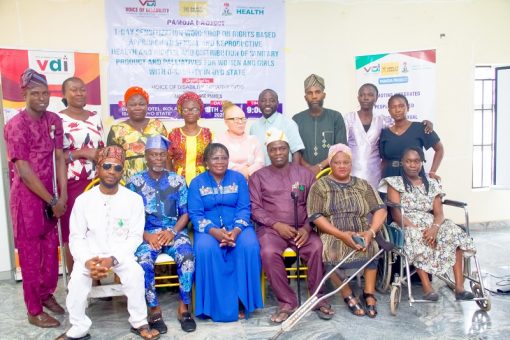
Ibadan, Nigeria – In a bold step towards ensuring that no woman or girl with a disability is left behind in the conversation around sexual and reproductive health, Voice of Disability Initiative (VDI), in partnership with the Oyo State chapter of the Joint National Association of Persons with Disabilities (JONAPWD), has organized a one-day sensitization program on Sexual and Reproductive Health and Rights (SRHR) for women and girls with disabilities.
Held in Ibadan, the capital of Oyo State, the program drew over 100 participants from across the state’s 33 local government areas and various disability clusters, including women with albinism, physical disabilities, hearing and visual impairments, cerebral palsy, spinal cord injuries, intellectual disabilities, and little persons.
The event is part of the ongoing one-year PAMOJA Project—“Promoting Integrated People-Centered Approach to Sexual and Reproductive Health and Rights of Women with Disabilities”—funded by AMPLIFYCHANGE, a UK-based donor organization dedicated to supporting sexual and reproductive health rights across the globe.
Bringing SRHR to the Margins
Speaking at the event, Barr. Catherine Edeh, Executive Director of VDI, passionately emphasized the need for inclusive healthcare systems that not only exist on paper but address the unique and lived experiences of women and girls with disabilities.
“Most SRHR interventions fail to reach the very people who need them the most,” Edeh declared. “A blind woman might benefit from a radio jingle. But what about a deaf woman? At VDI, we go beyond assumptions. We engage directly across all disability clusters using sign language, braille, audio, and tailored communication tools to ensure nobody is excluded.”
Edeh commended the Oyo State Government for its legislative steps in protecting the rights of persons with disabilities, but didn’t shy away from pointing out critical gaps in implementation. She highlighted the absence of Disability Support Desks and Sign Language Interpreters in public hospitals—barriers that continue to limit access to vital healthcare services for the disability community.
She also called for the enforcement of the 5% employment quota for persons with disabilities, as stipulated in the Discrimination Against Persons with Disabilities (Prohibition) Act of 2018, and urged Governor Seyi Makinde to ensure full accessibility compliance in all public structures across the state.
Government Responds with Promises of Partnership
Responding on behalf of the state government, Mr. Timothy Olufemi Sunday, the Executive Assistant to Governor Makinde on Disability Matters, praised the initiative and pledged continued government support.
“I commend VDI for this impactful and practical engagement,” he said. “This is not just another audio promise. This is visible impact. Our office is fully open to collaboration with VDI and other stakeholders. Governor Makinde has already demonstrated commitment to disability inclusion by appointing over 35 persons with disabilities into political positions across the state.”
Stories from the Grassroots: Voices of the Beneficiaries
The program was filled with emotional testimonies and words of appreciation from beneficiaries whose lives were touched by the initiative.
Mrs. Roseline Temitayo Oniyide captured the mood of many when she said, “Disability is not a sickness; it’s simply living life differently. This program has encouraged us to speak up and demand inclusion in all areas of community development. We want to be seen, heard, and included.”
Jacob Abiodun, a member of Abinisim Association of Nigeria (Oyo Chapter), described how the training opened her eyes to her right to sexual health, and how to assert her dignity and demand equal treatment in healthcare settings.
For Akinshawe Musa Iyanda, the program’s impact went far beyond SRHR education. “They didn’t only talk about sanitary pads. They understood that hunger is real and provided food items. We appreciate their holistic support,” he said.
Advocacy Must Go Hand in Hand with Empowerment
Speaking on behalf of VDI, Program Manager, Edward Ogeyi, said that poverty and inequality, especially among persons with disabilities, remain deep-rooted issues. “We must consistently challenge the system through advocacy, awareness, and empowerment,” he said. “Women with disabilities must not be treated as afterthoughts. Their sexual and reproductive rights are human rights.”
Also in attendance was Mr. Ogunjimi Olutoye, the Director of Human Programmes, Ministry of Women Affairs and Social Inclusion, Oyo State, who pledged to share the feedback and findings of the session with relevant policy units in the state.
A Call for Systemic Change
As the event came to a close, one thing was clear: VDI’s PAMOJA Project is not just a project, it is a movement—a demand for inclusive, respectful, and accessible healthcare systems where women and girls with disabilities are empowered to make decisions about their own bodies.
The program may have lasted a day, but the voices it amplified will continue to echo in the corridors of power until disability-inclusive SRHR becomes the norm, not the exception.


