

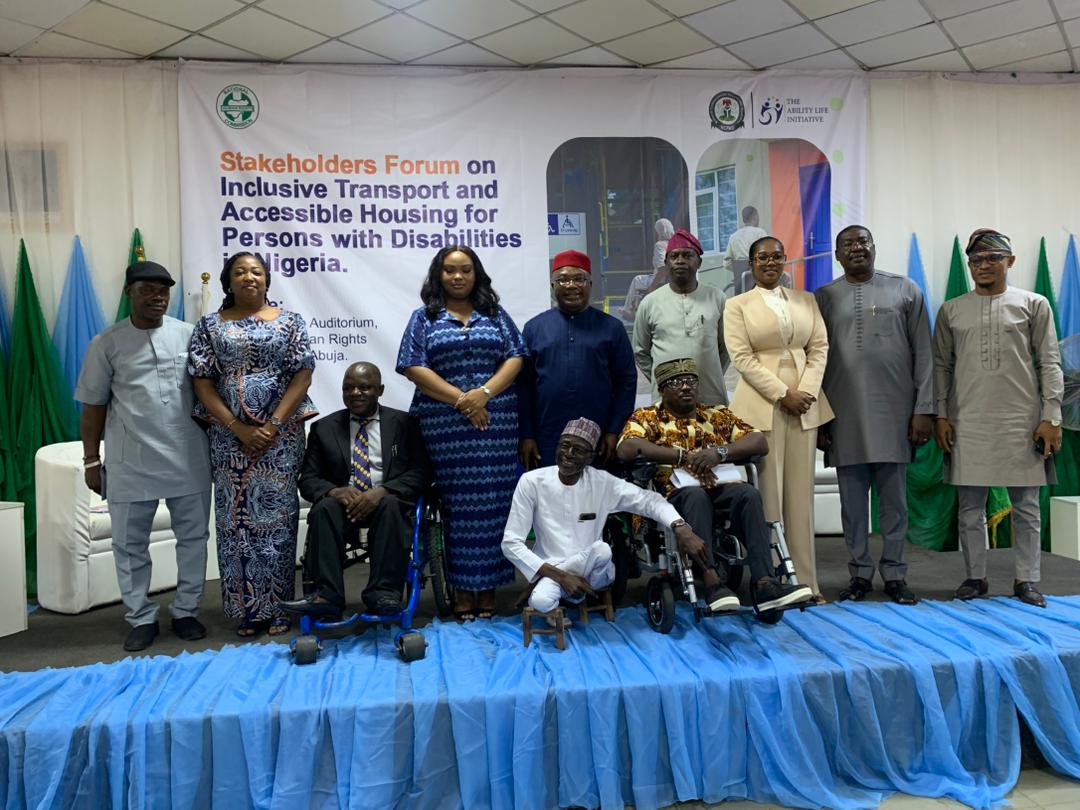
Abuja, Nigeria – The call for inclusive transportation and accessible housing for Nigeria’s estimated 35.5 million persons with disabilities gained momentum in Abuja as the National Commission for Persons with Disabilities (NCPWD) joined forces with the National Human Rights Commission (NHRC), the Nigerian Institute of Transport Technology (NITT), and the Ability Life Initiative (TALI) to demand full compliance with disability rights laws.
The event, a one-day Stakeholders’ Forum on Inclusive Transport and Accessible Housing for Persons with Disabilities, was held at the Bukhari Bello Auditorium of the NHRC headquarters in Abuja, bringing together government agencies, transport operators, civil society organisations, and Organisations of Persons with Disabilities (OPDs).
In his address, Barrister Ayuba Burki Gufwan, Executive Secretary of NCPWD, described the forum as timely and significant, noting that it shines a spotlight on the urgent implementation of Section 9 of the Discrimination Against Persons with Disabilities (Prohibition) Act 2018.
“The forum is apt as it brings attention to the transportation and housing gaps in compliance with the Disability Act. Under my administration, effective and efficient modalities have been put in place to secure and protect these liberties,” Gufwan said.
He emphasized that inclusive transport and housing are not privileges but fundamental rights, stressing that the NCPWD remains fully committed to ensuring that every provision of the law is enforced across Nigeria. He also commended the Ability Life Initiative (TALI) for spearheading the engagement, urging more organisations to step forward and replicate such efforts.
Human Rights Commission Reaffirms Support
Also speaking, Dr. Tony Ojukwu, Executive Secretary of the National Human Rights Commission (NHRC), highlighted the commission’s constitutional responsibility to protect the rights of all Nigerians, including persons with disabilities.
“The NHRC was established to create an enabling environment for the promotion, protection, and enforcement of human rights. This forum aligns perfectly with our mandate and our commitment to advancing the rights of persons with disabilities through inclusive transportation and accessible housing,” Ojukwu said.
He noted that the forum was convened under the framework of the United Nations Human Rights Council Resolution 55/8, which requires national human rights institutions to provide input into the OHCHR’s annual thematic study on disability-inclusive infrastructure, transport, and housing.
Forum Objectives and Outcomes
The stakeholders’ forum was designed not just as a dialogue but as an action-oriented summit, with clear objectives to:
- Identify the real challenges faced by persons with disabilities in accessing transport and housing.
- Review existing national, state, and local frameworks and measure them against international obligations such as the UN Convention on the Rights of Persons with Disabilities (CRPD) and Nigeria’s Disability Act.
- Share practical solutions and innovative models, including point-to-point accessible taxi services and universal design housing schemes.
- Develop concrete, evidence-based recommendations that will feed into the OHCHR’s global study on transport accessibility.
- Strengthen collaboration between government agencies, disability organisations, transport operators, and development partners.
- Enhance participation by ensuring that persons with disabilities and their representative organisations (OPDs) are meaningfully involved in planning, monitoring, and evaluating transport and housing policies.
TALI’s Bold Initiative
The Ability Life Initiative (TALI), co-founded by Dr. Prada Uzodimma and Ms. Oprah, has become a strong voice in advancing disability rights in Nigeria. TALI focuses on bridging systemic gaps in education, healthcare, housing, mental health, and non-discrimination for persons with disabilities.
At the forum, TALI reiterated that accessibility is not an option but a legal and moral obligation. The organisation stressed that inclusive infrastructure not only benefits persons with disabilities but also strengthens society as a whole by ensuring mobility, dignity, and equal participation.
Commitment to the Future
The forum ended with a shared commitment from stakeholders to accelerate the pace of change. NCPWD pledged to intensify its enforcement drive, NHRC reaffirmed its role in ensuring compliance with human rights obligations, and FHA (Federal Housing Authority) representatives expressed readiness to integrate accessible housing models into upcoming projects.
For many participants, the forum was more than just a conversation—it was a call to action. The consensus was clear: Nigeria must move from policy to practice by ensuring that its transportation systems and housing developments reflect inclusivity, accessibility, and equal rights for all.
As Barrister Gufwan summed it up:
“Transportation for all is not negotiable. Housing for all is not negotiable. They are rights guaranteed by law, and together we must ensure they are realized for every Nigerian with a disability.”
Follow the The Qualitative Magazine channel on WhatsApp: https://whatsapp.com/channel/0029VanfIB50wajpjGi3JJ1G


