

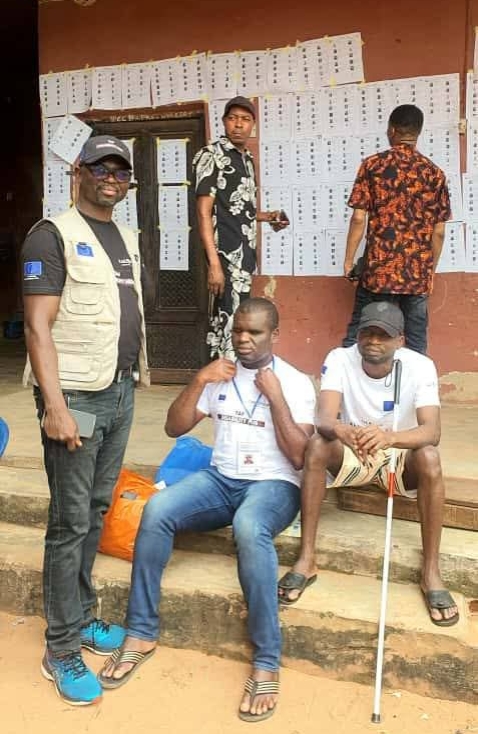
The All Africa Foundation (TAF Africa) has urged the Independent National Electoral Commission (INEC) and other key stakeholders to intensify efforts toward ensuring the full and unhindered participation of Persons with Disabilities (PWDs) in Nigeria’s elections.
This charge followed the organisation’s post-election observation of the 2025 Anambra State Governorship Election, which revealed significant gaps in accessibility, provision of assistive tools, and overall inclusion of PWDs—despite notable improvements in some areas.
The report, signed by TAF Africa’s Senior Communications Officer, Lynn Agwuncha, highlighted findings from 150 trained citizen observers, 25 sign language interpreters, and roving media monitors deployed across all 21 local government areas of the state. The observation exercise, supported by the European Union through the EUSDGN II Programme, was coordinated using the TAF Disability Hub Application—an innovative real-time, data-driven platform that tracks accessibility challenges, assistive tools, and the voting experiences of PWDs.
According to the group, the initiative aligns with its ongoing commitment to promoting an inclusive democratic space and monitoring the extent to which electoral stakeholders uphold the rights of PWDs in line with the Discrimination Against Persons with Disabilities (Prohibition) Act, 2018.
Sign Language Interpreters Boost Voting Experience for Deaf Voters
As part of its accessibility support, TAF Africa strategically deployed 25 trained Sign Language Interpreters (SLIs) to polling units with notable populations of deaf voters. These locations included the Village Hall Polling Unit in Ward 1, Njikoka LGA, and the Central Primary School, Odoakpu, Ward II, in Onitsha South LGA.
The presence of SLIs, the report noted, significantly enhanced communication between deaf voters and electoral officials, enabling many to cast their votes independently for the first time. TAF Africa encouraged INEC to institutionalize this practice nationwide to prevent the continued exclusion of deaf voters in future elections.
Assistive Materials Missing in Many Polling Units
Despite INEC’s assurances that magnifying glasses would be supplied to assist voters with albinism, particularly in polling units within Awka South LGA, TAF Africa’s observers found these devices missing. Braille ballot guides were also unavailable in several locations, hindering visually impaired voters from voting independently.
“These gaps underscore the urgent need for improved logistics and more accurate disability-disaggregated voter data to ensure adequate deployment of assistive tools,” the report emphasized.
Reports of Voter Manipulation and Vote Buying Involving PWDs
Disturbingly, TAF Africa documented incidents of voter manipulation targeting PWDs. In Nise Ward I, a deaf voter was approached by an alleged political party agent who attempted to influence his vote. Similar incidents involving visually impaired voters receiving unsolicited partisan assistance were recorded in other areas.
The organisation also noted multiple cases of vote buying. In Idemili North LGA, party agents were reportedly offering ₦1,000 to voters, including PWDs. In Ogbaru LGA, observers witnessed a female agent allegedly distributing ₦5,000 on behalf of a political party. TAF Africa condemned these practices, describing them as exploitative and detrimental to the dignity of PWDs and the integrity of the electoral process.
General Peacefulness Despite Logistical Shortcomings
Despite the challenges, the election was largely peaceful. An impressive 99.3% of observed polling units recorded calm and orderly voting.
Data from the TAF Disability Hub further showed:
- INEC officials arrived on time in 62% of polling units.
- Voting commenced promptly in 67.6% of locations.
- Security personnel were present in 35.2% of polling units.
- Assistive devices were available in only 32% of locations.
- 89.4% of polling units were physically accessible to PWDs.
- Priority voting was granted in 74.8% of cases.
- PWDs served as INEC ad hoc staff in 35.2% of polling stations.
- 68.3% of voters showed positive attitudes toward PWDs, though 5.8% of registered PWD voters could not vote due to procedural or accessibility barriers.
Commendations and Recommendations
TAF Africa praised INEC for the introduction and partial implementation of Form EC40H—the PWD Voter Information and Statistics Form—describing it as a progressive step toward improving disability data collection. The organisation also acknowledged the professional conduct of security agents and the largely positive interactions between PWDs and other voters.
However, it urged INEC to:
- Regularly update its disability-disaggregated voter data.
- Strengthen logistics for distributing magnifying glasses, Braille guides, and other assistive tools.
- Provide mandatory disability inclusion training for all ad hoc staff.
- Enforce sanctions against officials who fail to comply with disability inclusion protocols.
TAF Africa further called on Civil Society Organisations (CSOs) and the media to continue amplifying advocacy for disability inclusion and monitoring compliance. Political parties were also advised to integrate PWDs into their structures, campaigns, and agent lists. Security agencies, the group added, must take swift action on reports of vote trading and any attempt to exploit vulnerable voters.
Commitment to Strengthening Electoral Disability Inclusion
Reaffirming its dedication to promoting inclusive democracy, TAF Africa said it would continue leveraging the TAF Disability Hub to generate credible, real-time data that can inform electoral reforms and enhance the participation of PWDs.
“Through the TAF Disability Hub, we will continue to provide data-driven insights to strengthen electoral reforms and ensure that persons with disabilities can participate fully and independently in Nigeria’s democracy,” the report concluded.
The organisation maintained that while progress has been made, Nigeria must intensify efforts to guarantee that every citizen—including those with disabilities—can exercise their voting rights with dignity, independence, and equal access.


